|
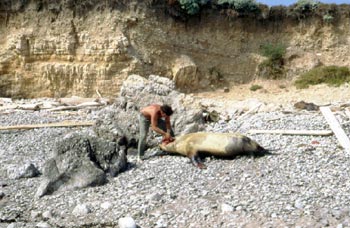
Ray Bandar cleans one of three male California Sea Lion skulls, Ano Nuevo Island, California, circa 1970’s.
BANDAR: Bones are beautiful. They’re fantastic pieces of sculpture. And so once they’re cleaned up, God…they’re art pieces. But they also can tell you a functional story about the life of the animal.
HOBAN: Ray eventually became a high school biology teacher and he continued to collect bones during his spare time. Now, after 40 years of beachcombing, his tall frame and tattered blue field jacket are familiar to wildlife authorities all along the California coast. Perhaps what’s startling is that most of his vast collection is stored at his San Francisco home.
BANDAR: The house is actually an art museum and natural history museum. And a bone palace.
HOBAN: Where do you live in your house?
BANDAR: Oh, I have plenty of place to live. There are bones on all three levels, and the third level has thousands of skulls on display.
HOBAN: Ray shows off the sculptural qualities of bones throughout the house, from abstract pelican pelvises over the fireplace to snake skeletons curled up in glass cases. In Ray’s house, bones are art and bones are humor. There’s a set of moose antlers in the bathtub and a ceramic cup full of penis bones on the dining room table.
But Ray doesn’t collect just for himself. In fact, that would be illegal. He has permission from the California Academy of Sciences in San Francisco to collect, and his findings are donated, at least in spirit. Because Ray’s home is actually an official annex of the academy.
LONG: One of the reasons why Ray has such a huge number of specimens at his house is because we don’t have the room here to store them.
HOBAN: Douglas Long is the head of ornithology and mammalogy at the Academy of Sciences. Last year when the academy made plans to renovate, Long knew they needed to accommodate Ray’s bones. So he sent architects to Ray’s house to take measurements.
LONG: I didn’t tell these people what they were going to run into, and I knew that they would be completely blown away by what they saw. And it was about 10, maybe 15 minutes before their jaws become un-slackened.
HOBAN: Long says a collection like Ray’s is invaluable to science. In just the past year researchers have taken tiny drillings from teeth in Ray’s sea lion skulls to study environmental toxins. Other scientists compared chemicals in the sea lion teeth from before and after an El Nino to examine changes in the animals’ diets.
LONG: People have come up with some fantastic ways of looking for scientific information from these specimens, so there are techniques that will come up in the future that we have no idea now. Who knew about DNA a hundred years ago? Who knew about isotopic chemical analysis from teeth ten years ago?
HOBAN: Over the years Douglas Long has learned to defend Ray’s hobby and what some people see as his weird, relentless search for dead animals.
LONG: I think he’s weird because he doesn’t have a TV, doesn’t have a computer, doesn’t drink alcohol, doesn’t gamble, doesn’t even eat junk food unless it’s free, and I think that is probably the weirdest thing about him. I think there’s absolutely nothing weird about having the drive to understand nature and to collect scientific information for our institution. That’s normal.
HOBAN: For Ray, collecting has been almost an act of faith. He has no way of knowing what use scientists will find for these bones, these studies in shape and light. They have been his life’s work and they’re his gift to the future.
Now Ray’s legacy is on display at the California Academy of Sciences. And soon there will be a permanent space dedicated to his collection. But he has no intention of resting.
BANDAR: In a month and a half I’ll be 75.
HOBAN: So, isn’t it time to quit?
BANDAR: Hell no. As long as my legs still hold up and there’s still stuff on the beaches, I’m going to work the beaches. As long as there’s still stuff to get from the zoos, I’ll be collecting stuff.
HOBAN: At this rate, the academy had better plan a big extension.
For Living on Earth, I’m Rose Hoban in San Francisco.
Links
http://www.calacademy.org/ - California Academy of Sciences
|