

AI Power Demand and the Climate
Air Date: Week of December 5, 2025
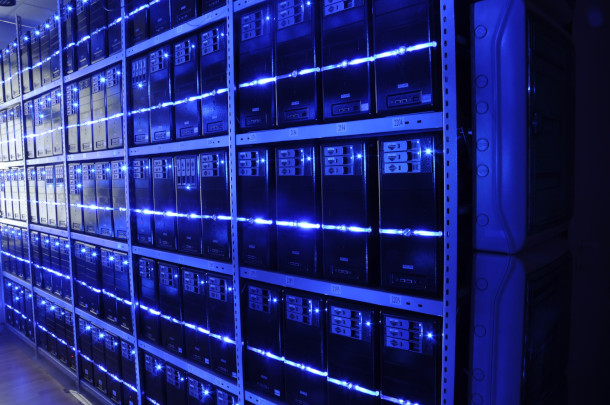
Data centers for artificial intelligence programs are becoming a major player in the tech industry as more and more electric power and storage is required for data use. (Photo: BalticServers, Wikimedia Commons, CC BY SA 3.0)
Artificial intelligence or AI’s huge appetite for power is reviving demand for older and dirtier fossil fuel energy. Dan Gearino, clean energy reporter with our media partner Inside Climate news, speaks with Host Steve Curwood about the massive data centers that power AI, community pushback, and how the AI trend could put vital climate targets out of reach.
Transcript
DOERING: From PRX and the Jennifer and Ted Stanley studios at the University of Massachusetts Boston, this is Living on Earth. I’m Jenni Doering.
CURWOOD: And I’m Steve Curwood.
AI or artificial intelligence can make it easy for us humans, but the computers behind it have to work very hard. In fact, to find the right word needed in an AI-generated document a computer might make 20 billion calculations, which takes a lot of energy. So, AI can conveniently summarize web searches or draft an email, but its huge appetite for power may make it harder to reduce global warming emissions from the electricity sector. By 2030 US data center energy use is projected to consume ten percent of all the energy of the grid. That's more than double current usage, according to the Pew Research Center, and climate friendly energy sources may not be able to keep up with the demand. Joining us now is Dan Gearino, a clean energy reporter with our media partner Inside Climate News. Dan, welcome back to Living on Earth!
GEARINO: Good to be here.
CURWOOD: Dan, when we hear the words “data center” getting tossed around, what exactly are we talking about here? What are the purposes of these places?
GEARINO: So data center is kind of an umbrella term. When this started to really boom, a lot of what we were talking about was cloud computing. So that's Gmail, that's the photos that you store online, that's a whole bunch of those things. And we're talking about large buildings filled with computer equipment, usually with really small headcount, so very few employees. What we're seeing now is a whole different kind of data center, which are AI data centers, artificial intelligence data centers, and they are much larger, doing the calculations behind various AI applications. So it is a totally different product, different on a whole bunch of different levels, but it's still a bunch of computer equipment inside a gigantic building with a small headcount, so we can say data center, and it includes all that stuff. But it is important to understand that we're talking about different kinds of things. Also, as we look ahead to the near future, the share of the overall data center market that is AI is rising a lot. So the new construction next year and the year after, AI is dominating that, whereas AI was a relatively small share of the construction we've seen up to this point.

The electricity consumption required to run data centers can be a significant contributor to the climate crisis if more fossil fuel powered generation is used to meet the demand. (Photo: Mostafameraji, Wikimedia Commons, Public Domain)
CURWOOD: So we're here to talk today about artificial intelligence data plants, AI plants. Just how bad for the climate are these AI data centers?
GEARINO: The climate concerns come from mainly the fact that these things use so much electricity. They also use a lot of water, but the electricity is a main concern. And deploy it on a large scale, you look at certain parts of the country, where you're going to see substantial increases in the amount of power plants they need. You're also going to see significant disruption in the economics of power plants, plants that would not have been economically viable before are going to be because the price of electricity is going to go up, because demand has gone up. An old coal plant that would not have been making money could conceivably be making money now. You can justify stopping old and dirty power plants from going offline. So just right down the line, this transition we were seeing to a cleaner power sector, this is a serious obstacle to that.
CURWOOD: So where are the biggest data centers right now in the US? One taps the old Three Mile Island nuclear power plant, or they want to, well, they want to restart it, because it's so hungry for electricity. Where are the big ones right now?
GEARINO: So the talk of reopening nuclear plants, those are for kind of future looking you know, those are things that haven't happened yet. As far as projects that are up and running, and if we talk about the market as it stands now, the largest concentration of these things is in Northern Virginia, just right outside of DC, and that's for a whole bunch of interesting historical reasons that have to do with just the development of the internet and development of businesses around the internet. The advantage of having this collection of early companies in the space meant that other companies in the space moved there, meant that the infrastructure was there for companies. But with each passing year, you're seeing other markets rise up, and they're not to the point that they're anywhere close to eclipsing Northern Virginia, but you're seeing markets like Columbus. Central Iowa and other parts of Iowa are an absolutely booming data center market. And a lot of times you can trace this back to the one big project that was viewed as successful, the one big project that showed other developers that this is how you can do it here, and it's a pretty easy development process. There is this kind of herd mentality with some of where these projects are going.
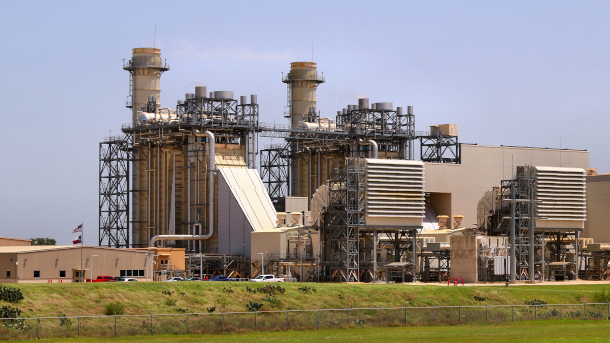
Because data centers draw enormous amounts of power, they may force utilities to keep fossil-fuel plants running longer in order to meet demand. (Photo: Larry D. Moore, Wikimedia Commons, CC BY SA 4.0)
CURWOOD: And where was this one big project?
GEARINO: One example is in Iowa, which is one of the fast-growing markets. There is a Microsoft Project in West Des Moines, Iowa that was, at its time, just mind blowingly large. And that was a project that helped to solidify the idea of Iowa as a viable and formidable market for this stuff. You see this in Columbus. There are several just gigantic, Meta has a pretty big presence here. Others do as well. And you see this where a project comes in, a lot of times, because there's some infrastructure there already in terms of internet lines and in terms of access to electricity. And you see others build somewhere close to there, because they're looking for some of those same things. And you have the local government or the permitting regime there becomes familiar with these projects, and it's easier rather than going to some random new place. We aren't yet at a point where these super, super projects are still in the future, and it'll be interesting to see where the market is once some of those are closer to going online, because of course, we're at a moment where everyone's kind of holding their breath, wondering, what in the world is going to happen with this market? Because it does seem like an unsustainable market.
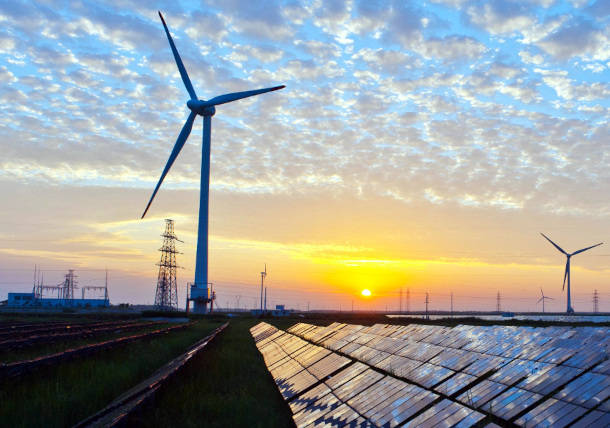
Renewable energy like wind and solar are the largest source of new power generation. (Photo: Kenueone, Wikimedia Commons, Public Domain)
CURWOOD: Yeah, what about renewables for these AI data centers? I mean, we're building lots of renewables. They need lots of power. Why not just use renewables?
GEARINO: There will be lots of renewables used. What's needed is electricity, and this whole idea of speed to power is what people in this industry talk about. So you want to get power plants up and running as fast as possible. You want to get as much power available as possible. Wind and solar are going to be natural, big parts of that, or at least they should be, because this is happening at the same time that there is an administration in Washington that is creating all of these impediments to developing renewable energy, taking away some of the programs and tax incentives and just kind of generally being hostile to, in particular wind power. And wind power is a really important part of the renewable energy mix. So you have this kind of one two punch of drastically increasing the demand for power and making it so that it's more difficult to build the cheapest and the cleanest forms of power, which are wind and solar. You add those two factors up, and it's not good for the climate.
CURWOOD: Now, Dan, we can't talk about energy use without talking about the power grid. The three of them, I guess in this country, we got the East, we got the West. And Texas has its own. They seem stretched pretty thin already. So as these data centers grow, what does that mean for the grid going forward, physically as well, as you know, the cost to us consumers?
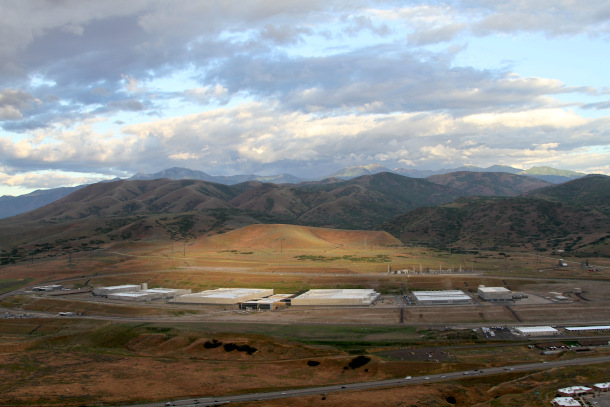
Due to the water and energy requirements of data centers in rural areas and near homes, they sometimes have drastically low approval ratings from neighboring towns and communities. (Photo: Parker Higgins, Wikimedia Commons, Public Domain)
GEARINO: It's interesting right now, how Texas' system, which has fewer barriers to entry, it's just easier to build there. It seems like that system works nicely for this moment where you need to add a ton of power quickly. The other regional grids, there are various other challenges where it's a little bit harder in some places, and it's a lot harder in other places, to the point where you could imagine some of these big data center projects, the only way they would be viable is if they are building power right next to them or within a really close distance of them, and the grid as a whole is built to be able to serve the public during times of peak demand, and that's actually only a few days a year. So you have an entire grid built for the hottest days of summer and the coldest days of winter. And if these large power users can find ways to ramp down when that demand is high, if these become this economic and power grid problem that creates the solution of improving flexibility in the system, that could be a really good thing.
CURWOOD: And how are various local communities responding to these plans to build data centers?
GEARINO: I think it's safe to say that data centers have about the lowest approval rating of just about anything. Wherever these are proposed, just about anywhere, there is community opposition. And what's fascinating to me is that this cuts across partisan lines. It cuts across income lines. In these complicated times, people can agree they don't want a data center anywhere near them, and this opposition is only going to grow. As you see data centers being built outside of some of the markets that are more used to these things, if you see them being built more in rural areas, more in new markets, the opposition is it's just about overwhelming. You're going to start to see projects that just don't happen because the opposition is too much, and you're going to see local governments not wanting these projects. So this is something that is an impediment on the path of development going forward, and I think it is a underappreciated factor that we need to keep an eye on.
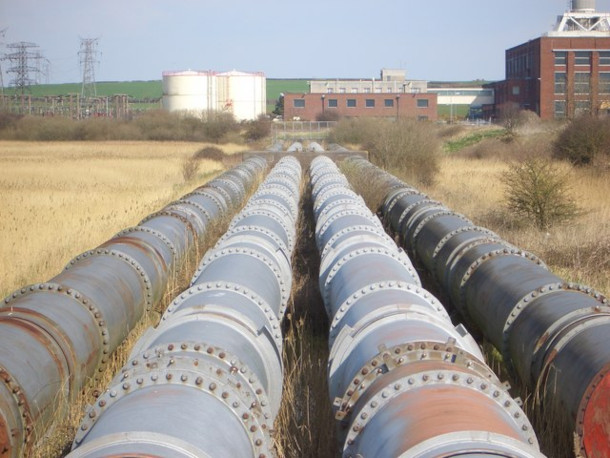
Many gallons of water must be pumped through data center cooling systems to offset the intense heat generated by constant computing. (Photo: John Mann, Wikimedia Commons, CC BY SA 2.0)
CURWOOD: And why don't communities want these things?
GEARINO: There is a lot of talk in communities about just how it affects water supply, how it may affect power. If you're building kind of a greenfield project, this is an absolutely gigantic thing that might be built on a woods or on a ridge or in an area that people don't want to see a giant new project. Also because these things do not have many employees, it's a different calculation in terms of the economic benefits to the community. It's not like this is an auto plant with 2000 employees, or something like that. This is a very small number of employees, so you're asking a community to sacrifice a whole bunch of its open land and potentially have this development that is sucking up a ton of water and power, with possible negative ramifications for other people who live in the area and the economic benefits for everyone else. I'm sure there are some benefits, these projects pay property taxes and things like that, but it's not enough for people to think this is something that they want to see.
CURWOOD: Dan, before you go, if data centers are here to stay and we're looking for net zero carbon emissions by 2050, how do you see sustainable development taking shape in this industry? Where will we be in 2050?

Dan Gearino is a clean energy reporter who writes for Inside Climate News, covering renewable energy and utilities. (Photo: Dan Gearino)
GEARINO: An important thing to remember is that for a solid decade, more than a decade before this recent boom in electricity demand, demand was pretty much flat. We had found various efficiencies through lighting, a whole bunch of different innovations to get more use from our existing electricity resources. And as a result of that, you saw the very most expensive and dirty electricity sources no longer be viable. You saw coal plants close. You saw a whole bunch of things that are good in the long run. We have shifted into a new era in which demand for electricity is super high, and in which inefficient and dirty power sources conceivably can make money because demand is incredibly high. That is very, very harmful for getting to anywhere close to net zero by 2050. It just doesn't work. The numbers don't work. And the way that you can get back on a path toward getting to net zero is to find ways to operate these data center systems more efficiently, to make it so they use much less power. Now, that kind of innovation is a natural part of the evolution of an industry. It could very well be that at some point, not far in the future, we realize there are ways to do this that are, use a lot less power and are much more flexible. That's what needs to happen. We're just not in that phase of development. But right now, based on what we know of what the power use of these things is, it is, it's pretty bleak in terms of imagining what this means for hopes for net zero.
CURWOOD: Dan Gearino is a clean energy reporter with our media partner, Inside Climate News, covering renewable energy and politics. Dan, thanks so much for taking the time with us today.
GEARINO: Thank you.
Links
Inside Climate News | “A New Unifying Issue: Just About Everyone Hates Data Centers”
Living on Earth wants to hear from you!
Living on Earth
62 Calef Highway, Suite 212
Lee, NH 03861
Telephone: 617-287-4121
E-mail: comments@loe.org
Newsletter [Click here]
Donate to Living on Earth!
Living on Earth is an independent media program and relies entirely on contributions from listeners and institutions supporting public service. Please donate now to preserve an independent environmental voice.
NewsletterLiving on Earth offers a weekly delivery of the show's rundown to your mailbox. Sign up for our newsletter today!
 Sailors For The Sea: Be the change you want to sea.
 The Grantham Foundation for the Protection of the Environment: Committed to protecting and improving the health of the global environment.
 Contribute to Living on Earth and receive, as our gift to you, an archival print of one of Mark Seth Lender's extraordinary wildlife photographs. Follow the link to see Mark's current collection of photographs.
 Buy a signed copy of Mark Seth Lender's book Smeagull the Seagull & support Living on Earth
© Copyright World Media Foundation. All Rights Reserved
Home | Contact | RSS | Donate | Newsletter