

Bill McKibben on Abundant Solar and the Waning Power of Fossil Fuels
Air Date: Week of December 12, 2025
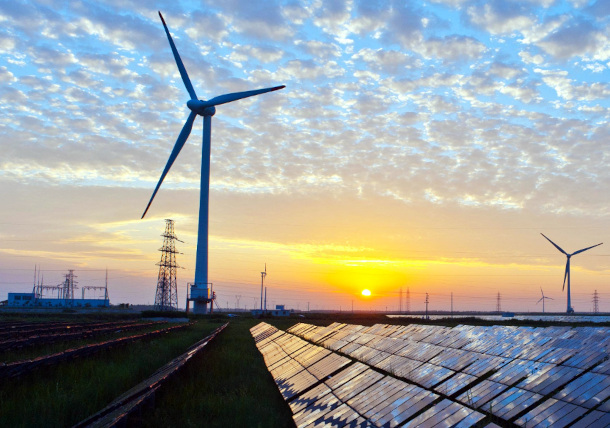
Energy from the sun and wind should no longer be called “alternative energy”, according to McKibben. (Photo: Kenueone, Wikimedia Commons, CC0 1.0)
Climate activist Bill McKibben, who authored The End of Nature nearly 40 years ago, is back with Here Comes the Sun: A Last Chance for the Climate and a Fresh Chance for Civilization. He joins us for a wide-ranging discussion on the stunning growth of renewable energy from the sun and wind, led in part by China, even as the fossil fuel industry digs in.
Transcript
CURWOOD: From PRX and the Jennifer and Ted Stanley studios at the University of Massachusetts Boston, this is Living on Earth. I’m Steve Curwood.
Back in September of 1989, along with a poem from John Updike and fiction from Muriel Spark, the New Yorker Magazine published what they called a Reflection with the title of "The End of Nature - The rise of greenhouse gases and our warming earth. ” It was penned by a writer in his late 20’s named Bill McKibben and he has been telling that story and calling us to action pretty much ever since. On the line now from Vermont is Bill McKibben and his latest book is called Here Comes the Sun, and it’s a more optimistic take on this world than your first book, The End of Nature, Bill, huh?
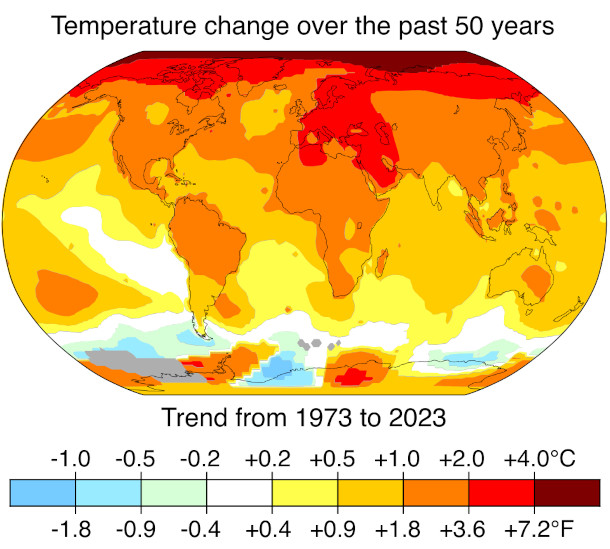
Planet Earth has warmed considerably since 1989 when Bill McKibben wrote The End of Nature, a book where he sounded the alarm on human-induced pollution and climate change. (Photo: NASA’s Scientific Visualization Studio, Key and Title by Eric Fisk, Wikimedia Commons, CC BY-SA 4.0)
MCKIBBEN: Well, you know optimism may not be exactly the right word. I mean, look, the things that we were warning about in The End of Nature now almost 40 years ago, have happened. The planet is now warming fast. The scientists were absolutely right. We face an endless series of disasters that will get worse. This is the main legacy of our moment on Earth so far, but as of the last three years, four years, we finally have a tool, not at this point, to stop global warming with — it's too late for that — but perhaps to at least shave some tenths of a degree off how hot the planet gets. And that tool is cheap energy from the sun and the wind and the batteries to store that power when the sun goes down or the wind drops. This stuff that we called for all of our lives. Steve, alternative energy no longer is. It's now the common sense, obvious, straightforward way to make power on this planet, which is why 95% of new generating capacity around planet Earth last year came from these clean sources.
CURWOOD: So Bill, looking back to The End of Nature some almost 40 years ago, the key point in your book Here Comes the Sun, is that, you know, we have all that we need to arrest this progression of of climate disruption, maybe not stop it completely, but at least have it be functional enough for our civilization. What inspired you to write this book?
MCKIBBEN: Well, mostly because I felt like I had a scoop. You know, I and I'm an old journalist at heart, like you. I do this newsletter every week on Substack called The Crucial Years, which, I think, because it's free, has turned into the largest newsletter of its kind around climate and energy and the environment. And it means that I get to keep track of all the things that are happening, you know, on a kind of weekly basis around the world. And about 36 months ago, if you were paying attention, you couldn't help but notice this sudden spike beginning. We'd finally hit the steep part of the S curve, you know. And all of a sudden there were stories coming in from around the world, especially, it must be said, China, which is providing the leadership here, and which is doing things on a almost inconceivable scale. In May, the Chinese were building three gigawatts of solar panels a day. As you know, a gigawatts, the rough equivalent of a big coal fired power plant. They were putting up one of those out of solar panels every eight hours. I mean, this is, you know, this is like building the pyramids or something, the scale at which this is going on. And it's... there're similar stories to be told from many corners of the world, and they just keep coming. I don't know whether you saw the news a couple of weeks ago, but I've been writing and talking about it ever since. In the country of Australia, where they've built so much solar power that the government has now decided that electricity will be free for all Australians for three hours every afternoon. I mean, human beings for 700,000 years have worked hard to get energy for our lives if it meant collecting firewood, if it meant paying your electric bill. Now you don't have to do that anymore, at least if you're in a place that's had the foresight to build the solar panels and the wind turbines.
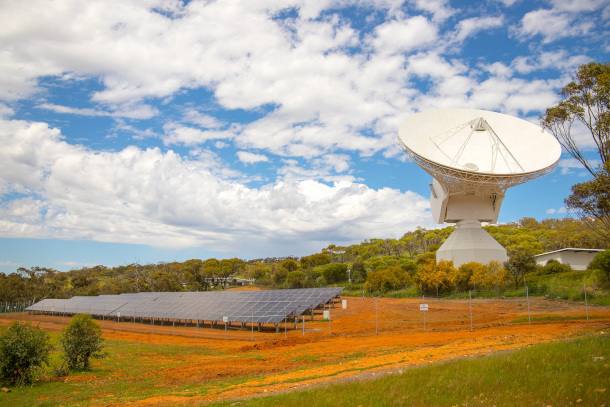
Beginning on July 1, 2026, Australia will provide everyone with free electricity for three hours each afternoon. (Photo: D. O'Donnell/ESA, Wikimedia Commons, CC BY-SA 3.0 IGO)
CURWOOD: So Bill, how will a transition to solar power address global inequality and the disparities that exist in the developing world, and actually in parts of our country as well, many of which came to be because of the fossil fuel industry?
MCKIBBEN: I mean, as long as you rely on a source of power that's only available in a few places, the people who control those places will end up with inordinate wealth and power. John D. Rockefeller, the first plutocrat, was the first guy to recognize that. His heirs include Vladimir Putin, you know, who's using his winnings to run a land war in Europe in the 21st Century. They include the Koch brothers, our biggest oil and gas refiners and pipeline suppliers, who use their winnings to systematically undermine our democracy. They include the King of Saudi Arabia who likes to cut up journalists like you and me with saws. The world on the other side of this is very different, because there's sun and wind everywhere, for everyone, and it works best the sun anyway, towards the equator. So this is perhaps even a way to start rebalancing a little bit of this North, South division. If you're in the 80% of humanity that lives in countries that have to import fossil fuel, this couldn't be really better news, because once you've paid the money to build your solar panel or your wind turbine, then you no longer have to come up with American money, cash on the barrel head to buy the next tanker load full of oil. Pakistanis, mostly working by themselves, without government help, have put up so many solar panels in the last few years that the Pakistani government last month, canceled the delivery of 27 I think, huge cargo loads full of liquefied natural gas from Qatar. They had to pay a penalty, but it was cheaper to pay the penalty than to import this gas that they didn't need anymore because now they've got lots of solar panels.
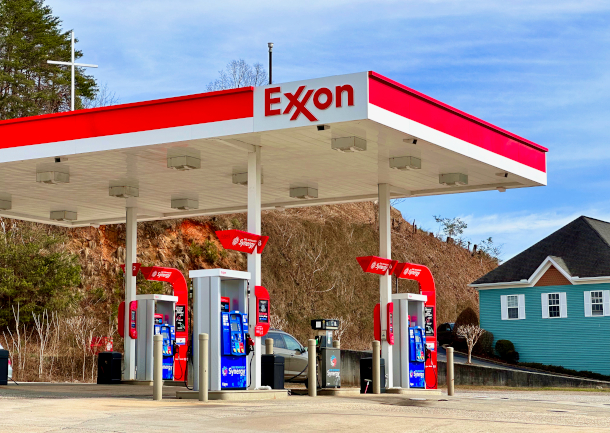
Exxon Mobil, the largest direct successor of John D. Rockefeller's Standard Oil Company, is one of the largest contributors to global warming and pollution from greenhouse gas emissions and toxic spills. (Photo: Harrison Keely, Wikimedia Commons, CC BY 4.0)
CURWOOD: So Bill, we have enough money on the planet to make the transition that's required to really put the brakes on this advance towards climate disruption. So what's keeping folks from providing the resources for poor fossil fuel trapped countries, from making the full transition right away?
MCKIBBEN: Well, to some degree, it's really starting to happen. And it's happening with Chinese financing and Chinese technology. The Chinese exported half again as much worth of green tech last year as America did of oil and gas. But the force that's slowing down all of this, of course, is the fossil fuel industry, which understands this good news for everybody else as the worst possible news for its future prospects, and they have trillions of dollars worth of hydrocarbons in the ground at today's market prices that they would like to get out and sell for trillions of dollars, which they won't be able to do if we're busily converting to sun, wind, to EVs, and heat pumps. And so they're doing, as you as you know, everything they possibly can to stop that transition. In our country, where their work is the most advanced, that meant when Donald Trump asked them for a billion dollars in campaign donations last year, they came up with about half a billion in donations and advertising and lobbying in the last election cycle, and that was enough to convince the President to, you know, shut down wind farms off the coast of New England that were 80% complete, or put the kibosh on huge solar farm couple weeks ago in Nevada that by itself, one solar farm, would have powered 2 million homes, more than 1% of American homes. You know, we can't have this stuff that the rest of the world is busily building because our oil and gas industry has corrupted our President, not that that was a very hard task, and so now we get to pretend that climate change isn't real, that green energy doesn't work, and that we're somehow all going to go back and inhabit the 1950s again.

China is currently leading global solar power expansion, at one point adding roughly three gigawatts of new capacity in a single day, according to McKibben. Above, solar panels installed on an aquaculture farm near Qingdao, China. (Photo: Benlisquare, Wikimedia Commons, CC BY-SA 4.0)
CURWOOD: Nixon, President Nixon famously saying, "What do you want us to live like animals?" But, but Bill, what's going on here in the United States and much of the rest of the world to let's just call it native intelligence. Why is it that people are acting this stupid. Let's be blunt about it here.
MCKIBBEN: All transitions are hard and they involve, you know, change, and our species doesn't deal particularly well with change. And in this case, as you know, better than almost anyone, we've had 35 years of full on disinformation campaign from the fossil fuel industry about climate change, about alternative energy, all designed to drive home the idea that only the way that we're doing things now could possibly work. And that's sunk in with too many people, especially in this country, but the rest of the world is quickly shaking off that habit, I think. And, you know, you could tell just watching in Belém in Brazil at the climate talks this year that, you know, people are sort of moving past the US, like we're sort of receding into the rearview mirror, you know. And it's becoming clearer and clearer where the future lies. Now, as patriotic Americans, that should upset us. These technologies were all invented in the US. The first solar cell is 1954 at Bell Labs in New Jersey. The first industrial wind turbine is 1941 at Grandpa's Knob in Vermont, about 30 miles south of where I'm talking to you from. We could have owned these technologies, and instead, we've just ceded them to our theoretical main rival on this planet. I don't think really there's been an act of national self sabotage quite like this that I can think of anywhere in human history.
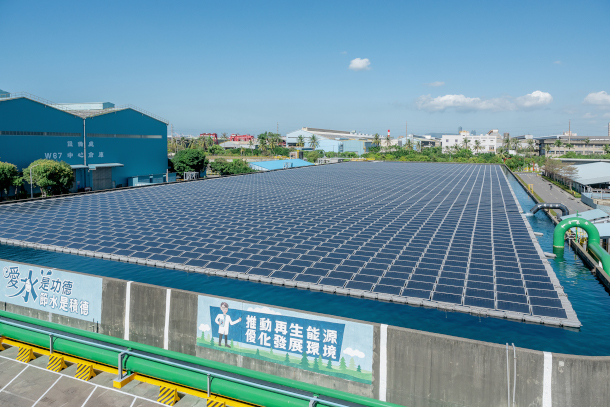
McKibben predicts that countries like China will gain a large economic advantage in the global market due to their headstart in producing cheap, renewable energy. Above, solar panels on a China Steel Corporation facility in Taiwan. (Photo: Makoto Lin, Wikimedia Commons, CC BY 2.0)
CURWOOD: So let's talk more about geopolitics. As you say, China has figured this out. What does this mean for this nation and the world going forward?
MCKIBBEN: Well, if we don't get our act together, then, you know, someday, someday the US will be the Colonial Williamsburg of internal combustion, and people will come here to gawk at how people lived back in the old days when they had to set stuff on fire in order to make their lives work. I anticipate that sometime before that, we will break out of the current spell that we're living under, and people will begin to realize that it's not going to work very well to try and run an economy on expensive energy when the rest of the world is running their economies on cheap energy. And I don't think any amount of Trumpian bluster will make up for that. Look, they're trying. They obviously designed tariff policy as a kind of shake down on precisely this issue, country after country, if they agree to buy billions of dollars worth of American liquefied natural gas see their tariffs cut in half. But even if that works in the very short run, any government being extorted like that is going to think to itself, "I do not want this to continue. I'd just as soon buy some of this solar panels from China, and after that, I won't depend on China, I won't depend on the erratic and unreliable U.S. I'll just depend on the sun, which heretofore, has made its appearance pretty much every morning."
[MUSIC: Norah Jones, “Sunrise” on Feels Like Home, Blue Note Records]
CURWOOD: We are spending this hour with environmentalist and author Bill McKibben, talking about the climate emergency and his book, Here Comes the Sun. Don’t go away. We’ll be right back after a short break. You’re listening to Living on Earth!
ANNOUNCER: Support for Living on Earth comes from the Waverley Street Foundation, working to cultivate a healing planet with community-led programs for better food, healthy farmlands, and smarter building, energy and businesses.
[CUTAWAY MUSIC: Stanley Turrentine, “Sunny” on The Spoiler (Reissue), The Blue Note Label Group]
CURWOOD: It’s Living on Earth, I’m Steve Curwood, and let’s continue our discussion now with climate activist Bill McKibben, whose 2025 book is Here Comes the Sun. Now, we’re talking about climate disruption, but you know research shows that just here in the United States, we have 300,000 excess deaths from the particulates from burning fossil fuel. Why isn't this a big public health issue? 300,000 people a year dying, Bill?
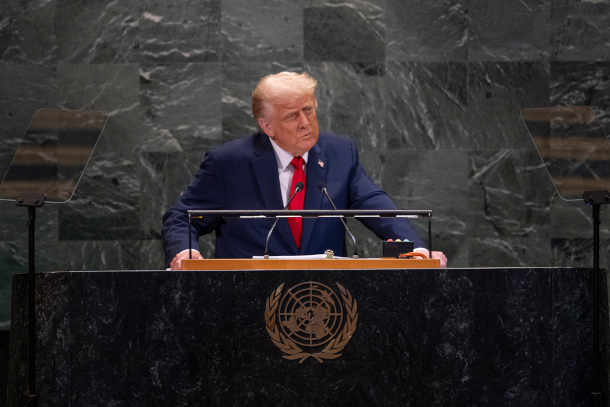
President Donald Trump called climate change the “greatest con job ever perpetrated on the world” during his speech at the United Nations on September 23, 2025. Nearly half a billion dollars in funds for his 2024 presidential campaign money came from the fossil fuel industry. (Photo: The White House, Wikimedia Commons, Public Domain)
MCKIBBEN: Yeah, well, because they don't... they don't all die in one place right in front of you, where you can see it happening. You know, in order for that statistic to make sense, you have to actually, like pay attention and trust the medical establishment, which we've now decided to vilify. You know, I mean, a country that doesn't want to be vaccinated against serious disease may not be paying as much attention as they should to the weekly mortality and morbidity reports out of the National Institute of Health, which doubtless are being shut down anyway. I don't have an answer for you about why we're behaving as irrationally as we are. My sense is that it can't last forever because reality will catch up. You know, there's the physical reality of climate change and of the public health reality that you describe that comes with a heavy economic penalty. And then there's the economic reality of the fact that we're, for some reason, deciding to double down on expensive energy when the rest of the world is going to cheap energy. I mean, look, there are any number of ways that the United States is behaving irrationally right at the moment. I'm doing my best to slow it down. We've got a we've got Third Act. This group we formed for older folk like me three years ago. We've now got 110,000 of us across the country. We're busy working on climate and on democracy. You may have noticed at your local no Kings Day protest that our age group was over represented, and we intend to keep it that way, because, well, in part, because we grew up in an era when we could see government action working. You know, the first Earth Day got us the Clean Air Act and the Clean Water Act, and then our air and our water got a lot cleaner. So we understand that this was possible once, and we don't understand why it's not possible now. So we're going to do our best to make sure.
CURWOOD: So your book, Here Comes the Sun, is, I guess, a handbook for people who are trying to wrap their heads around this notion that, "Hey, it really does make a lot of sense to make the transition away from fossil fuel and will be better for us." It's not just, I think you use the term, it's not like the Whole Foods of energy, that so called alternative energy. No, this is the, this is the main game.

Solar panels near the Xiyuan River in China. An increased demand for electricity in China, in part due to the rise of AI, has made building clean energy infrastructure more important now than ever. (Photo: Davidzdh, Wikimedia Commons, CC BY-SA 4.0)
MCKIBBEN: This is the Costco of energy man — cheap, available in bulk, on the shelf, ready to go.
CURWOOD: So how is this book doing? To what extent are people grabbing this and saying, "Oh, I... Oh, my goodness, this really is possible to make a change?"
MCKIBBEN: It's doing well. It's been fun. And, you know, I brought it out so, mostly so that we could use it as a kind of organizing vehicle for this thing in September that we called Sun Day, not Earth Day, but Sun Day. And the first iteration of that went great. We had 500 events across the country that you can read a beautiful account of it in the Times. So people are waking up, and I think that they'll wake up more as the next year goes on. My guess is that one of the two or three key issues for the midterm elections on which all attention will be focused are going to be the electricity prices, which are soaring, as you would expect, because we're permitting every data center that anyone could ever want to build at exactly the same moment that we're constricting the supply of sun and wind. You don't need to be a Nobel Prize-winning economist to know that when you increase demand and decrease supply, price is going to rise, and that's exactly what's happening. So, hopefully, there'll be increased attention as we go forward, and as the planet gets hotter and hotter, it will continue to summon people's imagination.
CURWOOD: Now you have a whole chapter on affordability in this book, Here Comes the Sun, which understandably is a big question for people right now, when it comes to transitioning to solar and and other forms of renewable energy. Let's take a micro look here. Walk us through the numbers here.
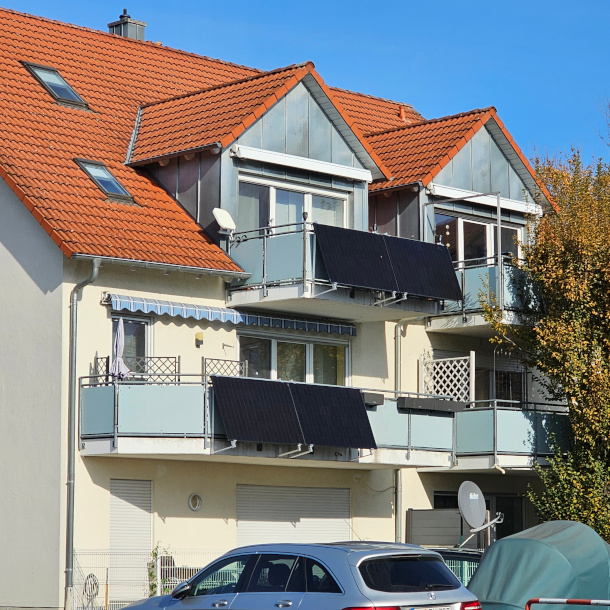
Balcony solar are small, plug-in solar panel systems designed for apartments, balconies, and patios. The technology has taken off in Germany and much of the EU but has yet to become legal in most places in the United States. (Photo: Nikolai Twin, Wikimedia Commons, CC BY 4.0)
MCKIBBEN: Well, I mean, if you want to get really micro, let's look at people's homes. It costs three times as much to put solar on your roof in the US as it does in Australia or the EU. Most of the world, you just... if you want solar on your roof, you call up some guy on Monday morning, and by Friday afternoon, the panels are up there pumping out power. In this country, wall. We are burdened with endless excess bureaucracy. We've got 15,000 municipalities in this country, each one has their own building code. They'd like to send a team of inspectors up on the roof. It takes months to get all this done, and that drives the price through the well, through the roof, I guess you would say. We can get around this. The National Renewable Energy Lab, a couple of years ago, put out this thing called the SolarAPP+ that essentially allows for instant permitting. A contractor just types in the address and the piece of equipment that he's going to put on top, and as long as the computer likes it, then they give him an instant permit, and he or she is up there on the roof, hammer in hand. That's how it works, as I say, everywhere else. An even more remarkable example is what the Europeans are calling balcony solar, what you could call plug in solar. Across Germany and Italy and Belgium and places, millions of Europeans in the last three years have gone to their, I don't know, whatever you call Best Buy in Italy, and come home with a solar panel designed not to go on the roof, but just to be hung from the railing of your balcony on your apartment. And, in the back, it has a standard plug that you just stick into a wall, no electrician needed. This often produces 20%, 25% of the power that an apartment uses. It's a great gateway drug to renewable energy, and it's illegal everywhere in this country, except that progressive Bastion, the state of Utah, which in March by unanimous vote of the state legislature passed the enabling legislation. The Republican senator who proposed it, when I talked to him, said, "Well, you know, if it's good enough for the people of Stuttgart, why should it be denied the people of Salt Lake City?" And in the wake of Sun Day, I think we have legislation now in about 15 state legislatures to get the same thing done here. One of the things about renewable energy, solar power, is that it's not as bound by partisan and ideological divisions as some other things. I've lived in rural America all my life, red state and blue, and so I have lots of neighbors who have Trump flags in the mailbox and solar panels on the roof. And if you ask them, why a church or fire company or whatever, the answer boils down to, "My home is my castle, and it's a better castle if it has an independent power supply." That's not why I put solar panels on my roof, a quarter century ago. I did it because I care deeply about climate change, but I'm also enough of an American to feel that other impulse too. I like the fact that I don't have to depend as much on utilities and things.
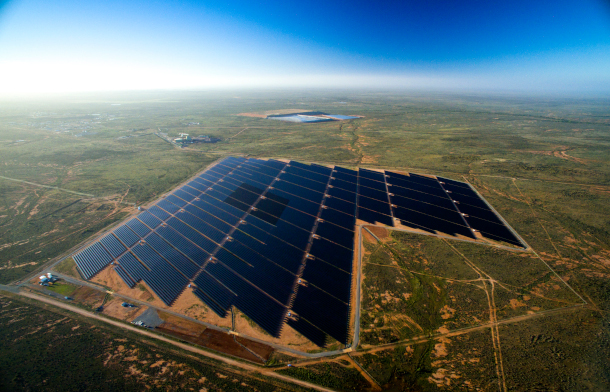
Pictured above is the Broken Hill Solar Plant, New South Wales. Solar power is a major contributor to electricity supply in Australia. (Photo: Jeremy Buckingham, Flickr, CC BY 2.0)
CURWOOD: Wait a second. Bill McKibben, what you're saying is there's no ideology then to solar and and other renewable forms of energy, and yet we seem to be tied up in this ideological knot.
MCKIBBEN: It's not ideological in this country. It's the power of money. The fossil fuel industry does not want us to stop using coal and gas and oil, so they are done everything they can to make sure that we don't. And that's where we are.
CURWOOD: But Bill, it is ideological. Because when you look at the Supreme Court case Citizens United, which allowed corporations to put as much money as they wanted into politics, that's based on ideology.
MCKIBBEN: Fair enough, but that's based on the ideology of... I mean, if you took a vote on Citizens United in this country, the vast majority of Americans do not want corporations running our political life. They just took a vote among Supreme Court justices who have been, you know, specially tailored by the Federalist Society for decades now to fall in line behind corporate projects. So I don't think it's people's ideological commitment to fossil fuel or anything else. I just think our political system has gone pretty dysfunctional, and who knows if we can rescue it. We're definitely going to try. We'll keep trying. But it's, you know, we are in a mess, and our energy system is one of the most obvious reflections of that mess.
CURWOOD: Yeah. I mean, in American history, these messes have not ended well. I'm thinking of our mistake of setting up slavery in this country, and what it took to get rid of it, and the absolute devastation that resulted in many parts of the country, you know, typically the South, but even in other places. I mean, it was very ugly getting rid of slavery, which was obviously at the time, even to many people, so wrong. And now again, burning fossil fuel seems very ugly and so wrong, and we don't seem to be able to get off this... what do you want to call it? A runaway train?
MCKIBBEN: Let's hope that, in this case, the fact that it's makes such eminent practical sense will eventually start to prevail. But yeah, you're right. The forces, the powerful forces lined up behind the status quo, are going to be tough to beat. They won't win in the long run. Thirty years from now, we're going to run the country and the planet on sun and wind, just because the economics is overwhelming. Look, the state that's putting up the most clean energy right now is the state of Texas, headquarters of the world hydrocarbon industry, because the economics are just so overwhelming. But if it takes us 30 years to get there, then you know, as well as I do, that the planet that we're running on, sun and wind will be a fundamentally broken planet. So let's try to make it happen a little sooner.
CURWOOD: My guest is Bill McKibben, and his most recent book is called, Here Comes the Sun.
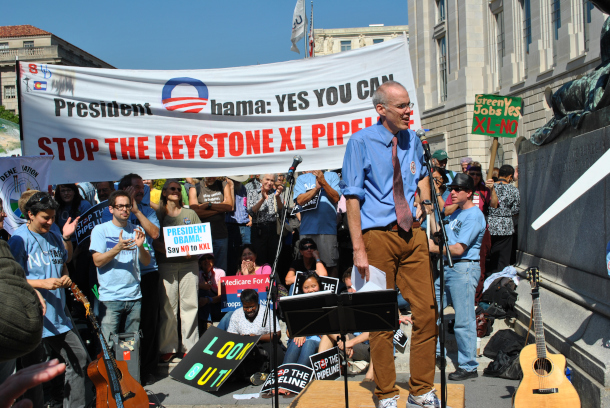
Bill McKibben speaks at a Stop the Keystone XL Pipeline rally outside the State Department hearing at the Ronald Reagan building in Washington, D.C., 2011. (Photo: Chesapeake Climate, Wikimedia Commons, CC BY-SA 2.0)
CURWOOD: Let's drill down a little bit. People who might you know, want to say, "Well, is this guy McKibben, right?" What would you say to them who say, "But what about building solar fields or wind turbines in our backyards? I mean, we don't want to have that happen."
MCKIBBEN: There's a lot of not in my backyard sentiment going around. Again, some of it's sponsored by the fossil fuel industry. They've done good work here. But much of it just based on that human desire to have everything stay the same. My state of Vermont, which I love, has had a de facto moratorium on wind turbines for 15 years now because people don't want to look at them. You know, sometimes I say to people, maybe our state motto should be change anything you want once I'm dead, you know. But we've got to get past that, and we should. I think wind turbines are gorgeous. I think seeing them against the horizon is a source of enormous beauty. Solar farms, one of the things we're starting to realize is that they're the sort of blank slate for an entirely new form of human endeavor that we're calling by the clunky name agrovoltaics, which means growing things in between rows of solar panels. What we've been growing near me in many places, are lots of pollinator friendly weeds and flowers, and the number of pollinating insects has increased by a factor of 100 in many cases, from what it was when these were agricultural fields. So the surrounding farmers get the benefit of that increased pollination. The birds get the benefit of all the bugs that are now there. It's, you know, it's taking a bite out of the biodiversity crisis at the same time as the climate crisis, but we do need to adjust our esthetic some and say this is what a responsible human settlement pattern looks like, and that's beautiful.
CURWOOD: And what about electric vehicles? As I understand it, maybe one in five cars being sold around the world these days is electric, but here in the United States, I think it's got to be a 10th of that. Why do some people say that EVs are worse for the environment than gas and diesel fired ones?
MCKIBBEN: I think anybody who says that at this point is completely wrong. At this point, it takes a matter of a year or two before you pay back the energy investment on an EV. And this is where the whole rest of the world is going. You'll remember that 10 years ago, when we saw the lists of the most polluted cities in the world, they were all in China. None of them are in China anymore, and the rise of EVs has a lot to do with that. In fact, I've been talking to friends in Beijing and Shanghai this year who say that even compared with six months ago, not only is the air cleaner, but it is much, much, much quieter in those cities, because more than half the cars sold in China last month came with a plug hanging out the back. I don't know. You must drive an EV, Steve. They're way better cars than what they replace — quiet, nothing to break, very cheap to operate. You never have to go to a gas station unless you want a Diet Dr. Pepper or something. You know, it's just a much more elegant way to do things, in the same way that a heat pump is a lot more elegant than the oil furnace clanking away in your basement or the induction cooktop is a much better way of cooking than the open campfire in your kitchen.
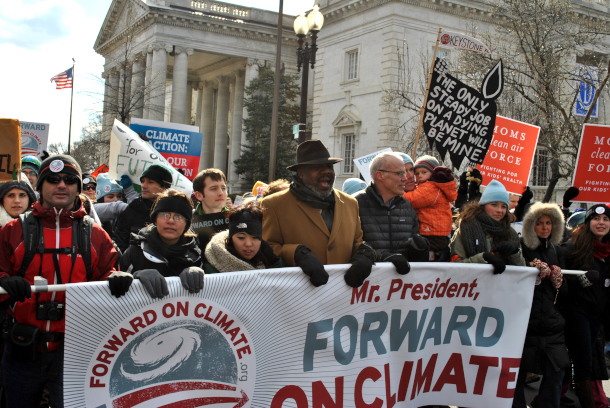
Bill McKibben marches at the Forward on Climate Rally in Washington DC, 2013, where protesters urged President Obama and Congress to address global warming and put a stop to the expansion of the Keystone XL Pipeline. (Photo: Chesapeake Climate, Wikimedia Commons, CC BY-SA 2.0)
CURWOOD: Bill, to what extent is this EV thing a matter of testosterone? Because the one thing you know running an electric car, it doesn't go vroom.
MCKIBBEN: Doesn't go vroom, but if you're really dedicated to going quickly, you know, my...
CURWOOD: It's faster. Yes, it's faster.
MCKIBBEN: My, you know, 2019 Kia, can dust just about any internal combustion engine off the stoplight you can find. That's not my particular hobby. But if going fast is your thing, you know, the torque is immediate, applied directly. It's... these things jump.
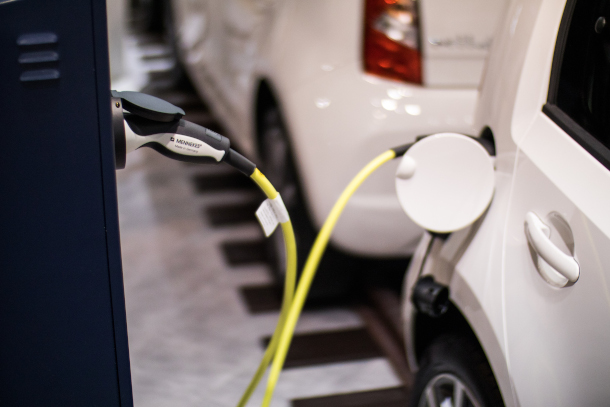
According to the International Energy Agency, more than 20% of new cars sold worldwide in 2024 were electric. (Photo: Ivan Radic, Flickr, CC BY 2.0)
CURWOOD: Bill, let's turn now to what's going on in the U.S. right now. I noticed that you were in New Jersey just a little while back. What were you doing there?
MCKIBBEN: Ah, this was great. It's part of this ongoing effort to pass what people are calling climate super fund laws, or polluter pays bills, or things like that. These are things already passed in Vermont and New York that would send a bill off to the oil industry for the damage that comes with climate change. On the argument that if anyone has to pay for new culverts and bridges and stuff after every flood, it shouldn't be the taxpayers. It should be the people who've been making huge profits off the fossil fuel that's driving these changes. So this year, New Jersey, California, and a number... Massachusetts, other places, are considering the same kinds of legislation. Really important.
CURWOOD: How possible is it to get this legislation passed? I think famously, in New York, you guys had a big sitin outside the governor's office to get her to sign it at the last minute.
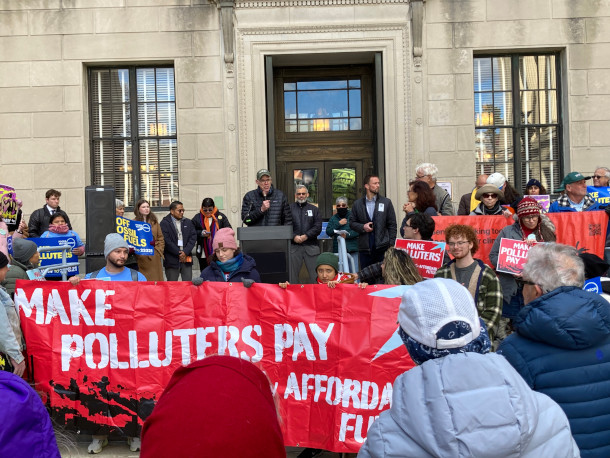
Bill McKibben speaks at the New Jersey Climate Superfund rally outside the Trenton Statehouse on November 17, 2025. This call to action supports legislation requiring major fossil fuel companies like Exxon, Shell, and BP to pay for damages from climate change impacts. (Photo: Alice Fruend)
MCKIBBEN: Yes, we had to... we had to send to jail a number of us oldsters. I think, truthfully, this one should be a no brainer. I can't think why any politician would rather send their own taxpayers a bill for this stuff than send the bill to Exxon unless they're taking big contributions from Exxon, in which case maybe the equation changes. But if we got it through the, you know, political pit that is Albany, New York, I think it should be possible in a bunch of places.
CURWOOD: Well, I mean that people are saying that this is going to raise energy bills and transportation costs.
MCKIBBEN: Well, it clearly doesn't raise the price of gas, because, as you know, the price of oil is set on the global market. It doesn't depend on, on, on what happens in New York. I mean, it depends on what happens if the next war breaks out, or the Suez Canal gets closed, or, you know, whatever. That's what sets the price of oil. The fact that New Yorkers are getting money back from Exxon doesn't affect it. Exxon, even Exxon doesn't set the price of oil. That's set on global markets.
CURWOOD: So on the back of this envelope here, I've scribbled some numbers that would indicate that if there are serious Cimate Superfund Laws that really assess for the damages, it would pretty much bankrupt Big Oil, these companies.
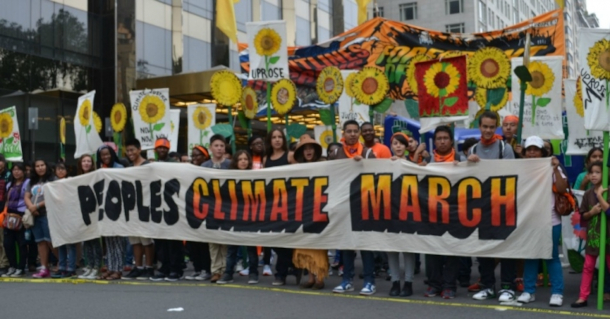
In 2014, Bill McKibben wrote an article for Rolling Stone magazine, entitled "A Call to Arms", which invited readers to the “People’s Climate March” in New York City. (Photo: Southbend Voice, Flickr, CC BY SA 2.0)
MCKIBBEN: Probably, if, I mean, if they, if, if we could really get them passed, and if the Supreme Court doesn't gut them and things. It would have the effect, I think, of beginning to push these guys in a direction of real negotiations. This is more or less what happened with the tobacco industry. States, one after another, began to sue them and win for the damage that they were causing to people's health the states were having to pay for, so the model is out there.
CURWOOD: But I mean, if the numbers really reflect the damage, can the oil companies afford this?
MCKIBBEN: There's no amount of money to cover the damage that climate change is doing around the world. I mean, the last numbers that I saw anyone even attempt to do said that by the end of the century, climate change will be doing $551 trillion worth of damage, economic damage on the planet, which is literally far more money than exists on planet Earth at the moment. So, yeah, no, Exxon can't foot the whole bill, but if you could put some pressure on Exxon that forced them to start deciding they'd rather become a renewable energy company than a bankrupt oil company, that would be all to the good.
[MUSIC: Jon Batise, “Sunny Side of the Street” on Jazz is Now, Naht]
CURWOOD: Bill McKibben, environmentalist and author of Here Comes the Sun among other books. We’ll be back in just a moment with the rest of our chat. Keep listening to Living on Earth!
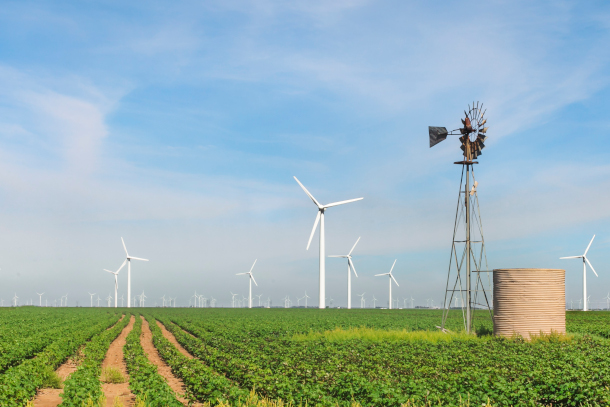
Roscoe, Texas is home to one of the world’s largest-capacity wind farms with 627 wind turbines. Roscoe Wind Farm powers approximately 250,000 homes and stretches for nearly 100,000 acres. (Photo: Matthew T Rader, Wikimedia Commons, CC-BY-SA)
ANNOUNCER: Support for Living on Earth comes from the estate of Rosamund Stone Zander - celebrated painter, environmentalist, and author of The Art of Possibility – who inspired others to see the profound interconnectedness of all living things, and to act with courage and creativity on behalf of our planet. Support also comes from Sailors for the Sea and Oceana. Helping boaters race clean, sail green and protect the seas they love. More information @sailorsforthesea.org.
[CUTAWAY MUSIC: United Guitar Players, “Here Comes the Sun” on Here Comes the Sun – Instrumental Acoustic Guitar Songs from the 50s, 60s, 70s & 80s, UGP]
CURWOOD: It’s Living on Earth, I’m Steve Curwood, and my guest is climate activist and author Bill McKibben. Bill, you’ve been doing this work for decades now. Talk to me about some of the triumphs that have kept you going through all these years.
MCKIBBEN: Well, for the first 35 years of this work, you know, we lived in a world where fossil fuel was cheap and renewable energy was expensive. So the job basically was to some ways drive up the cost of fossil fuel. People tried to do that with things like carbon taxes and carbon pricing that never really, at least in this country, took hold. So we also did things like try to prevent their expansion of their infrastructure and hence their consolidation of new territory. The Keystone Pipeline was a perfect example. When we started that fight, Canada was planning to quadruple, or quintuple, the amount of oil they were pumping out of the tar sands in Canada. By the time we were done, those dreams were much diminished. Similarly, we ran this massive ongoing fossil fuel divestment campaign that called on institutions to sell their stock in coal and gas and oil in order to make a moral stand, but also to raise the cost of capital for these companies. It's been the most successful anti corporate campaign in history. We're at about $40 trillion worth of endowments and portfolios that have taken those steps. So those things are ongoing. Now we've moved into this new world where the economics have flipped because sun and wind are cheaper than coal and oil and gas, and now our job, above all, is to figure out how to accelerate this transition. The force of economic gravity is working in our favor now. The fossil fuel industry, of course, knows this, which is why their resistance has stiffened. And so the fight is on. And I really think the fight is about what happens over the next four or five years because I think that's about how much window we have left to be making significant difference in what ends up happening with the climate.
CURWOOD: Depending on the math, you know, some 30% or so of climate changing emissions come from deforestation and degradation of forests, particularly the tropical forests. What do we need to do there to turn that around?
MCKIBBEN: Well, it's not a place where I'm the great expert, but it's pretty clear that we need to do the kind of things that say Lula has been doing in Brazil, which has dramatically slowed, again, the rate of deforestation in that part of the world. I think the worry is that we're now on a planet where that work is much physically harder because the rapid heating is reducing the ability of forests to sequester carbon and more and more and more, leading to their destruction. You know, the biggest forest loss in the last couple years have been these enormous fires across the boreal forests of Canada and Siberia. Canada, in 2023, was the fourth largest carbon emitting country on Earth, after the U.S., China and India. Despite its tiny population, just because its forests were on fire. Those boreal forests weren't supposed to burn. You know, they're too far north, too cold, too wet, but in the world we've created, they're tinder. So this is very, very, very hard place to be at work. I completely agree.
CURWOOD: Bill, what are you up to these days?
MCKIBBEN: Well, I spend a lot of my time volunteering at Third Act, which organizes, as I said, older folks like me, people over 60 for action on climate and democracy. And that... you know, climate and democracy are the two things most at risk, and we're pretty proud of the work that we're doing. We were really proud earlier this fall when Stephen Miller, the President's henchman, was giving reporters a tour of his newly militarized Washington DC, and boasting about all the National Guardsmen and tanks and stuff. And he said, "Our only problem is all these elderly hippies who keep coming out of their houses to scream at us. They should go home and take a nap." We immediately wrote him a letter saying we're not going home to take a nap. We're going to keep bedeviling you, because we think you're selling out the America that we've always known on democracy terms and on energy and climate and environmental terms. So that fight is what preoccupies me. I think the midterm elections this year will take up an enormous amount of that effort, and part of the way that we're going to win those elections is by helping people understand the huge possibilities that the sun is suddenly giving us to change our economies and our lives in benign and even beautiful ways. Look, if every Australian gets three free hours of electricity, what human being is going to look at that and not say, "Me too, please?'
CURWOOD: Now you mentioned, of course, dealing with fossil fuels and also working for democracy. And here's the question, when it comes to China, you say China is really ahead of us and is moving quite strongly in this sector, but it's hardly a democracy. What is the risk of getting behind the Chinese model?
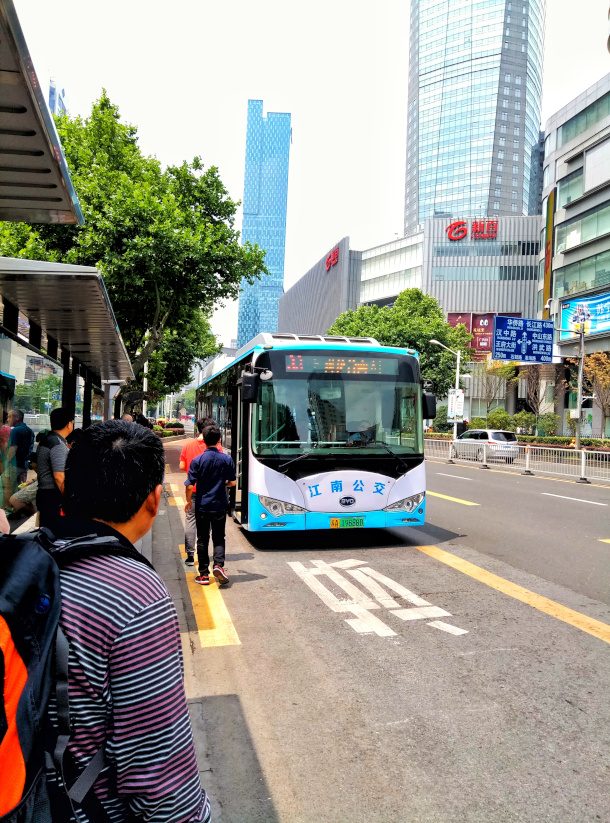
The rise of electric vehicles in China has made the air cleaner and the roads quieter, says McKibben. Above, an electric bus stops in the central business district of Nanjing, China. (Photo: DKMcLaren, Wikimedia Commons, CC BY-SA 4.0)
MCKIBBEN: Well, I think that the... well, I mean, I completely agree with you. I'm well aware that if I'd spent my life in China doing what I've spent it doing in this country, I would have spent my life in prison, which is one of the reasons why it makes me so sad that we've just ceded technological and economic primacy to China. But I think the difference here is if you know the U.S. and Donald Trump has explained that we want energy dominance through sales of hydrocarbons to the rest of the world. If you end up buying oil and gas from U.S. or Russia or Saudi Arabia, you're just stuck with them forever. You're dependent on them. If you go buy some solar panels from China, it's a one time transaction, and after that, you don't have to give a fig about the Chinese, you know, because now you work with the sun directly.
CURWOOD: You know, Bill, given the current political situation here in the United States, where do you see an opportunity to get everyone pulling in the same direction towards a future powered by renewable energy?
MCKIBBEN: Well, I don't actually think we're going to get everyone pulling in the same direction anytime soon. I think the fossil fuel industry is going to continue to pull in the wrong direction, and their economic might is enough that they'll bring too many politicians with them. I think that the rest of us, ordinary people, are going to have to do a lot of that pulling, and that's why things like Sun Day are so important.
CURWOOD: So, Bill, anything you want to add to our discussion?
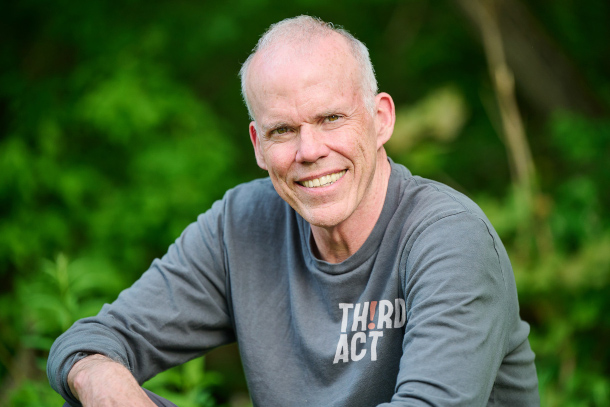
Bill McKibben serves as the Schumann Distinguished Scholar in Environmental Studies at Middlebury College and holds honorary degrees from 20 colleges and universities. McKibben is the author of 20 books and the founder of 350.org and Third Act. He has also been awarded the Gandhi Peace Prize, the Right Livelihood Award, and Foreign Policy named him to its inaugural list of the 100 Top Global Thinkers. (Photo: StoryWorkz)
MCKIBBEN: The only thing I'd add is that, you know, we've talked about the economic necessity of doing this and the climate urgency of doing this, but there's also just a certain amount of beauty that comes with it. You know, when we were getting ready to do Sun Day, one of the things we did was make a playlist of all the songs about the sun that there were. And I mean, obviously I stole the title of my book from George Harrison, which is the "Here Comes the Sun" is the most listened to Beatles song on the world's streaming services. There were hundreds of songs to choose from, which, by the way, is hundreds more than if you tried to compile a playlist of great songs about fracking. And the reason is that humans have a deep, deep connection to the sun. You know, we don't really know how prehistoric people thought, but all the piles of stone they left behind, like Stonehenge, point towards the equinox or the solstice as soon as people were in the business of making myths, the first thing they had to explain was how the sun rose over here, set over here, and got back over here again in the morning to rise again. And so there are 1000s of great stories about giant turtles or emus who swallow up the sun and vomit it forth in the morning. That's the you know, that's the great possibility here. I was in Rome in September with the new pope, who had summoned people over for a conference on the 10th Anniversary of Pope Francis's epic encyclical on global warming. The new pope, strangely normal American said, "Yes, we're going to continue this work that Francis set us on. In fact, next year, the Vatican will become the first fully solar powered nation on Earth, when they flip the switch on this big new solar farm they're finishing up outside Rome." And I...when it was my turn for my remarks, I just said, "I think this is fantastic. Let's henceforth concentrate on energy from Heaven, not from Hell." I think that's a useful mantra for the period ahead.

This year’s fall equinox, September 21, 2025 marked the first official Sun Day, a celebration of solar power and other forms of clean energy. This day of action marked over 500 events across the country including demonstrations, rallies, festivals, and faith-based events. Here, Bill McKibben poses with a solar power setup. (Photo: Simone Salvo)
CURWOOD: In other words, Bill, you're suggesting that the solution here involves some sort of a spiritual connection as well. It's not just technical or economic.
MCKIBBEN: Well, I mean, you can make a completely compelling and full case on economic grounds, and certainly on the practical grounds that we don't want to destroy the planet on which we depend. But I think that those are in tune, in this case, with a deep human affection for our local star, the most charismatic object in our corner of the universe. I don't think there's a human alive who doesn't involuntarily grin when the sun breaks out from behind the clouds and hits them in the shoulder blades. So, you know, here comes the sun.

The people of ancient Britain built Stonehenge to align with the sun on both the winter and summer solstices. (Photo: Clive Ruggles, Wikimedia CommonsCC BY 4.0)
CURWOOD: Bill McKibben has been a leading environmental activist on climate change and nature for, I don't know, on the scale of almost 40 years, and helped found the first global grassroots campaign 350.org. And he's also written on the scale of about 20 books, starting with The End of Nature and most recently, Here Comes the Sun. Bill, thank you so much for taking time with us today. Really appreciate it.
MCKIBBEN: Steve, a pleasure as always, this is a conversation we've been having across the decades, and I'm very glad it continues.
Links
Visit Bill McKibben’s website.
Purchase a copy of Here Comes the Sun (Affiliate link supports Living on Earth and local bookstores)
Living on Earth wants to hear from you!
Living on Earth
62 Calef Highway, Suite 212
Lee, NH 03861
Telephone: 617-287-4121
E-mail: comments@loe.org
Newsletter [Click here]
Donate to Living on Earth!
Living on Earth is an independent media program and relies entirely on contributions from listeners and institutions supporting public service. Please donate now to preserve an independent environmental voice.
NewsletterLiving on Earth offers a weekly delivery of the show's rundown to your mailbox. Sign up for our newsletter today!
 Sailors For The Sea: Be the change you want to sea.
 The Grantham Foundation for the Protection of the Environment: Committed to protecting and improving the health of the global environment.
 Contribute to Living on Earth and receive, as our gift to you, an archival print of one of Mark Seth Lender's extraordinary wildlife photographs. Follow the link to see Mark's current collection of photographs.
 Buy a signed copy of Mark Seth Lender's book Smeagull the Seagull & support Living on Earth
© Copyright World Media Foundation. All Rights Reserved
Home | Contact | RSS | Donate | Newsletter