

Evergreen, A Cherokee Myth
Air Date: Week of December 19, 2025
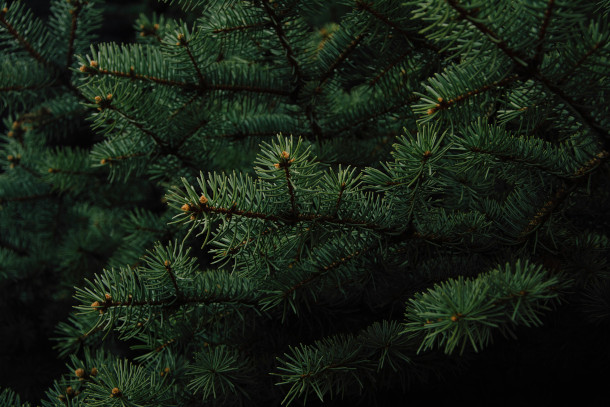
Storyteller Diane Edgecomb shares the Cherokee myth of the Evergreen. (Photo: Irina Iriser, Pexels, CC0)
A Cherokee myth, told here by storyteller Diane Edgecomb, explains why pines, spruces and firs stay green year-round. She joins Host Steve Curwood to talk about the value of bringing old stories alive for people -- what she calls “living myth” – and how stories have accumulated around this time of year, the winter Solstice, when in the Northern Hemisphere the Sun stands still on the horizon for three short days and three long nights.
Transcript
CURWOOD: That’s Haudenosaunee storyteller Perry Ground. Now if you’ve ever wondered why pines, spruces and firs stay green year-round, well, there’s also a story for that. Storyteller Diane Edgecomb shares the Cherokee myth of the Evergreen.
EDGECOMB: When the plants and trees were first created, they were given a task to stay awake for seven days and seven nights. The first day and night, all of the plants and trees stayed wide awake and the second day and night as well. But, on the third night and the dawning of the fourth day, most of the plants and many of the smaller trees had fallen fast asleep. Who would be able to stay awake and keep watch for seven days and seven nights. But, on the seventh night and the dawning of the eighth day, there stood the cedar, the pine, the spruce, the fir, the hemlock, the ewe, the Laurel, the Holly and the Ivy. You have endured a voice said, and you shall be given a gift. All the other plants and trees will lose their leaves and sleep the winter long, but you shall never lose your leaves or their green color. You shall provide a shelter for the birds and animals from the harshest winds, and you shall remind the people that even during the darkest times, something remains strong. You shall be ever green.
CURWOOD: And Diane Edgecomb is here with us. Welcome back to Living on Earth, Diane!
EDGECOMB: Thank you very much, Steve, it's lovely to be here.
CURWOOD: So Diane, you've been a storyteller for over what 30 years? What kind of stories do you like to tell?
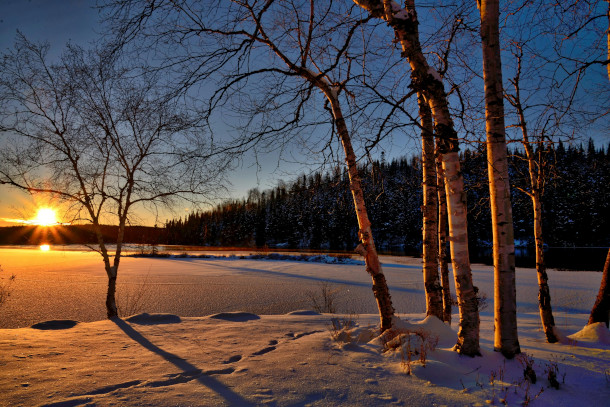
Our guest, Diane Edgecomb, says that many cultures have long told stories and myths around the time of the winter solstice. (Photo: Pixabay, Pexels, CC0)
EDGECOMB: Well, there's always an occasion for a story. And of course, there's a lot of understanding in the culture of personal stories and the value of personal stories. And I do tell stories to children as well. I, I think anyone who doesn't tell stories to children is just missing one of the most beautiful things in the world. But one of the most important things I try to do as a storyteller is to tell the old stories that have to do with how something in nature came to be. And stories are kind of a doorway to understanding, and I found that when people hear the story of origin, let's say, of an element of nature, how a place came to be, or a certain time of year, their feelings become aligned with it, and they see its meaning and its significance. So, I call some of what I'm doing. I call it living myth, and I try to have those old stories really live again for people.
CURWOOD: So, telling stories time of year, we're speaking as we approach the winter solstice, the day that, or the days actually the sun stands still, and up here in the northern hemisphere, it's pretty cold.
EDGECOMB: It's wonderfully seasonably cold. I'm really enjoying it, and I do find that the solstice is one of the times where stories really have accumulated around it, no matter where you live. There is this moment when the sun has been progressing along the horizon, and then it -- Sun stands still. Solstice, it rises and sets at the same point. And people wanted to tune to that. It's a very serious time of year, and so they told some of their most incredible myths at this time about the birds and animals that might do something different at this time, and also about the meaning of light. What does it mean to come out of the darkness and into light and still experience the darkness, because we put up a lot of holiday lights, but we also want to tune with our feelings at this time of year, and that is something serious, because we're feeling the darkness.
CURWOOD: Diane Edgecomb will be back soon to share a Greek myth about this time of peace around the solstice. As we head to a short break here’s a piece from her CD, The Winter Solstice in Story and Song, performed with musicians Margot Chamberlain and Tom Megan, and recorded by Tom Eaton.
Links
Learn more about Diane Edgecomb
Purchase “The Winter Solstice in Story and Song” Double CD from Diane Edgecomb’s website
Living on Earth wants to hear from you!
Living on Earth
62 Calef Highway, Suite 212
Lee, NH 03861
Telephone: 617-287-4121
E-mail: comments@loe.org
Newsletter [Click here]
Donate to Living on Earth!
Living on Earth is an independent media program and relies entirely on contributions from listeners and institutions supporting public service. Please donate now to preserve an independent environmental voice.
NewsletterLiving on Earth offers a weekly delivery of the show's rundown to your mailbox. Sign up for our newsletter today!
 Sailors For The Sea: Be the change you want to sea.
 The Grantham Foundation for the Protection of the Environment: Committed to protecting and improving the health of the global environment.
 Contribute to Living on Earth and receive, as our gift to you, an archival print of one of Mark Seth Lender's extraordinary wildlife photographs. Follow the link to see Mark's current collection of photographs.
 Buy a signed copy of Mark Seth Lender's book Smeagull the Seagull & support Living on Earth
© Copyright World Media Foundation. All Rights Reserved
Home | Contact | RSS | Donate | Newsletter