

Ceyx and Alcyone, The Coming of the Days of Peace
Air Date: Week of December 19, 2025
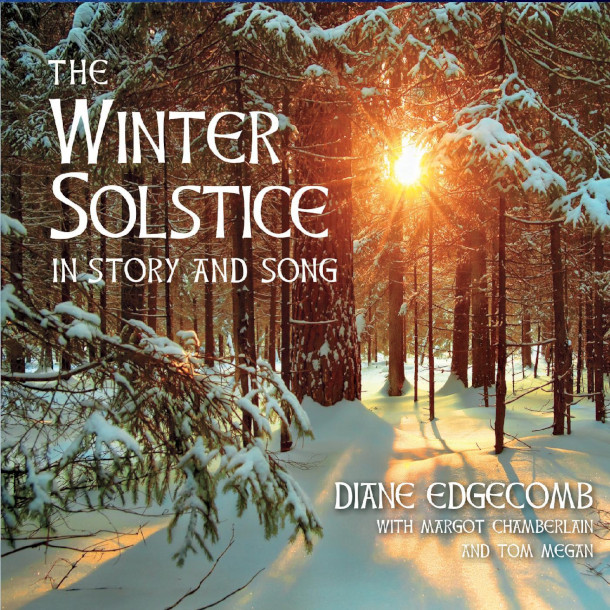
The story “Ceyx and Alcyone,” performed by storyteller Diane Edgecomb and accompanied by Margot Chamberlain and Tom Megan, is part of the CD, “The Winter Solstice in Story and Song.” (Photo: Courtesy of Diane Edgecomb)
Storyteller Diane Edgecomb performs the Greek myth “Ceyx and Alcyone” about the origin of Halcyon birds, also known as kingfishers. The ancients noticed these birds would appear during the “Halcyon Days” when the seas became calm, around the time of the winter Solstice. She also discusses with Host Steve Curwood how stories can help illuminate why we take part in old traditions at this time of year such as putting up lights, decorating evergreens, and hanging mistletoe.
Transcript
CURWOOD: It’s Living on Earth, I’m Steve Curwood.
We are back now with storyteller Diane Edgecomb. So, please Diane tell us about the next story you have for us today. Why this one in particular?
EDGECOMB: Well, it's a wonderful old Greek myth, a very little known myth, and the title is Ceyx and Alcyone, The Coming of the Days of Peace. And this story came to me in some form when I was 12 years old. So I always felt like it was a story that, in a way, I was meant to tell, because I read a fragment in an Audubon Society pamphlet on these birds and what happened to them at the winter solstice, and then I forgot about it. And years later, when I was working with Solstice myths, I thought, what was that fragment of story when I was 12 years old? And the amazing thing is that I still had those pages. I mean, how many things do you save from childhood? But there was another synchronistic thing too, which is the Celtic Harper that I work with, Margo Chamberlain. She had encountered a lot of early music in her travels and work, and she had these beautiful Greek songs that she'd always loved and had nothing to do with them, and we married them with the story, and it became this incredible weave. And so that's the story that we'd like to have for you today along Margot Chamberlain myself, and also Tom Megan, my husband, who plays many, many instruments on the piece,
CURWOOD: And once again, the title of the story?
EDGECOMB: Ceyx and Alcyone, The Coming of the Days of Peace.
Ceyx and Alcyone: The Coming of the Days of Peace adapted and retold by Diane Edgecomb © 2021
EDGECOMB: You may have heard the saying, Halcyon Days. Halcyon Days, meaning Days of Peace. The story behind that phrase comes from ancient Greece, where at the time of the winter solstice, a mysterious thing happens. At that time, small blue and white Halcyon birds arrive to nest by the shore and the seas are calm for them. There are never any winds. That they say is the "Coming of the Days of Peace."
[Margot Chamberlain sings]
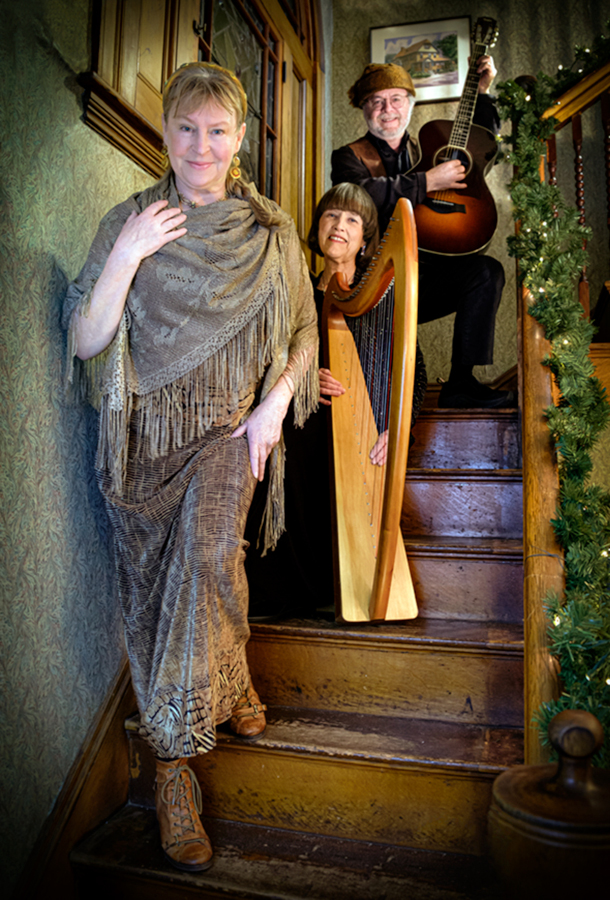
From left to right: Diane Edgecomb, Margot Chamberlain, and Tom Megan. In “Ceyx and Alcyone,” Diane performs as the narrator, Margot performs vocals and harp music, and Tom Megan plays other instrumentals. (Photo: Pamela Ruby Russell)
EDGECOMB: Ancient Greece: the landscape of myth, where every natural force, every mysterious power, wears the mask of a God. Hypnos, the God who rules over your sleep, sending dreams in the night. Eros, the childlike God who plays with your love life. And Zeus, king of Olympus and his wife, Queen Hera, highest of all the gods and rulers over the fate of every mortal. You can try to propitiate the gods. You can try to influence them with your prayers and your sacrifices, but do not think that you are above them, for then you commit the sin they hate the most: pride, hubris. For that, they will strike you down. Every force of nature, the face of a God, even the winds, are known and named. Erus, who brings the warm rains from the East. Notus from the South, so cloaked in fog you hardly notice him. And gentle Zephyrus from the West, who arrives with all the little Zephyrs in tow. And Boreas cruel storm wind from the North, whose howling scream strikes fear in every sailor's heart. To guard and contain the winds, Zeus has chosen Aeolus: tireless, agile, every muscle tuned for service, loyal Aeolus to watch over them all.
[SFX harp music]
EDGECOMB: He gathers the winds on his hollow floating island where he lives with his only daughter, Alcyone, lovely Alcyone, but she is every day alone. Her father is restless, never at her side. "Father, come here. I want to show you--." "I have no time to see. The winds can arise at any moment, and it takes all my cunning to capture them."
[Margot Chamberlain sings, SFX harp music]
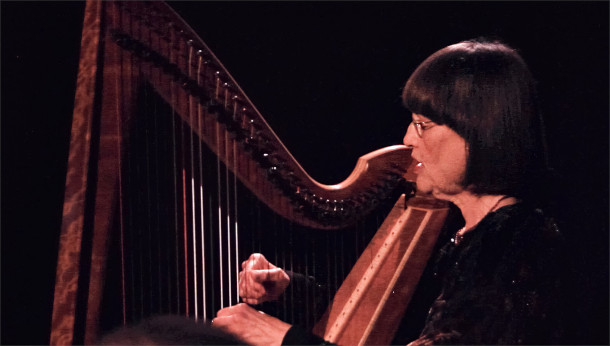
Margot Chamberlain, accompanist, performs the opening vocals and harp music during “Ceyx and Alcyone.” (Photo: from video captured by Larry Buckley)
EDGECOMB: His focus is only on the winds. He can feel the slightest trace of a whisper, and he sets out his traps. "Traps! No they are toys to entice them, leaves that they can rustle, sails that they can billow. For the winds are scientists. They are engineers. They want to know, how much can I fill this sail before I tear it? How far can I push that swing? They're downfall is their curiosity. They have to see around every corner, and when the winds come tearing around the bend, surprise, I capture them in my magic sacks. There is no bad day to catch a wind, but when I sense Boreas, Alcyone, run for the cave! Boreas wants only to destroy. Shall I tell you how I trick him? I use myself as bait, hiding behind me a special sack, soft as rain, strong as grief, forged from human tears. Come and get me, Boreas, you can't resist. Come and when he attacks, I catch him, twisting that sack into a figure eight hole. In there, Boreas, howl for eternity until the gods should call you forth again." Aeolus drags his sacks deep into Island caves where they lie, numbered and named, according to force, according to scent, according to danger.
[harp music and vocals stop]
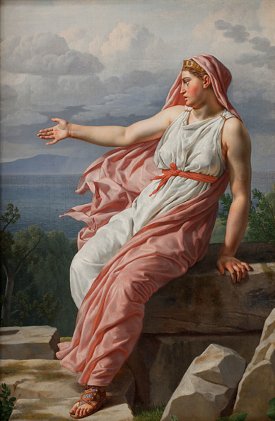
Aeolus’s daughter, Alcyone, as portrayed by Danish painter Christoffer Wilhelm Eckersberg. (Photo: Wikimedia Commons, Public Domain)
EDGECOMB: Only the Zephyrs, those gentle breezes, he allows those to roam free, for they are his daughter's only companions. They loved to play around her, to make her laugh, tease her out of her sadness, and they encouraged her to race with them, run, run as fast as she could to the edge of the island, all the while whispering, "Alcyone, there is another world beyond this one. You cannot see but look beyond. Imagine there are people, there are others." But though she would run to the edge of the island and look, she could never see another living soul, sometimes a ship she would see, but they would never come near her island, for that was the home of the terrible storm winds. Those were her worst days. When Zeus commanded her father to let loose the winds of vengeance, "Father, please do not set them free. The Zephyrs have told me there are others on that ship. There are people." "Stand back, Daughter. What is this pride? I do as the Gods command. That's why I have dinner with Zeus and Hera twice monthly. Now stand back! The storm winds but howl past Alcyone. She would be bent over, tears streaming down her face, not just from the force of the wind, but from knowing the damage that they would do. Sweet Alcyone.
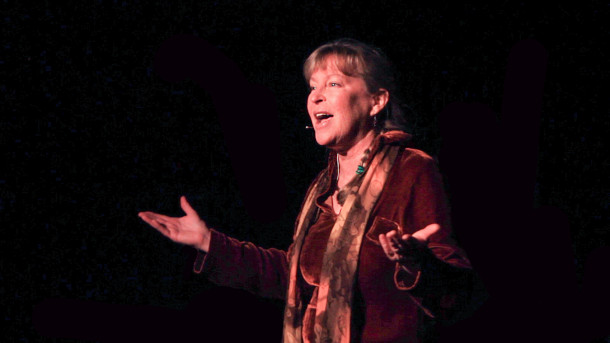
Diane Edgecomb performs the story of “Ceyx and Alcyone.” The phrase “Halcyon Days” comes from ancient Greece, and refers to the time when during the winter solstice, small blue and white Halcyon birds arrive to nest by the shores of the Mediterranean and the seas are calm. (Photo: from video captured by Larry Buckley)
[SFX harp music]
EDGECOMB: She could not stop Zeus. She could not even stay her own father's hand. She told her troubles to the Zephyrs and those winds, you know they listened, and not only to her words. They heard what was silent in her heart, and they knew she was so lonely. So the Zephyrs went in search. They went in search of someone who would be brave enough, someone who knew the winds and the waters well enough, someone who would dare come near that island, and they found him. And wouldn't you know, he was a bachelor. So it was one day, "Father, come down to the shore. There is a ship!" "How can that be? No one would dare come near this island." "But there is, Father. Come see!" It was a vessel of many sails, such as a king would have. There, coming up the hill was Ceyx, the young king of Thessaly. Oh, the Zephyrs had told him that he must come to this island to rescue this young woman. But they could never tell him he would fall hopelessly, completely and forever in love with her.
[harp music ends]
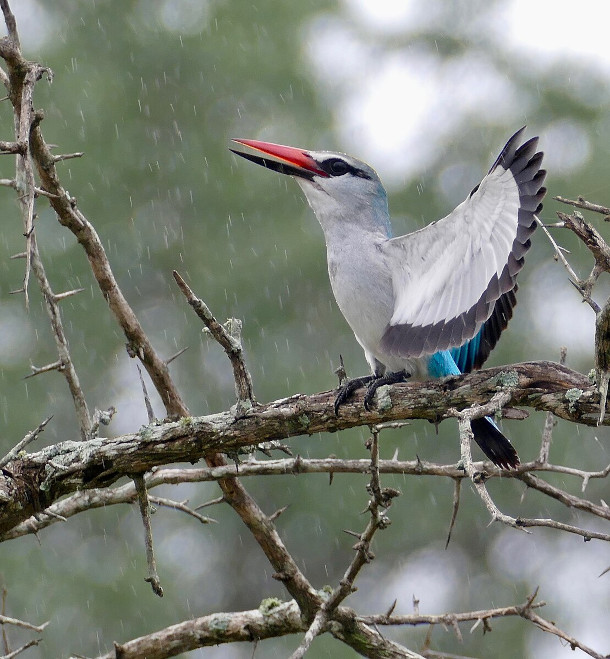
Halcyon birds can be found all over the world, though modern Halcyon birds prefer to live far from water. (Photo: Bernard Dupont, Wikimedia Commons, CC BY-SA 2.0)
EDGECOMB: What could her father do but release a wind steady and sure to send them? On their way. "Farewell, Father! Don't work too hard. Get some rest." Oh, Alcyone entered a world she never could have imagined. Everything delighted her, and Ceyx saw everything new through her eyes. She loved to sit for hours in the rose garden, taking in the colors and the different scents, and he would companion her. He loved her compassionate heart, and the people loved her too. After they had been together a year, he gave to her a soft blue gown with cloud-white edging, and when she put it on, the royal blue the same color as her eyes, it took his breath away. "Alcyone you are so beautiful. You should be queen of the gods." "Do not say that, Ceyx." "But you should be. I am as happy as Zeus. We are as happy as Zeus and Hera." "Happier. We are so much happier than they." As soon as she said it, she wished she had not. Oh, those words that tumble from our lips and we can never take them back. She never forgot that moment, because after that, their fortunes changed. Ceyx's ships, lost at sea, their crops that they needed for food and barter decimated by drought. Then there was the day Ceyx called to her in a voice she had never heard from him before. His only brother had been found dead upon the road. "How can that be?" "Yes. How can it be? He was not ill, he was not wounded. Alcyone, something is terribly wrong. I fear that we have angered the gods. I am going to consult the oracle at Delphi. It will be a sea voyage of, of many, many days, but I must go. I must know what sacrifice they would demand of me." "Then I will go with you. Please. Let me go with you. Then if something happens, it will happen to us both together." "I want you to wait for me here. Wait for me. I swear I will return to you." She held onto his hands, not believing his words. Tears filled her eyes, yet bravely, she nodded.
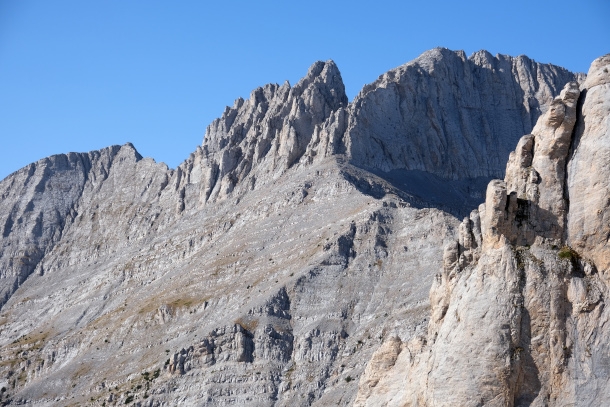
Mount Olympus, Greece, where the ancient Greek gods are said to reside. (Photo: kallerna, Wikimedia Commons, CC BY-SA 4.0)
[SFX drums]
EDGECOMB: At once, preparations for the voyage began. A lucky ship they chose that had weathered many storms and brought all home safe and strong men from the kingdom would do the rowing until the sails were lifted at last. And so with ship and crew of the best, the boat was launched and the men rowed out towards the open water. Ceyx watched Alcyone as the ship pulled away. She was standing atop the ramparts where they often walked before. And as the men rode and rode, their muscles straining to pull the ship away, Ceyx's heart sank, for truly, there was nothing in him but his fears pushing him onward. And behind him, dressed in the blue gown he gave her, it was Alcyone. Almost she seemed to merge with the sky or lift up into the air. So great was her longing to follow him. At last he could see his beloved wife, no longer. Still, he watched, and still she watched, and as she watched, his ship melted into the haze of the horizon. The command was given to hoist the sails, and soon the ship was winging its way swiftly across the open waters. For two days, they traveled strong and sure, but on the third day, storm clouds.
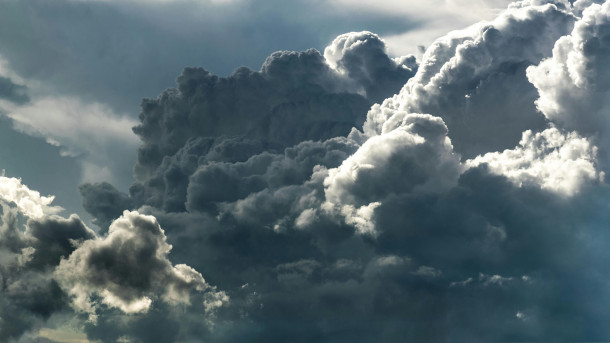
Zeus chooses Aeolus to guard and contain the winds. (Photo: Pixabay, Pexels, CC0)
[SFX harp music]
EDGECOMB: Blown on fierce winds were headed their way, causing the gray seas to grow turbulent, to grow rough, coaxing and playing them into froth. It was the hand of Zeus that sealed their fate. It was Zeus that commanded Alycone's father to let loose Boreas, the most ferocious of the storm winds that day, fast and howling as vengeance they came. When they hit the ship, it shuddered, keeling almost over, its sails dragging into the sea. Ceyx shouted, "Strip down the sails! The ship will be lost! Take them down!" Ceyx shouted, but the wind threw his words back in his face, that it was every man for himself. The torrent was so sudden, so complete with waves, so gigantic, that at first the ship would go down into a deep trough and then billow up on the next, tossed and tossed until at last, with a great groaning sound, it shuddered, cracked and began to go under, each man grasping for a bit of driftwood before they were towed under in the wake of the great vessel, Ceyx, drowning at the very last, called out, "Alcyone, I'm sorry. I'm sorry."
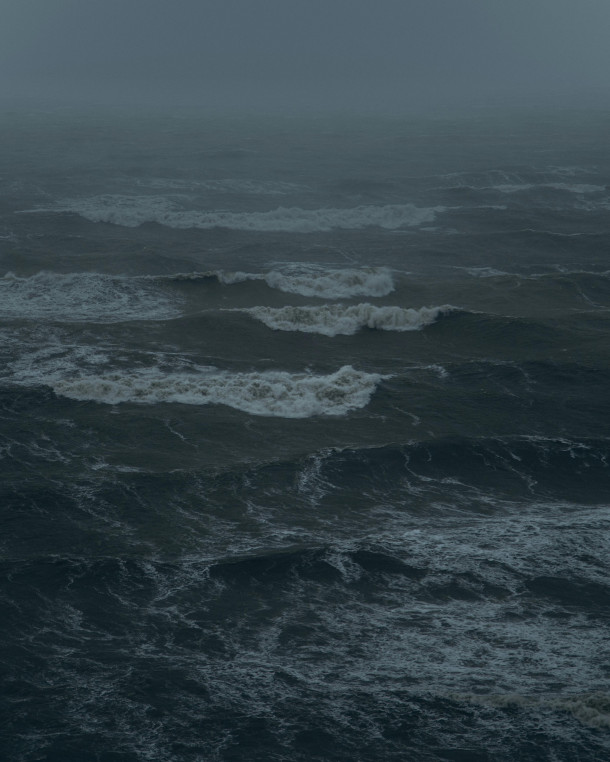
Ceyx’s ship faces a storm sent by Zeus. (Photo: Yura Forrat, Pexels, CC0)
CURWOOD: We’ll be back in a moment with more from Diane Edgecomb and the story of Ceyx and Alcyone. Keep listening to Living on Earth’s winter solstice special!
[MUSIC: Diane Edgecomb, Margot Chamberlain and Tom Megan, “Lay Down Your Burden” by C. Williams/M. Castilaw/S. Osbourne on The Winter Solstice in Story and Song]
ANNOUNCER: Support for Living on Earth comes from the estate of Rosamund Stone Zander - celebrated painter, environmentalist, and author of The Art of Possibility – who inspired others to see the profound interconnectedness of all living things, and to act with courage and creativity on behalf of our planet. Support also comes from Sailors for the Sea and Oceana. Helping boaters race clean, sail green and protect the seas they love. More information @sailorsforthesea.org.
[MUSIC: Margot Chamberlain and Tom Megan, “Waiting for Snow” by Julie King on The Winter Solstice in Story and Song]
CURWOOD: It’s Living on Earth, I’m Steve Curwood. Let's continue now with our winter solstice story from Diane Edgecomb. Ceyx and Alcyone are deeply in love, but they’ve gone a step too far. The couple has dared to compare their joy to that of the Gods. And in retaliation, Zeus has thrown Ceyx from his ship into the sea.
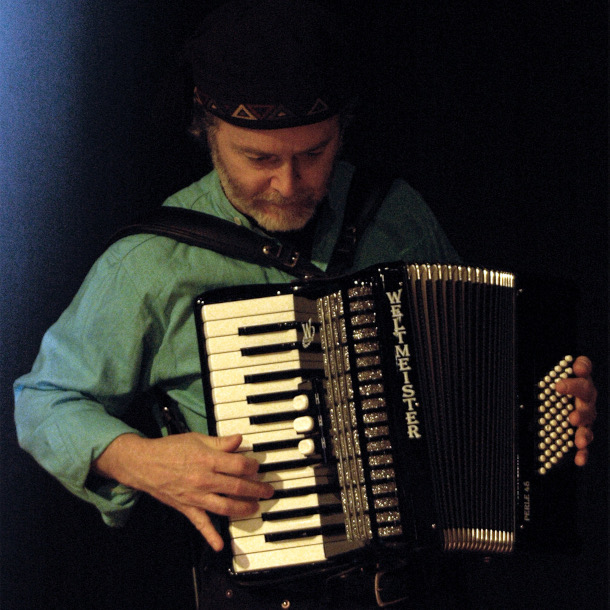
Tom Megan plays the accordion during the storm scene. (Photo: Barbara Gates)
EDGECOMB: Alcyone knew nothing, only that he had promised to return, and she must wait.
[SFX harp music]
EDGECOMB: Every morning would find her down at the shore to see if in the night his ship had arrived, her beloved had returned. She would stand as close as she could to see if she could hear some news in the lapping of the waves, in the slow shifting of the tides. Oft she felt them, the gentle winds she had known since childhood, almost those breezes, they seemed to want to lift her up and show her the course of her beloved. Every day she gave gifts and sacrifices to Hera, praying as the smoke rose, "Please Hera, as the smoke of this sacrifice rises, let Ceyx's way be safe. Let the skies be clear. As you feel the sacrifice come to you, do not forget your most devoted follower, Hera, protectress, of those who are married, send him home safe to me."
[harp music stops]
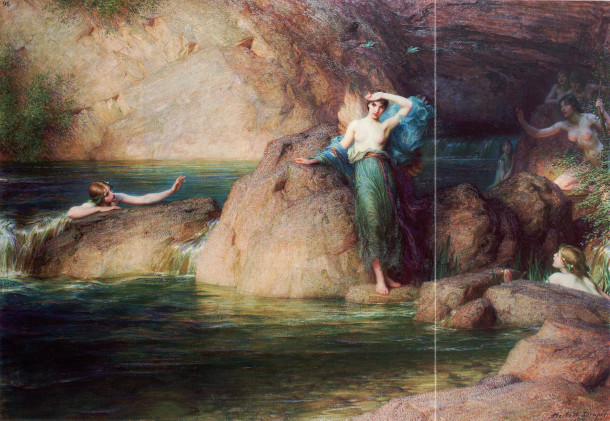
Alcyone waits for Ceyx by the shore, wearing her blue gown and with halcyon birds dancing above her head. Painting by Herbert James Draper. (Photo: Wikimedia Commons, Public Domain)
EDGECOMB: And on Olympus, Hera did not know why, but this woman's voice, it touched her in a way she had never felt before, almost, almost she felt human emotion. "Zeus, how can it be that this one who, with her pride, angered us so much, is now my most devoted follower? She should not be propitiating me. She should be performing the funeral rites for her husband, they must be performed." Hera decided to intercede, to send to Alcyone a dream, a vision.
[SFX harp music]
EDGECOMB: "Iris! Fly down your rainbow path, go to the darkened cave where Hypnos, the god of sleep slumbers. Rouse him and tell him this from me. Tell him to send to Alcyone a dream of the untimely death of her husband."
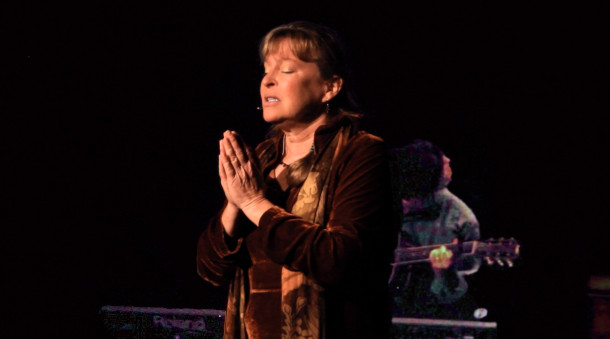
Diane Edgecomb performs the moment when Alcyone prays to Hera to send Ceyx home safely. (Photo: From video captured by Larry Buckley)
EDGECOMB: So with arms raised, Iris slid down her rainbow path, soft as the dawn. She entered that airless cave, her iridescent light illuminating the great slumbering form of Hypnos. Oh, the intoxicating bellows of his lungs, snoring in and snoring out.
[SFX snoring]
EDGECOMB: Iris almost fell under his spell, but she kept to her task, rousing Hypnos to heed Hera's request.
[SFX yawning]
EDGECOMB: "It shall be done." Hypnos turned to give delivery of that dream to Morpheus.
[harp music stops]
EDGECOMB: Morpheus who can assume the shape of any mortal, Morpheus who can imitate the gate, the manner, the voice.
[SFX harp music]
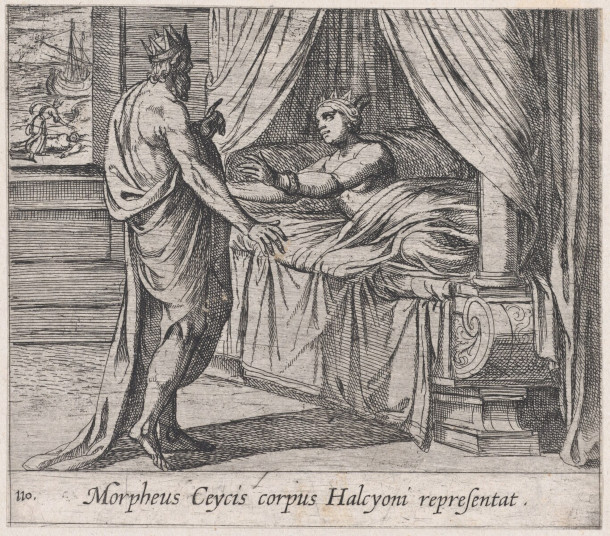
Morpheus, god of dreams, transforms into Ceyx and visits Alcyone in her sleep. (Photo: Metropolitan Museum of Art, Wikimedia Commons, CC0 1.0)
EDGECOMB: Morpheus tuned to the form of Ceyx, and stepping through dream's gate of polished horn, he was instantly by Alcyone's bed. "Alcyone, my beloved wife." "Ohh!" And in a dream, she saw her husband, the same clothes he had worn the day he left, but now they were rags, drenched and torn, and his beloved body changed from days in the water, but it was him, his voice. His every movement was his. "Alcyone, I am drowned, drowned. I beseech you, perform the funeral rites for me so that I may enter the kingdom of the dead. Do not forget me, my beloved wife, I beseech you. I am drowned." And he was gone. Her eyes searched the empty room. "Ohh!" Tears came and would not stop, and she wept into the night at her dream.
[harp music stops]
EDGECOMB: The next morning, she dressed in the soft blue gown Ceyx had given her. She would look for his ship one last time before wearing forever garments of black, for she believed this dream. She knew it was her husband come to her. She knew in her heart he was gone.
[SFX drums]
EDGECOMB: Head high, she walked out of the palace. Alone she climbed the steps to the ramparts from where she had watched his ship depart. The gentle breezes touched her hair. How could they be so sweet? How could the day be so beautiful? The day she felt her love was gone forever. Were her eyes weak from crying?
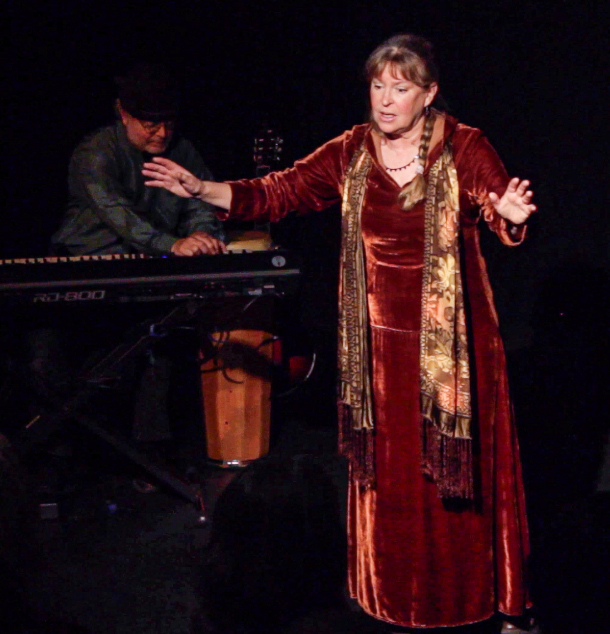
Diane Edgecomb and Tom Megan (keyboard) perform the dream scene from “Ceyx and Alcyone.” (Photo: From video captured by Larry Buckley)
[SFX harp music joins percussion music]
EDGECOMB: She thought she saw something floating in the water. The wind grew stronger, bringing that floating something closer, and then a cry escaped her. It was a person drowned wearing the same colors her husband had warned the day he left. It was Ceyx. Ceyx drowned. She stumbled forward and let out an anguished cry. On Olympus, Hera. Hera, when she heard that cry, suddenly, in that moment, Hera, the goddess, felt what humans feel when they lose their loved ones: the sorrow, the loss, the terrible emptiness. She turned to Zeus with this new emotion in her eyes, to Zeus whose anger had caused this parting, and she saw that Zeus was moved as well. [Gasp!] There it came. Another terrible cry. Alcyone had jumped or she had fallen. She was tumbling off the ramparts, falling swiftly down through the sky, as though to meet her husband in death. "Zeus!" called out Hera, "intercede!" Zeus held out his hands, and now in his hands, Alcyone fell, and within his hands, he changed her smaller and more nimble. He made her with hollow bird-like bones. He refashioned her her blue and white garments. He softened and softened into blue and white feathers and her aching heart. He quickened it until it beat and beat faster and faster until it became the trembling heart of a bird. He transformed her into the very first Halcyon bird that flew out over the waters circling Ceyx's body, her wing tips almost brushing his body, till with a bird's screaming cry, it flew out to sea. And Zeus raised his hand once more and decreed that Ceyx gain life, breathe once more, not as a mortal, but as a companion bird. He fashioned another blue and white Halcyon bird that flew out, flew over the waters to comfort its desperate mate.
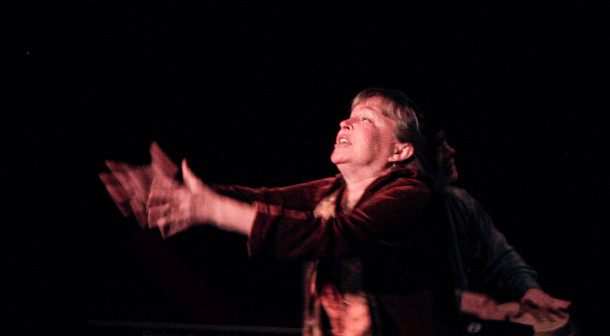
“He transformed her into the very first Halcyon bird.” Diane Edgecomb performs “Ceyx and Alcyone.” (Photo: From video captured by Larry Buckley)
[percussion music ends]
[SFX harp music continues]
EDGECOMB: Then Zeus and Hera together spread out their hands, and that sea became glassy, calm and full of peace, for their meeting, for their reuniting, the sweet, loving, Halcyon birds. We know them as Kingfisher birds, but they are the same delicate blue and white birds. In the Mediterranean, they nest during the time of the winter solstice. The Greeks call those days Halcyon Days, for at that time, the sea is calm like a mirror, reflecting the moment when there was real understanding between gods and mortals. And for a while, mercy, Sweet Mercy, reigned.
[Margot Chamberlain sings, SFX harp music]
CURWOOD: Well. Thank you so much Diane for this wonderful story.
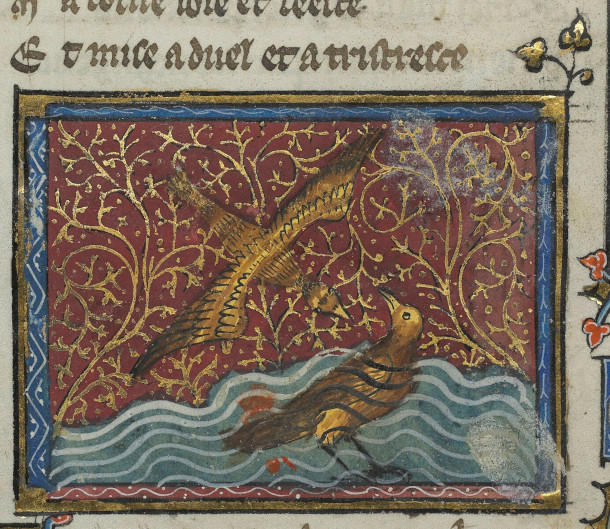
Alcyone and Ceyx reunite as Halcyon birds in the now peaceful ocean. (Photo: Chrétien Legouais, Wikimedia Commons, Public Domain)
EDGECOMB: It's my pleasure to tell. It my pleasure to be here, and I hope everyone delves more deeply into these old myths of origin, because there's a lot of treasures there that help us to feel nature in the way that we know that it is a very spiritual essence.
CURWOOD: And the days of peace sounds like something we all need right now, doesn't it Diane?
EDGECOMB: I love that the story has this message of compassion and this message of mercy. And really, I feel like the story tells us we should open ourselves up to what we hear around us, so as just as the gods did, they heard the cries of Alcyone, and I think of that when I hear the cry of a bird, how beautiful it is and how it can move you, and also the cries of our fellow people, that we should really remain open and compassionate, and we need that in these days.
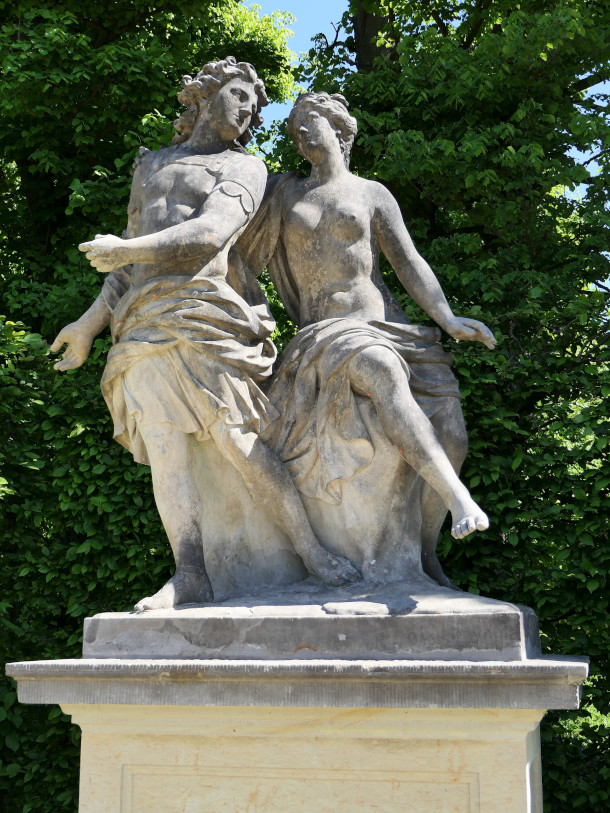
Ceyx and Alcyone are seen as symbols of eternal love and freedom. This sculpture, by artist Johann Benjamin Thomae, is on display at Grosssedlitz Baroque Garden in Germany. (Photo: Dr. Bernd Gross, Wikimedia Commons, CC BY-SA 3.0 DE)
CURWOOD: Today's program is centered around Winter Solstice stories. What do you think people miss about the meaning of this special time of year?
EDGECOMB: Well, this winter solstice really needs to be a time for gathering, and I think that what people miss is why we're doing some of the things that we're doing at this time of the year. For instance, why do we put up lights? Why do we celebrate the evergreens? And really, if we understand the story that goes along with it, that the evergreens symbolize, they really symbolize this enduring power that can go through the winter. Then when we put them up, we know more the reason behind it. There's also elements in the solstice for the mistletoe that that really was a plant that was supposed to be raised on high, to remind us to forgive past wrongs at this time of year. So gathering around a fire, being together, bringing forth our own inner lights. We put up festive lights, but our inner lights of joy and generosity, knowing that that is what we are have been doing from time immemorial. At the solstice is really helpful. We can bring our whole selves to it. Then it's not just say. Why am I doing this?
CURWOOD: There was a time in human history where we would have paid a lot more attention to the solstice. I believe you say it actually lasts for three nights?
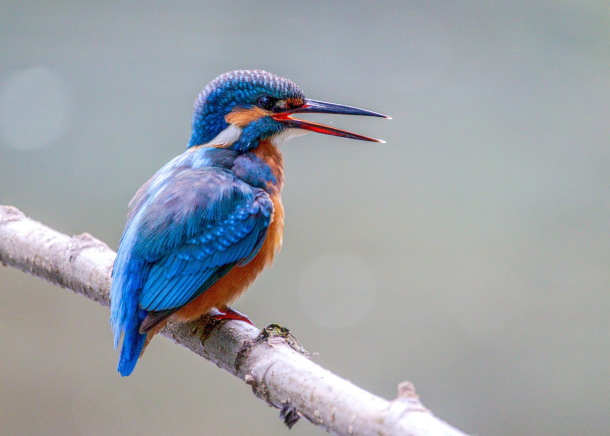
The Kingfisher bird, also called a “Halcyon” bird. (Photo: Marco Federman, Pixabay, CC0)
EDGECOMB: Yes, it was a three day, three night festival. And of course, that's because, if you think about and I really encourage people to use your own home, your own dwelling, as a Stonehenge, and see where the sun is rising every day, see where it's setting, because at the time of the solstice, it's like a pendulum has swung all the way to its furthest point. That's the sun on the horizon has swung the furthest south, and then it rises at the same place for three days and sets at the same place for three nights. And that's considered one of these doorway times in nature where things can enter, and what we want to enter is our energy. We want to give the sun energy to come back, so that the pendulum swing comes back and order is restored again.
CURWOOD: Ceyx and Alcyone is part of Diane Edgecomb CD The Winter Solstice in Story and Song, performed with musicians Margo Chamberlain and Tom Megan and recorded by Tom Eaton. Thanks so much for this story Diane.
EDGECOMB: Oh, thank you for having me. I really enjoy your program.
CURWOOD: And we’ll leave you with one more of their songs. This one’s called “The Fertile Darkness”.
Links
Learn more about Diane Edgecomb
Purchase “The Winter Solstice in Story and Song” Double CD from Diane Edgecomb’s website
Living on Earth wants to hear from you!
Living on Earth
62 Calef Highway, Suite 212
Lee, NH 03861
Telephone: 617-287-4121
E-mail: comments@loe.org
Newsletter [Click here]
Donate to Living on Earth!
Living on Earth is an independent media program and relies entirely on contributions from listeners and institutions supporting public service. Please donate now to preserve an independent environmental voice.
NewsletterLiving on Earth offers a weekly delivery of the show's rundown to your mailbox. Sign up for our newsletter today!
 Sailors For The Sea: Be the change you want to sea.
 The Grantham Foundation for the Protection of the Environment: Committed to protecting and improving the health of the global environment.
 Contribute to Living on Earth and receive, as our gift to you, an archival print of one of Mark Seth Lender's extraordinary wildlife photographs. Follow the link to see Mark's current collection of photographs.
 Buy a signed copy of Mark Seth Lender's book Smeagull the Seagull & support Living on Earth
© Copyright World Media Foundation. All Rights Reserved
Home | Contact | RSS | Donate | Newsletter