

Justice Advances in Cancer Alley
Air Date: Week of March 6, 2026
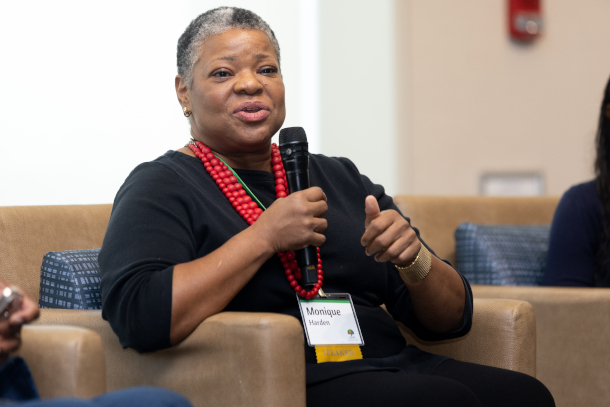
Veteran environmental justice attorney and advocate Monique Harden speaks about environmental justice and the law at the Center for Environmental Justice Media (CEJM) conference in September 2025. Harden discusses the history of the 13th and 14th Amendments as it relates to the Cancer Alley land use lawsuit brought by residents of St. James Parish. (Photo: CEJM)
Descendants of enslaved people fighting pollution in Louisiana’s ‘Cancer Alley’ have been greenlit for a trial. Their lawsuit alleges the St. James Parish government discriminated against Black residents by repeatedly permitting industrial plants in predominantly Black districts while shielding mostly white districts from industry. Monique Harden, a longtime environmental justice attorney and advocate, joins Host Jenni Doering to explain how the 13th amendment outlawing slavery plays into the case.
Transcript
CURWOOD: From PRX and the Jennifer and Ted Stanley Studios at the University of Massachusetts Boston, this is Living on Earth. I’m Steve Curwood.
DOERING: And I’m Jenni Doering.
As the Mississippi River winds its way from Baton Rouge, Louisiana down to New Orleans, it’s flanked by hundreds of industrial plants that refine and transform oil and gas into chemicals and plastics.
CURWOOD: Because of the toxic air that is also released by these plants, this area is commonly called Cancer Alley, and the Black residents of the region have borne most of the burdens of living amid this pollution. Many of them are descended from the enslaved people who labored on sugarcane plantations along the river, back when owning and brutalizing another human being was legal.
DOERING: But while the horrors of slavery may be mostly behind us, its ugly legacy lives on to this day with former plantation land zoned in ways that unfairly subject Black people to toxic air. That’s according to a lawsuit brought by residents against the St. James Parish government over its repeated decisions to greenlight industrial plants in predominantly Black districts.
CURWOOD: The plaintiffs invoke the 13th amendment of the United States Constitution, which outlawed slavery and led to laws to prevent Black Americans from being clawed back into enslavement. The 14th amendment which is also mentioned in the lawsuit, guarantees equal protection under the law and was also intended to protect all people including African Americans from discrimination.
DOERING: In a potent 34-page ruling, federal district judge Carl D. Barbier found that the plaintiffs presented enough evidence to move the case forward to a trial, marking an important step in the long arc towards justice for the Black residents of Cancer Alley. Here to discuss is Monique Harden, a longtime environmental justice advocate and attorney. Welcome back to Living on Earth, Monique!
HARDEN: Thank you. Glad to be back.
DOERING: And I hope you had a wonderful Mardi Gras.
HARDEN: We had a pretty rambunctious Mardi Gras here in New Orleans, but I'm glad to have survived it and to be on your show.
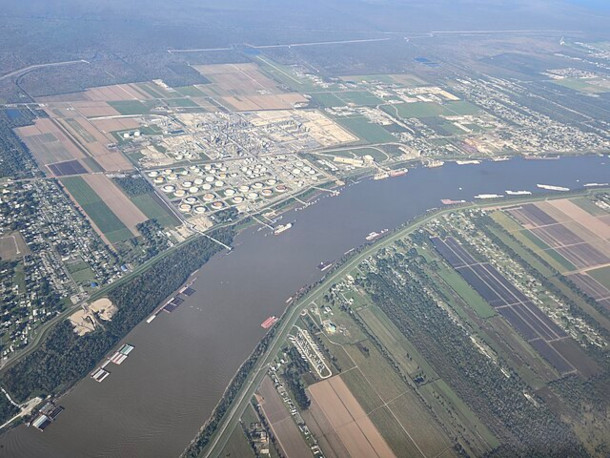
St. James Parish East and West Bank with Mississippi River. Black residents of St. James Parish, Louisiana, are suing their local government accusing it of a history of discriminatory land use practices in the siting of industrial facilities in majority Black districts. (Photo: Spatms, Wikimedia Commons, CC BY-SA 4.0)
DOERING: I'm glad you survived as well. We're here to talk to you about this lawsuit that concerns Cancer Alley and whether plaintiffs have been discriminated against in terms of land use. The judge denied the defendant's attempt to dismiss this lawsuit. What does this ruling really mean?
HARDEN: It means that the demand for equal protection under the law, the demand for racial equality and justice, and environmental justice in particular, now have a day in court. The residents in St. James Parish, Louisiana, organized as Rise St. James and Inclusive Louisiana, are the main plaintiffs who brought a challenge to the way that their local government in St. James Parish, Louisiana, has been deciding zoning and land use matters in a way that targets black communities for large, heavy, toxic, polluting industries.
DOERING: Monique, this case does touch on some fundamental issues of race and civil rights, and that's something that shows up a lot in the judge's 34-page ruling about the next steps here. So for instance, the plaintiffs claim that their 13th Amendment rights were violated. Passed in 1865 the 13th Amendment outlawed slavery, and the plaintiffs allege that the current land use plan operates as quote, “a badge and incident of slavery.” Can you explain for us what that means and how this relates to how the history of slavery colors this dispute?
HARDEN: Judge Karl Barbier, the Federal Court judge presiding over this case, really goes at length in discussing the constitutional claims brought by the community groups in St. James Parish. The violation of their rights under the US Constitution's 13th Amendment is an important one. Well, first of all, the 13th Amendment abolishes slavery and the in servitude, except for incarceration for a person convicted of a crime. That amendment has a second part to it that says Congress is to enact laws to enforce this abolition on slavery. The badges and incidents of slavery are those restrictions that a state government would impose on a population that results in Black residents being subjected to inferior treatment or being marked as subordinate to White citizens or White residents of that state or local government. Here, the claim is that the St. James Parish government through its decisions of land use that targets majority Black districts for toxic heavy industrial facilities, while protecting, actually, not just ignoring, but actually protecting majority White districts from that type of industrial development is in effect, continuing on a badge or incident of slavery within the parish government, and that is in violation of the US Constitution.
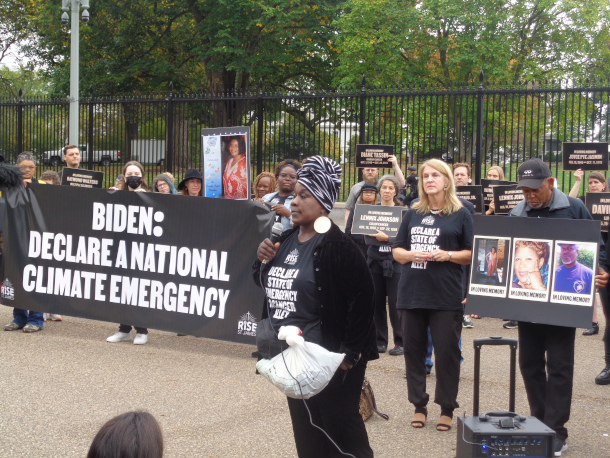
Members of RISE St. James march in Washington, D.C. in October 2022. The group is one of several plaintiffs suing St. James Parish in Louisiana alleging discrimination in its land use policies. (Photo: Frypie, Wikimedia Commons, CC BY-SA 4.0)
DOERING: What do you make of the fact that this judge, Carl D. Barbier, he seems to be open to this argument that this is a really long-standing history of practices. It's not just this one 2014 land use plan document, but this has been a historic pattern that's been established in this parish. What do you make of the fact that he is pretty open to that in this ruling?
HARDEN: The ruling is all about those decisions and the plaintiffs in this case, the Black communities and their attorneys represented by Center for Constitutional Rights and Tulane University Law School's Environmental Law Clinic have done the yeoman's work in providing the court with nearly 200 pages of decisions by the parish government that have led to where we are right now, with all of the toxic industries in that parish being in two adjacent Black communities, nowhere else in the parish, and so the facts of the pattern of time and time again, this consistent targeting. When requests are made by the community for a moratorium on industrial facilities, the parish government denies it. When a solar farm is proposed in a majority-White community and residents don't like it, the parish government accepts and denies that solar farm to protect the interest of majority-White residents elsewhere in the parish. And so the plaintiffs, they live in the community, they know their history, they know what happened in their lifetime, and the history of industrial development in their parish. So bringing all of that together in these court documents. It was just overwhelming. And you would think that of all the parties involved in this lawsuit, the one that would have the best access to this information is the defendant, right? It's the parish government. And they're saying, no, let's just talk about this one plan we did in 2014 and nothing else. And the planners were like, well, we're going to talk about that plan, of course, and we're going to talk about everything else that has been done in the name of St. James Parish government, because it all violates our rights under the US Constitution.
DOERING: And Monique, can you please explain this moratorium on industrial development that was requested by people in St. James Parish?
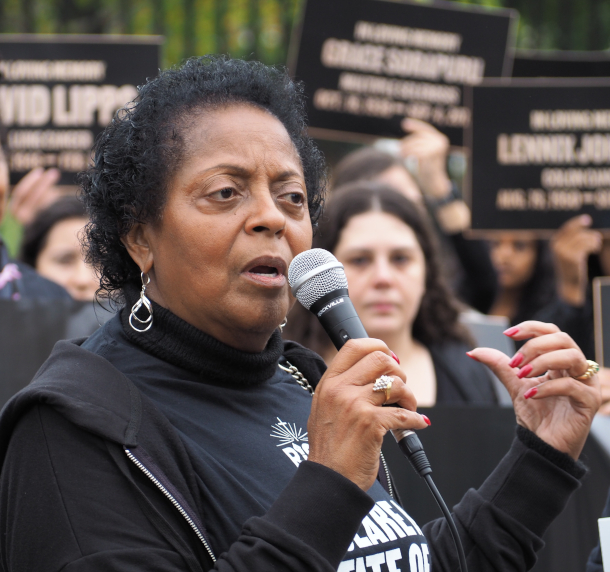
2021 Goldman Prize Winner Sharon Lavigne, founder of RISE St. James speaks during a rally in Washington, D.C. in 2022. Lavigne’s group is one of several suing St. James Parish over discriminatory land use practices. In February, a federal judge cleared the way for the lawsuit to proceed to trial. (Photo: Frypie, Wikimedia Commons, CC BY-SA 4.0)
HARDEN: Yes, Black residents organized as Rise St James developed advocacy campaign for a moratorium on toxic industrial facilities in the parish. Why? Because they lived with them, and many of their members, family, relatives died and are dying from it, the pollution that is spewed from these toxic facilities. And so they brought that demand for a moratorium on industrial development to their parish government, and they were rejected, just out of hand, just rejected, notwithstanding the pain, the harm and the hazards that they were seeking to prevent. And this moratorium idea is a very important one in terms of where this lawsuit goes, because it would mean that St. James Parish government would have to rethink its earlier rejection of the moratorium, and it also means that toxic industrial facilities really have no place near any residential area, regardless of the color of residents, regardless of the race. You know what has transpired over time is that it's Black communities, Latino, Asian, Pacific Islander, Indigenous communities that bear the brunt of the environmental burden of toxic industrial development in this country. And this moratorium that sought in St. James Parish is one that has definite national overtones to it, and that's now further reinforced in terms of connecting those local decisions on land use and siting to the US Constitution now.
DOERING: Monique, what's been the real impact to the communities there in the St. James Parish, especially the majority of Black districts. I mean, we're talking about land use, but we're also talking about actual impacts to the health and well-being of residents living there. So how do the plaintiffs say they've been affected by this?
HARDEN: You're absolutely right. This is not a land use decision without impact. This is about saving their lives. I can just tell you, as a resident of Louisiana and an environmental justice advocate. Every meeting in St. James Parish comes with notice of a death from cancer. So this is serious. This is a community fighting for its survival. The decisions come out of land use governance and policy and plans, but those decisions have been weaponized in such a way that people are not able to live and survive the onslaught of toxic chemicals in the air they breathe.
DOERING: Monique, the legal question at the heart of this case is a question of land use, how local regulations can really harm communities of color if residents are not vigilant, what's a solution here?
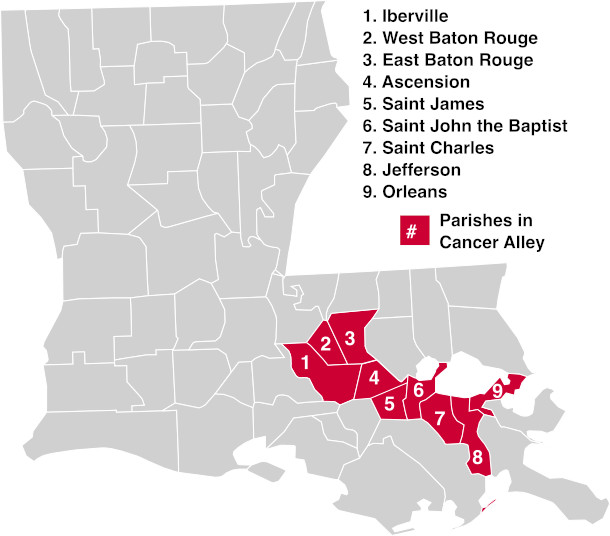
Shown here is a graphic depicting the 9 parishes of Louisiana’s Cancer Alley. (Graphic: WWWHHHHYYYYYY, Wikimedia Commons, Public Domain)
HARDEN: Step one is fighting for your rights under the law. And that's exactly what's happening here. And it's taken what might look like a mundane, routine land use decision, like all other land use decisions that have come before it, and continuing, and compared it against the ruler of constitutional right, and found it wanting right because it's those decisions that are violating basic constitutional rights. That's the first thing. The second is that the siting of industrial facilities is really outside of a permitting decision by the EPA or state environmental agency. It really rests with the local government. It might be a county government or municipal government, but it's the decisions around how an area of land will be zoned. Will it be zoned for commercial use? Will it be zoned for residential use or heavy industrial use where those parcels of land are located, and what can then take place on them can be, and has shown to be here in Louisiana, and looking at our Cancer Alley, in particular, a life and death decision.
DOERING: Monique, how encouraged are the Black residents of St. James Parish by the latest ruling?
HARDEN: Well, I can tell you, as an ally, that they are thrilled. They are thrilled with the results, and because it vindicates what they have been saying all along, that they want to be able to hold their parish government to account for citing toxic heavy polluting industries next to their homes, churches, and on in the areas that their ancestors were buried.
DOERING: Monique Harden is a longtime environmental justice advocate and attorney. Thank you so much, Monique.
HARDEN: Thank you.
Links
NOLA.com | “Court Rules Louisiana Parish Held Illegal Secret Meetings on Proposed Chemical Plant”
Capital B News | “Black Residents Win Key Ruling in ‘Cancer Alley’ Environmental Racism Case”
Read the ruling document here:
Living on Earth wants to hear from you!
Living on Earth
62 Calef Highway, Suite 212
Lee, NH 03861
Telephone: 617-287-4121
E-mail: comments@loe.org
Newsletter [Click here]
Donate to Living on Earth!
Living on Earth is an independent media program and relies entirely on contributions from listeners and institutions supporting public service. Please donate now to preserve an independent environmental voice.
NewsletterLiving on Earth offers a weekly delivery of the show's rundown to your mailbox. Sign up for our newsletter today!
 Sailors For The Sea: Be the change you want to sea.
 The Grantham Foundation for the Protection of the Environment: Committed to protecting and improving the health of the global environment.
 Contribute to Living on Earth and receive, as our gift to you, an archival print of one of Mark Seth Lender's extraordinary wildlife photographs. Follow the link to see Mark's current collection of photographs.
 Buy a signed copy of Mark Seth Lender's book Smeagull the Seagull & support Living on Earth
© Copyright World Media Foundation. All Rights Reserved
Home | Contact | RSS | Donate | Newsletter