

Back to the Moon!
Air Date: Week of March 13, 2026
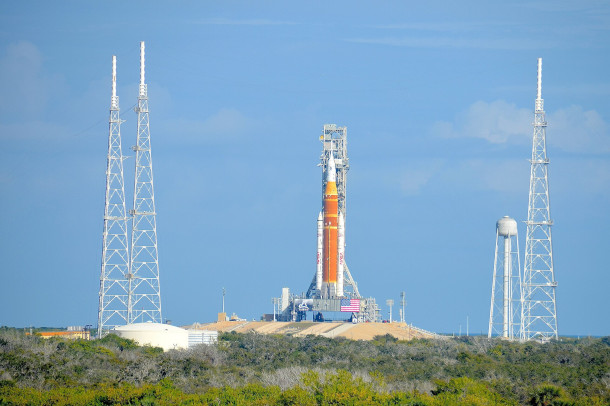
The Artemis space program seeks to return humans to the moon by 2028. The Artemis II mission, currently set to launch in April 2026, will fly a crew of four astronauts around the moon for 10 days. (Photo: Olga Ernst, Wikimedia Commons, CC BY-SA 4.0)
The Artemis II mission is getting ready to use the most powerful rocket ever built by NASA to return to the moon for the first time since the original Apollo missions more than 50 years ago. Erik Conway, a historian of science and technology at Purdue University and former NASA historian, tells Host Aynsley O’Neill about how declining public support shut down the Apollo program and why NASA again faces headwinds in maintaining the public’s interest in space exploration.
Transcript
CURWOOD: The United States’ Artemis Two mission is getting ready to use the most powerful rocket ever built by NASA to return to the moon for the first time since the original Apollo missions more than 50 years ago. That program led to the first human footprints on the moon but before the men of Apollo 11 took those historic steps in July of 1969, the crew of the Apollo 8 mission became the first humans to ever orbit the moon and take that iconic picture of the Earth rising over the lunar surface.
O’NEILL: Like Apollo 8, the Artemis Two mission only plans to orbit the moon in advance of an actual landing planned for 2028. But experiments, measurements, and observations made during its ten days in lunar orbit are expected to yield scientific insights not only about the Moon itself, but also about conditions for future interplanetary voyages.
CURWOOD: The four-person crew features the first woman, African-American and Canadian astronaut planned for a lunar mission, all standing by for a launch now scheduled in April of 2026. But the launch date has already been pushed back more than once because of the technical challenges of this extreme pioneering effort.
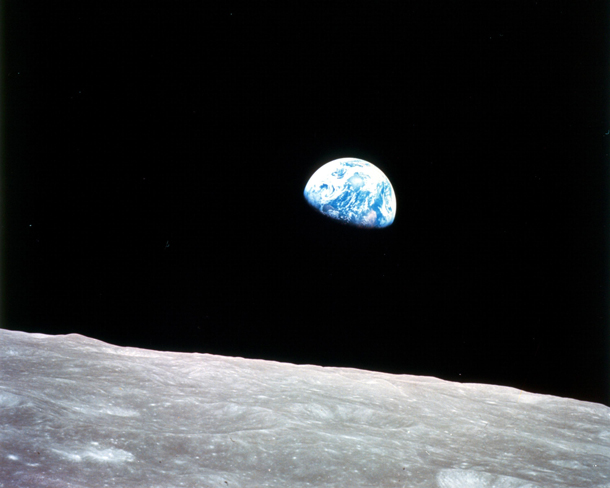
Earthrise is the image of planet Earth taken from the Apollo 8 spacecraft during the first manned orbits of the moon, led by NASA in 1968. (Photo: NASA, www.earthday.org, Public Domain)
O’NEILL: As we wait for the Artemis Two blast off, we thought we would call up Erik Conway, a historian of science and technology at Purdue University. He’s a former historian at NASA's Jet Propulsion Laboratory. Erik, welcome to Living on Earth!
CONWAY: Thanks for having me. Glad to be here.
O'NEILL: Let's start with just the basics. What would you say is the purpose and the goals of the Artemis space program?
CONWAY: So the goals of the Artemis program was to return humans to the moon for the first time since the early 1970s, with a slightly larger crew complement. It dates actually really back to the Obama administration and Congress essentially required the development of the Space Launch System as we know it. And in the Obama administration, the intent was to go to an asteroid. When Donald Trump became president, it got redirected back to a lunar program.
O'NEILL: And now, obviously there's the parallel name between the Artemis mission and the Apollo program. What would you say are some of the key differences, other than just the time period in which they happen?
CONWAY: A big difference is the Artemis program is being pursued under the idea that it will be a more sustainable approach to lunar operations. The orientation is different. For example, the lunar module for Apollo was entirely disposable, which the new landing system is not intended to be.
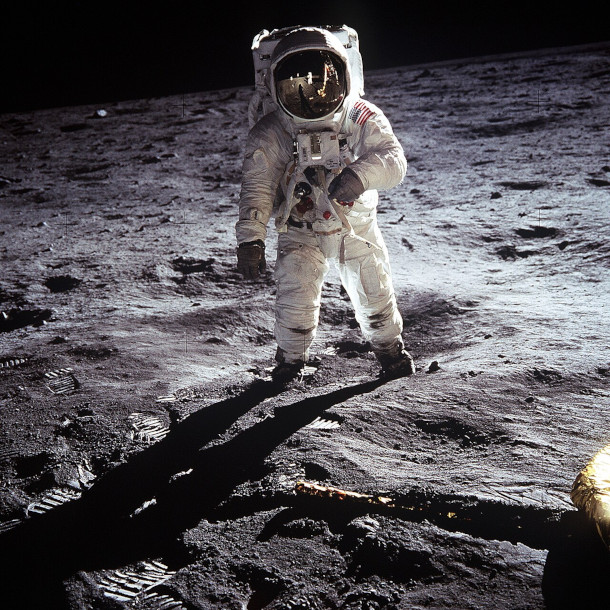
Apollo 11 was the first mission to land humans on the moon, including astronaut Buzz Aldrin (pictured above) in 1969. NASA now plans to put humans back on the Moon again in 2028. Throughout the 1970s, Congress defunded NASA as it grappled with an expanding budget deficit and rising costs of geopolitical conflicts. (Photo: Neil A. Armstrong, Wikimedia Commons, CC0)
O'NEILL: Well, our last lunar human space flight mission was Apollo 17 in 1972, I believe. Now, how did the political climate of the time affect the success of that mission, but also lead to a halt in our trips to the moon?
CONWAY: So the political climate in the 1970s was one of really shrinking budgets for NASA. And the competition was costs of other geopolitics. The Vietnam war is still going on then, there's still the ongoing civil rights turmoil in the 70s. The Apollo program wasn't particularly popular with the public. A large fraction, more than 50%, thought we shouldn't be spending money on such things, such luxuries. So faced with expanding budget deficits, costs of wars, and protests and other kinds of demands, the Apollo program got defunded.
O'NEILL: Well, so, Erik, I'm sure you've come across this exact sentiment before, of people saying, "Oh, why are we even spending all this money? Shouldn't we be focusing on the problems we have here at home?" What do you say when somebody says something like that?
CONWAY: So I say two things, really, in response to that. And that is, you know, it's our elected representatives' job to decide what to spend our money on. And if you're concerned that it's being misspent, you should become more politically active, and therefore ensure that more of the money goes to your priorities over somebody else's. And second, NASA doesn't really compete with, for example, social programs. The way Congress actually funds things is there's 13 different subcommittees that fund various stuff, and NASA nowadays is actually in the science and commerce budget. NASA competes with other science agencies, not with, for example, it used to be in the committee that handled veterans' affairs, and so it was competing with veterans for money. And that's been different, gosh, about 20 years now, that it's in the science budgets. And so less money for science is less money for innovation, and that only gradually impoverishes the United States, instead of the opposite.
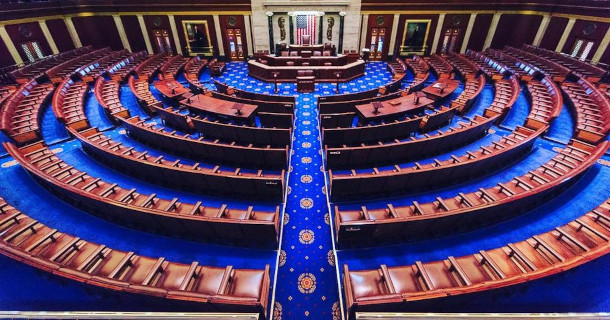
Despite the Trump administration’s attempts to slash NASA’s financial year 2026 budget, Congress ultimately voted to allot NASA its full funding. (Photo: United States House of Representatives, Wikimedia Commons, CC0)
O'NEILL: Well, I mean, you'll pardon the pun, but it takes an astronomical amount of money to actually launch any sort of space mission, especially going to the moon and, you know, launching humans into space. And in 2025, the Trump administration had threatened to slash NASA's budget by 24% in their budget request for 2026, although in January of 2026 Congress voted to allot NASA its full budget. So what have you seen as the, sort of, results of this back-and-forth regarding the budget? What is most at threat when something hangs in the balance like this?
CONWAY: What the administration had tried to do was to really slash the NASA science budget. Really, there's two big pots of money in NASA. There's the human spaceflight program, and then there's the science program that's overwhelmingly robotic. And it's the robotic program that the administration was trying to cut, right? Congress still supports the human spaceflight program and NASA generally. My concern, though, is that the budget deficits are enormous and growing, and will eventually make it an unsustainable program.
O'NEILL: And now, as I understand it, in January, NASA also announced that it is ending funding to a number of independent advisory groups. So what does that mean? What is the purpose of these advisory groups, and how is this likely to impact research, or missions, or robotics, or any of that?
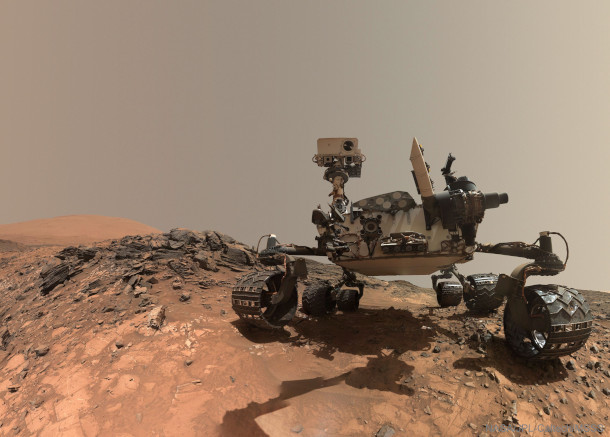
The Trump administration’s proposed budget cuts would have had the greatest impact on NASA’s robotics programs. Robotic systems often explore planets and other objects in the solar system as a precursor to crewed missions like Artemis II. (Photo: NASA's Marshall Space Flight Center, Flickr, CC BY-NC 2.0)
CONWAY: So the ending of support for the advisory groups was clearly a step towards gaining more internal control over its programs on NASA's part. And to me, it's very short-term thinking, because the reason those groups exist is NASA quickly discovered that Congress wants to hear support from the external scientific community. And those advisory groups ensure that, you know, each of the disciplines in NASA—astronomy, planetary science, and earth science—all go to Congress with a common voice. Without those groups, what I suspect will happen is what was happening back in the 70s, before these groups got really going, individual scientists would go to Capitol Hill and pitch individual programs, and NASA will find itself with less support than it had in the past. So that's the real danger. You lose the community buy-in and the ability to speak clearly to Congress.
O'NEILL: Now we've been talking about the US program to, you know, send people back to the moon. What about other countries, other space programs? Where are they in terms of looking to send their own missions to the moon?
CONWAY: So the only other country that's proposing to send astronauts to the moon is China. And they have been, I want to say, a really formidable presence, relatively recently, but very successfully. And so amongst the folks who really want us to believe that there's a new moon race, they're the ones that are being raced. I'll say outright that I'm not a big fan of that framing. In my opinion, if you really want a sustainable future in space, you need cooperation more than you need competition. Right now, US law doesn't permit that. There was a rider put in a budget, gosh, many years ago, by a representative by the name of Frank Wolf, that bars bilateral cooperation between the US and China basically in anything. You cannot write a paper with a Chinese scholar unless there's at least a third country party to it. So, international, okay. But bilateral, not okay. And I think ultimately that's a mistake. We might very well have some common interests, and maybe we should explore them.

Erik Conway is a historian of science and technology at Purdue University in Indiana, and a former historian at NASA's Jet Propulsion Laboratory. (Photo: Courtesy of Erik Conway)
O'NEILL: And to what extent do you feel like there might be any sort of public buy-in or attachment to the space program, knowing that the average American can say, "Well, that comes from my tax dollars?"
CONWAY: Because there's public dollars being used here, the intention, I think, is that the public has some level of ownership. A lot of the public is not that interested, frankly. And so NASA had, past tense, a pretty extensive outreach operation to push the news it wanted out into the public. One of the things this administration did, though, was slash that. Don't know why. If you want more public support for a program, you have to create it. So NASA has been further crippled, I think, in its ability to gain attention for its programs. The fundamental problem I think NASA has at reaching the public these days is the lack of media. The collapse of newspapers also meant the collapse of science reporters. Newspapers used to have whole science sections, and now they just don't. And I don't know the solution. To me, it seems like a real problem for sustaining interest.
O'NEILL: Erik Conway is a historian of science and technology at Purdue University in Indiana. Erik, thank you so much for taking the time with me today.
CONWAY: Thanks for having me. It's been fun.
Links
Learn more about the Artemis II space mission here
National Aeronautics and Space Administration | “Our Artemis Crew”
Science | “NASA Ends Support for Planetary Science Advisory Groups”
Living on Earth wants to hear from you!
Living on Earth
62 Calef Highway, Suite 212
Lee, NH 03861
Telephone: 617-287-4121
E-mail: comments@loe.org
Newsletter [Click here]
Donate to Living on Earth!
Living on Earth is an independent media program and relies entirely on contributions from listeners and institutions supporting public service. Please donate now to preserve an independent environmental voice.
NewsletterLiving on Earth offers a weekly delivery of the show's rundown to your mailbox. Sign up for our newsletter today!
 Sailors For The Sea: Be the change you want to sea.
 The Grantham Foundation for the Protection of the Environment: Committed to protecting and improving the health of the global environment.
 Contribute to Living on Earth and receive, as our gift to you, an archival print of one of Mark Seth Lender's extraordinary wildlife photographs. Follow the link to see Mark's current collection of photographs.
 Buy a signed copy of Mark Seth Lender's book Smeagull the Seagull & support Living on Earth
© Copyright World Media Foundation. All Rights Reserved
Home | Contact | RSS | Donate | Newsletter