

Major National Climate Victory in S. Korea
Air Date: Week of May 8, 2026
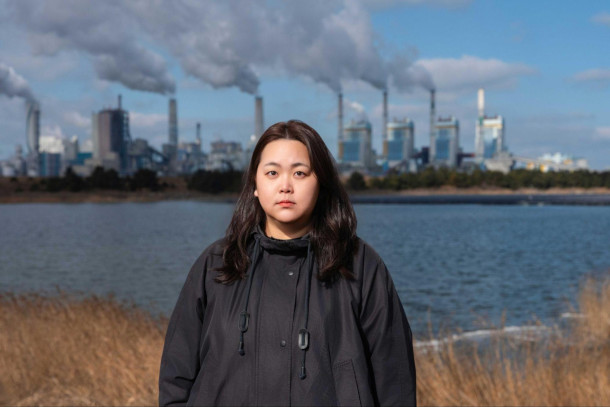
Borim Kim is the founder of Youth 4 Climate Action and winner of the 2026 Goldman Environmental Prize for Asia. Here she stands in front of the Taean Coal Power Plant, one of the largest coal power plants in the world. (Photo: Goldman Environmental Prize)
The recipient of the 2026 Goldman Environmental Prize for Asia is South Korean activist Borim Kim. She and her organization, Youth 4 Climate Action, sued the South Korean government on the grounds that it was putting future generations at risk. And in August of 2024, they won at the South Korean Constitutional Court, making this case the first successful youth-driven climate litigation in Asia. Borim Kim joins Host Aynsley O’Neill to discuss this historic decision.
Transcript
O’NEILL: We continue our coverage of the 2026 Goldman Environmental Prize Winners in Asia this week. Activist Borim Kim and her organization, Youth 4 Climate Action, sued the South Korean government on the grounds that its inadequate climate policies were putting the rights of future generations at risk. And in August of 2024, they won a historic decision at the South Korean Constitutional Court, making this case the first successful youth-driven climate litigation in Asia. Borim Kim joins us now. Welcome to Living on Earth, Borim, and congratulations on this Goldman Environmental Prize!
KIM: Annyeonghaseyo.
O'NEILL: So Borim, you grew up in Seoul, which is the capital of South Korea and one of the most densely populated cities in the world. Tell us how this shaped your understanding of environmental issues.
KIM (TRANSLATED): So yes, I was born and raised in Seoul, which is a very densely populated city, and I think I grew up thinking that I need to do something to protect the Earth or protect the environment on an individual level, rather than thinking of climate as a crisis. So I was practicing things like a vegetarian diet or trying to reduce waste. However, that all changed in 2018 when there was a terrible heat wave that came about in Korea. And at that time, I was living in a very old house, and I felt that the heat wave was a great threat to my existence. And the government was just telling the people to stay inside for their safety, however, I felt that that was not safe for us. So I started then to think of the climate crisis as a more existential threat than something that I could just respond to on my own, on an individual level. I saw that it was directly related to our human rights and recognize the government's responsibility in having to protect its own citizens.
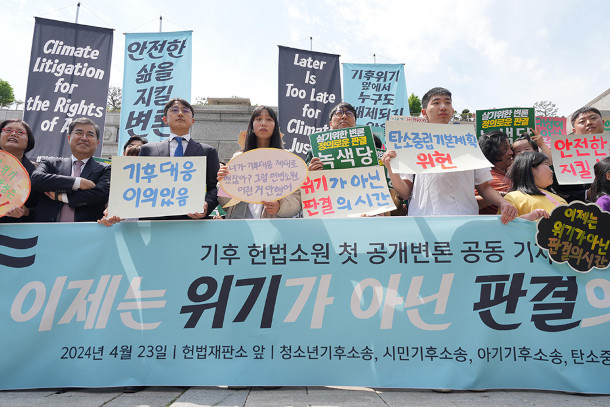
Borim believes that youth are essential in the fight against climate change partly because they will suffer the most from its impacts. Above, a Y4CA-led rally in support of increased climate litigation. (Photo: Youngmin Kim for the Goldman Environmental Prize)
O'NEILL: Well so you founded this group, Youth 4 Climate Action, which organizes and engages young people in the fight for climate solutions. When you organized this lawsuit against the South Korean government, what inspired that decision?
KIM (TRANSLATED): I think after that extreme heat wave in 2018, more and more people started to realize that the climate crisis is an actual threat to our lives. And at the same time, there were more scientific reports that came out speaking to the seriousness of the climate crisis. So more and more people understood the gravity of the situation. And when I was campaigning with my group to ask for change from policymakers, it was a very difficult process, and we tried to emphasize that the climate crisis is directly related to our own lives and our existence, and demanded change as first parties living with this crisis. And we recognize that the youth's voice is a fundamental voice, not only because they will have to live in the future and they will feel more of the effects of the climate crisis, but because also we can show them the long term accumulation of dangers that we have to be faced with. So we organized a super strike in Korea in line with the global climate strike. However, the actual change that came about from these actions were very minimal. Politicians would say, oh, we're doing this for the children, and want to take pictures with us, but it was just a photo op. So we realized that pleading to policymakers to protect our own lives was not enough, and in looking for alternative ways, we thought of this idea of a climate litigation being brought to the Constitutional Court.
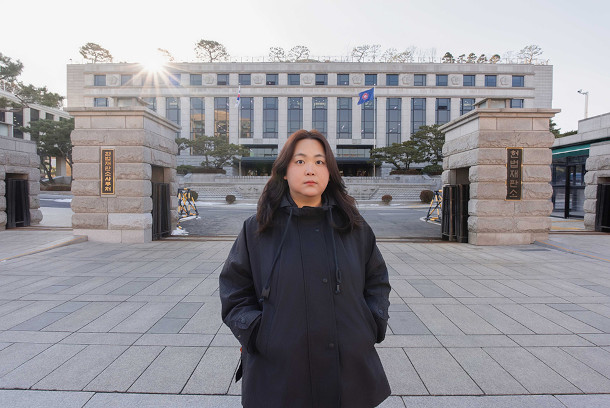
Borim’s team brought their case to the Korean Constitutional Court, pictured above, when it became clear that their organized strikes were not resulting in any action. (Photo: Goldman Environmental Prize)
O'NEILL: And in 2024, the courts ruled with you. They agreed that the climate policy from the government was unconstitutional. Can you take us back to that day and how you felt when the decision was made?
KIM (TRANSLATED): Awaiting the decision from the constitutional court comes with no definite deadline. We were just waiting and waiting. So when the day came and we were told that there would be a decision made on that day, I was very, very nervous, but it wasn't a total win, because on some of the claims that we brought forth, it was decided that it was not unconstitutional. For example, the decision said that the existing policy for climate crisis might be insufficient, but it is still in place, so that, in itself, is not unconstitutional. However, the part that we rejoiced was that there is no pathway to reduce emissions on the long term, between 2031 and 2049. And that is a failure to protect the environmental rights of its citizens. And that was the part that was deemed unconstitutional. So I had a lot of mixed feelings. It was not pure joy. And I was inside the courtroom with my colleagues, and I can't describe the exact emotion that I felt in that moment, but we were all crying. We saw that the Korean government recognizes that anybody should be able to be protected in the face of the climate crisis, and the decision was a checkpoint that confirmed the Korean government's responsibility to protect its citizens. So when I heard that ruling and thought about the meaning of it more, I realized that the fight or the response against the climate crisis will not go backward from this moment on, at least.
O'NEILL: And so we are about two years out now from that ruling. So what do you think about South Korea's climate actions since then? What kind of changes have been made, but what else is there still left to do, as well?
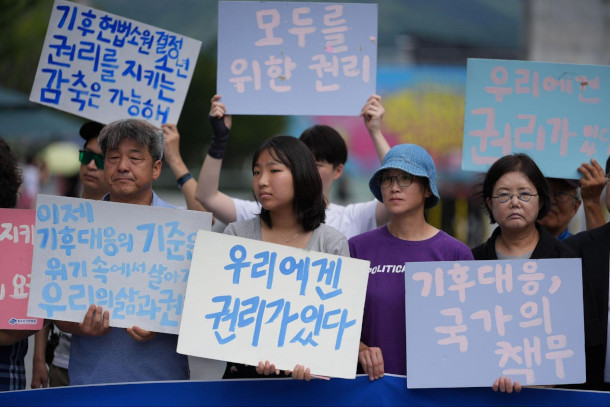
Though Y4CA won their case in 2024, the fight to implement these policies in South Korea is far from over. Above, protestors gathered on the first anniversary of the climate ruling. The signs roughly translate to phrases like “We have rights”, “Rights for all”, and “Climate change is the country’s responsibility”. (Photo: Youngmin Kim for the Goldman Environmental Prize)
KIM (TRANSLATED): Since the decision, the National Assembly was tasked to prepare a path forward for 2031 to 2049 to reduce emissions, recognizing that the response to climate crisis is a basic right for the people. And actually, the National Assembly was tasked to come up with improved legislation reflecting that decision by February 28 in 2026. However, the deadline came and passed, and the legislation did not come about, so we have had to continue to demand a more aggressive action from policymakers. However, what is hopeful to me is in that process, the National Assembly has opened up the discussion as a public deliberation, and in that forum, civil society got to deliberate how much emissions to reduce and by when, are we going to take a more short term aggressive action right now, or are we going to make it a long term plan and let future generations also deal with the responsibility. The result of the public deliberations came about on April 13, and civil society decided that it is our responsibility to take more aggressive actions right now on the historical emissions that South Korea has contributed. So based on that result, the National Assembly, I believe, is in preparation processes to reflect that into legislation.
O'NEILL: And from your perspective, what is the role of your country of South Korea in addressing climate change on a global level?
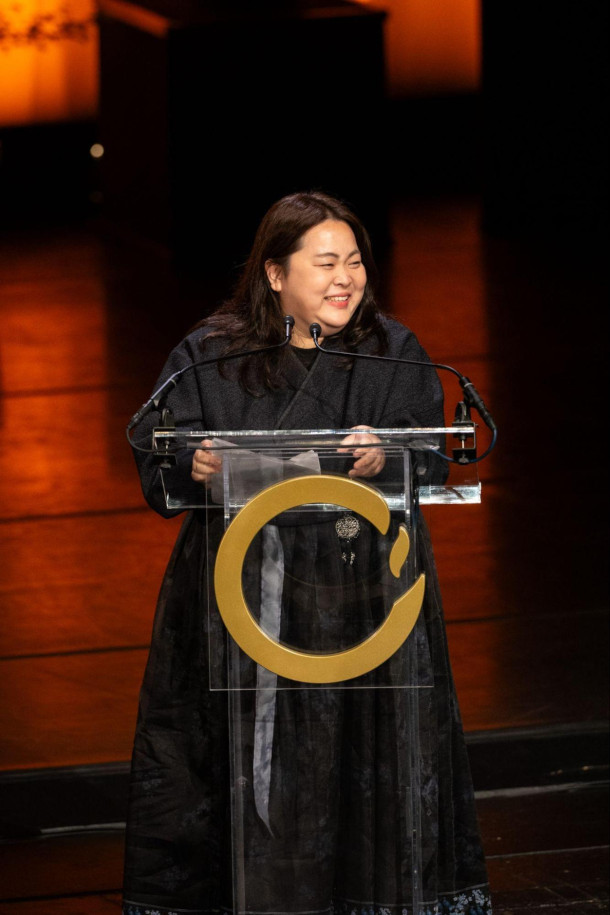
Borim Kim at the Goldman Environmental Prize award ceremony. (Photo: Goldman Environmental Prize)
KIM (TRANSLATED): So within South Korea, I believe that the government has the responsibility to protect the basic rights of its people, but globally, I think it can contribute in several different ways. Korea actually experienced very fast growth based on fossil fuels and greenhouse gas emissions. So it does have to take responsibility on the past emissions. Not only that, it also exports coal power plants to countries in Southeast Asia, but when the country or the government decides to do these things, it has to recognize that it impacts the lives of those who are most vulnerable to the climate crisis. And I think from the constitutional court case, this was the first of its kind in Asia. So I believe that any kind of climate action that comes out after this will be a more progressive one, more aggressive one, and I know that Korea's decisions on the climate crisis will not go backwards from here. That is also my hope. And I know that there are other litigations in other countries in Asia, and I hope to network with them and be in solidarity with them, so that the decisions that come forward are even better ones that the ones that came out from Korea.
O'NEILL: Borim Kim is the winner of the 2026 Goldman prize for Asia. Borim, thank you so much for taking the time with me today, gamsahamnida.
KIM: Gamsahamnida.
Links
Borim Kim’s profile at The Goldman Environmental Prize
Living on Earth wants to hear from you!
Living on Earth
62 Calef Highway, Suite 212
Lee, NH 03861
Telephone: 617-287-4121
E-mail: comments@loe.org
Newsletter [Click here]
Donate to Living on Earth!
Living on Earth is an independent media program and relies entirely on contributions from listeners and institutions supporting public service. Please donate now to preserve an independent environmental voice.
NewsletterLiving on Earth offers a weekly delivery of the show's rundown to your mailbox. Sign up for our newsletter today!
 Sailors For The Sea: Be the change you want to sea.
 The Grantham Foundation for the Protection of the Environment: Committed to protecting and improving the health of the global environment.
 Contribute to Living on Earth and receive, as our gift to you, an archival print of one of Mark Seth Lender's extraordinary wildlife photographs. Follow the link to see Mark's current collection of photographs.
 Buy a signed copy of Mark Seth Lender's book Smeagull the Seagull & support Living on Earth
© Copyright World Media Foundation. All Rights Reserved
Home | Contact | RSS | Donate | Newsletter