

Elephant Elder Wisdom
Air Date: Week of May 15, 2026
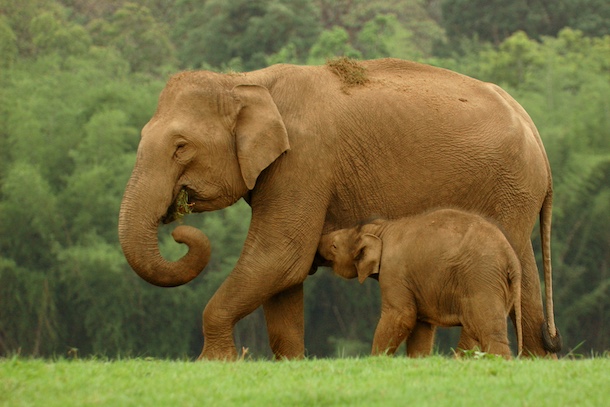
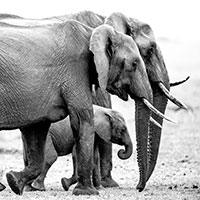
Strategies for calf survival is one of the skills researchers think elephants may be passing down through generations. (Photo: Kalyan Varma, Wikimedia Commons, CC BY-SA 4.0)
Elephants are social animals like us and pass down to their young knowledge and skills crucial to living a successful life. Researchers have found that elephant youths conduct themselves differently if they were raised without elders. Orphaned elephants have been seen struggling to integrate into broader social groups and inaccurately assessing threats from predators. Lucy Bates, a lecturer with the Center for Comparative and Evolutionary Psychology at the University of Portsmouth, speaks with Host Aynsley O’Neill about how this important role of elephant elders can help shape conservation priorities.
Transcript
O’NEILL: In the 1970’s and 80s, officials in South Africa's Kruger National Park decided to thin their elephant herd, killing a number of adults, and eventually sending some of the orphaned young to a rewilding project in Pilanesberg. Now called Pilanesberg National Park, it is just a two-hour drive from Johannesburg with convenient access for tourists. But shortly after the animals were reintroduced to Pilanesberg, park rangers saw the orphaned elephants entering into abnormally early and long periods of musth, a bull elephant state of heightened testosterone and aggression. Now, decades later, researchers have found that elephant youths conduct themselves differently if they were raised without elders. Orphaned elephants have been seen struggling to integrate into broader social groups and inaccurately assessing threats from predators. Lucy Bates is the author of a 2025 paper about how the loss of experienced elephants stops knowledge transfer between generations. She is a senior lecturer with the Center for Comparative and Evolutionary Psychology at the University of Portsmouth in the UK, and she joins me now -- Welcome to Living on Earth, Lucy!
BATES: Thank you very much. I'm delighted to be here.
O'NEILL: So let's start with some of the basics here. Tell us a little bit about elephant communities. Why do we consider them a social species? What kind of social structures are in place that makes us think that?
BATES: Elephant society is really interesting, and I mainly work with African elephants, the savannah elephants and their social structure is, in a way, it's very like ours. Female calves stay with their mother for life. Then that builds up families of related females. So you can have a grandmother and her daughters and their daughters, and so cousins and aunts all living together in one very cohesive family. Those families are then led by a particular individual, who's called the matriarch. That is usually, almost always, the eldest female in the group. The males, the boys, it's slightly different. As they reach adolescence, they spend less time with their families, and they'll start to hang out more with other males the same age of them, and also older males.
O'NEILL: Now you wrote a paper about elephants passing down survival knowledge to future generations. What kind of survival skills are we talking about here?
BATES: The primary sort of area that we think knowledge is being passed down from elders is in calf survival, and that would involve things like finding food sources, finding water sources, but also just how to behave with a calf, how much time you should spend feeding it, for example, versus looking after yourself. And there's quite a lot of evidence now that families that are led by older females tend to do better in certain things, most importantly, calf survival.
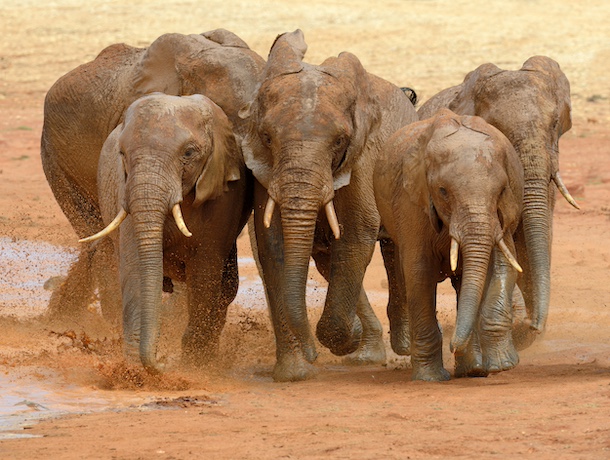
Lucy Bates' 2025 study suggests that elder elephants may teach crucial survival skills to their youth, and that the loss of these elders can have irrevocable effects on the lifetimes of the orphaned young. (Photo: Byrdyak, Wikimedia Commons, CC BY-SA 4.0)
O'NEILL: So Lucy, to what extent do we know that elephants are learning these skills from their elders or each other, rather than these being some sort of genetic or biological responses or some sort of individually acquired piece of knowledge?
BATES: Yeah, that's the million dollar question at the moment. We don't know for sure. We have very little direct evidence that elephants are learning socially. A lot of it is more circumstantial. There's probably in almost all behaviors that elephants engage in, I suspect there's some sort of combination of individual learning and social learning. In some ways, it would be impossible to imagine elephants living in this close-knit society and not learning from what the individuals around them are doing.
O'NEILL: And now in your paper, you also get into the fact that cultural knowledge and tradition is really crucial in elephant society. What defines a culture in the animal kingdom? How similar is it to the kinds that we understand in our human society?
BATES: Yeah, so within biology, we essentially define culture, perhaps a little bit more simply than we might consider human culture, but essentially, for us to think about culture, we need behavior that has been learned from observing others, rather than practicing yourself or learning something individually, which then sets up a tradition that you can then pass on to someone else, and that passes down as a behavioral tradition.
O'NEILL: What sort of would you see as like key differences between human and elephant culture?
BATES: There are really sort of two key differences, I would say, between human culture and animal culture. The first one is how information can be built upon in human culture. So for example, knowledge, really, we talk about ratcheting up. The knowledge that I acquired from watching you do something, I can add to that, and the person watching me can benefit from both parts. The information sort of improves over generations, which doesn't necessarily happen in animal culture. The other aspect that I think is really interesting, that's different is about how we use our culture. And I think one of the key ways we use our culture is to define our groups. We set up rules based on our culture, sort of normative behaviors, for example, so people in one culture might dress a certain way or listen to a certain kind of music. We essentially use those cues as definitions of belonging to a certain group. And those sort of normative rules don't seem to happen in animal culture.
O'NEILL: And so what does it look like when elephants grow up without elders or social groups that can teach them cultural knowledge and tradition?
BATES: There's a lot of evidence that suggests that elephants that grow up without elders make poor decisions, so things like responding appropriately to predators, but also how they respond to other elephant families. Families that grew up without elders, essentially waste time by being fearful of all other elephants and can't really recognize the difference between families that they know and are friends with and families that they don't, for example.
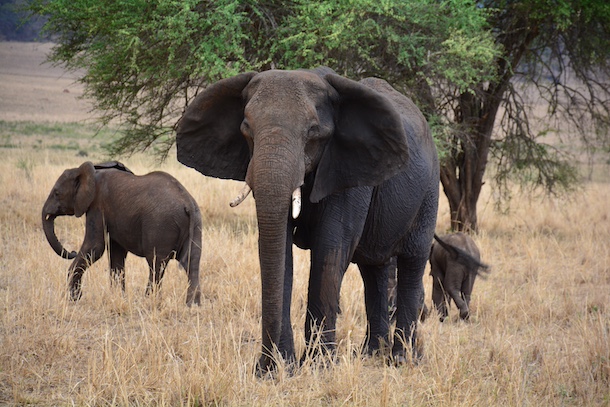
Elder female elephants, or matriarchs, are the leaders of elephant family structures. (Photo: Vincent Mugaba, Wikimedia Commons, CC BY-SA 4.0)
O'NEILL: A number of years ago, Living on Earth, we've actually done a story about a group of orphaned young elephants who were relocated to a National Park in South Africa. Researchers saw these relocated male elephants showing this particularly aggressive behavior. Could you tell us a little bit about what that behavior is in elephants?
BATES: Yeah, so all male elephants, as they mature and start to enter, usually about once a year, into a phase called musth, which is a period of extremely heightened testosterone, essentially, usually in a normal sort of structured elephant society, males don't start entering into these musth phases until mid to late 20s. This population that you're referring to in South Africa, where these elephants were sort of taken in without having any elders present in the society, the males in that group, as they matured, they started coming into musth extremely early, with no role models and no behavioral understanding of what was happening or how they should respond to it, but also very few females in the population that were available for them to mate with. So they had to find alternative outlets as it were, the levels of aggression that were associated with this heightened testosterone. Essentially, one of the key behaviors that they were then engaging in was killing rhinos.
O'NEILL: So obviously we've been talking about the importance of culture and society to these elephants. To what extent is that culture and that society at risk right now?
BATES: It's probably more at risk now than it has been for a long time. There have been various waves of poaching. Individuals obviously come in and kill elephants so they can remove the ivory, the elephant tusks and elephant tusks grow throughout their lives. So it stands to reason, obviously, that the older, larger individuals have the largest tusks. So it's typically the older individuals in a community, in a society, that poachers will be targeting. The other issue that elephants are facing at the moment is just extremely rapid changes to their environment. As human populations grow, the sort of wild habitat available to elephants is decreasing. So there's a competition for space and also a competition for resources, and I think a lot of that is driven by changes in the climate.
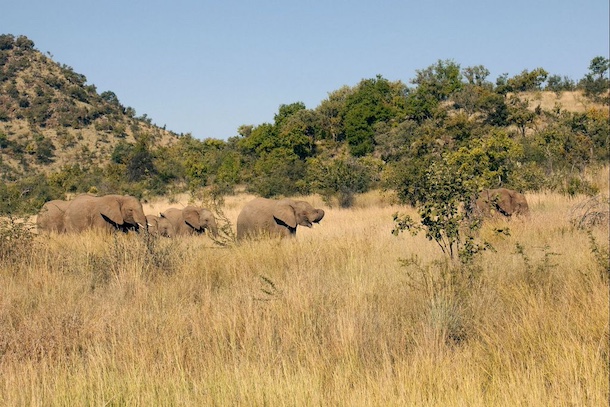
Elephants in the Pilanesberg National Park & Game Reserve. After a group of young, orphaned elephants were moved there in the late 20th century, they were seen developing aggressive behaviors. (Photo: South African Tourism, Wikimedia Commons, CC BY 2.0)
O'NEILL: What are the implications of all of these things that we've found out on, say, our conservation efforts when it comes to protecting these species of elephants?
BATES: Yeah, I think this is the really important question. To me the takeaway from all of this is that if we accept that knowledge and the information of elders being passed down is important for elephant society, then conservation becomes not just a question of conserving elephant numbers. It's about conserving the social structure, and that means particularly conserving the elders and protecting the elders or protecting the knowledgeable individuals. But there's actually an increasing emphasis, I think, on the importance of elder individuals, not just in elephants, but across a whole host of different animals, from even from invertebrates, birds as well. You know, evidence that this sort of life knowledge and these acquired skills is really becoming accepted as important and as a conservation priority.
O'NEILL: Lucy Bates is a Senior Lecturer with the University of Portsmouth Center for Comparative and Evolutionary Psychology. Lucy, thank you so much for joining us today.
BATES: Thank you for having me.
Links
National Geographic | “How Elephants Pass on Crucial Survival Skills to Next Generations”
Living on Earth wants to hear from you!
Living on Earth
62 Calef Highway, Suite 212
Lee, NH 03861
Telephone: 617-287-4121
E-mail: comments@loe.org
Newsletter [Click here]
Donate to Living on Earth!
Living on Earth is an independent media program and relies entirely on contributions from listeners and institutions supporting public service. Please donate now to preserve an independent environmental voice.
NewsletterLiving on Earth offers a weekly delivery of the show's rundown to your mailbox. Sign up for our newsletter today!
 Sailors For The Sea: Be the change you want to sea.
 The Grantham Foundation for the Protection of the Environment: Committed to protecting and improving the health of the global environment.
 Contribute to Living on Earth and receive, as our gift to you, an archival print of one of Mark Seth Lender's extraordinary wildlife photographs. Follow the link to see Mark's current collection of photographs.
 Buy a signed copy of Mark Seth Lender's book Smeagull the Seagull & support Living on Earth
© Copyright World Media Foundation. All Rights Reserved
Home | Contact | RSS | Donate | Newsletter