

Trump Cuts Ocean Monitoring
Air Date: Week of June 5, 2026
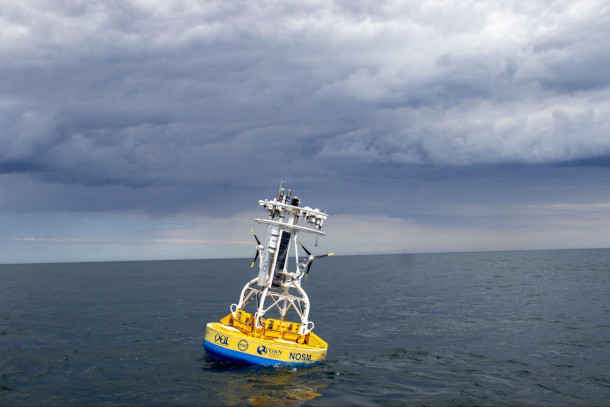
The Ocean Observatories Initiative uses ocean monitoring instruments, such as sensors attached to buoys for data transmission and collection (Photo: Woods Hole Oceanographic Institute, Courtesy of Suzanne Pelisson)
The National Science Foundation has announced it will begin removing most of the Ocean Observatories Initiative, a collection of roughly 900 instruments in the Pacific and Atlantic Oceans that gathers fixed-point data on temperature, carbon dioxide levels, and more. Craig McLean, formerly the assistant administrator for research and acting chief scientist at NOAA, joins Host Jenni Doering to discuss the importance of this monitoring system to understanding climate risks, vital ocean currents and more.
Transcript
O’NEILL: From PRX and the Jennifer and Ted Stanley Studios at the University of Massachusetts Boston, this is Living on Earth, I’m Aynsley O’Neill.
DOERING: And I’m Jenni Doering.
In just the latest of a series of Trump administration moves against climate science, the National Science Foundation has announced dramatic cuts to the Ocean Observatories Initiative. That’s a collection of roughly 900 instruments providing data on ocean currents, temperature, carbon dioxide levels, and more. Ocean-based scientific readings have long been a crucial part of understanding our warming world, and some of the early observations came from the fossil fuel industry itself.
O’NEILL: In 1979, Exxon outfitted a supertanker to sample carbon dioxide levels in the air and water as it traveled between the Gulf of Mexico and the Persian Gulf. This research was uncovered through an investigation from Inside Climate News in 2015, a year before the Ocean Observatories Initiative was commissioned by the National Science Foundation. And for 10 years, the OOI has provided steady data from fixed points in the Atlantic and Pacific oceans, a necessary companion to the information gathered by mobile instruments like the international Argo program.
DOERING: For more on the implications of dismantling this ocean monitoring network, we turn now to Craig McLean, formerly the assistant administrator for research and acting chief scientist at NOAA, the National Oceanic and Atmospheric Administration.
Craig, welcome to Living on Earth!
MCLEAN: Thank you for having me. You have a great show, and I'm proud to be part of it.
DOERING: Well, thank you. First of all, what was your reaction to the news that the National Science Foundation plans to remove this ocean monitoring network?
MCLEAN: I was very disappointed, and I saw it as a companion piece, actually, to the National Science Foundation's moves to attempt to shut down the National Center for Atmospheric Research, NCAR, out in Boulder. So it seems like a two-stroke hit here, where we're going to the atmosphere and also going to the ocean. I think there's more to it than that. I don't think it's quite so strategic, but the Trump administration really has not described in any sufficient degree the reasons why.
DOERING: What does this network of monitoring instruments look like, and what kind of data is being gathered by it?
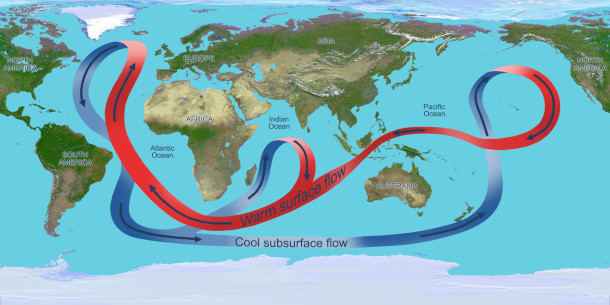
Accelerated warming from human activities have proven to be disrupting the planet’s natural thermal ocean system. (Photo: NASA, Wikimedia Commons, public domain)
MCLEAN: Well, the physical characteristic of these components are very exquisite sensors, which you could in some cases fit in the palm of your hand, in other cases they're much larger, but they're attached to buoys and cables that conduct them to the ocean bottom, so that they could be recovered and serviced, and then redeployed. There are also cable observatories. I just described vertical cables. There are also horizontal cables that are electrically conducting and can transmit data back to the beach, if you will, and then transmit that data onto various research centers. But what's exquisite about the Ocean Observatories Initiative is to be putting these same type of sensors in one place and leaving them there, so that they can continue to report on what are very remarkable, and one could say charismatic parts of the deep ocean, so that the biological profile, the physical profile, chemical profile can be continually measured and understand what's happening in those exact locations, because most of our other ocean measurements are mobile.
DOERING: And I mean, these days being able to track changes over time is vital, I think, when it comes to the temperature of the oceans, the acidity. What kinds of other things are important to be able to understand?
MCLEAN: Well, start with temperature. Temperature is responsible for an opportunity of error, that's about 180%, if we take away discrete ocean temperature measurements. So the Argo program, with 3900 thereabouts, floats in the global ocean, if that system didn't exist, just the United States contribution to that system would garner a 180+ percent error in global ocean heat, and as you know, global ocean heat is the engine behind the weather, it is the engine behind climate, and what we experience. So, components like the OOI installation, the Irminger Sea Array, which is just to the southeast of Greenland. If I were a European resident, I would be very concerned about the United States' choice of withdrawing that equipment, because the Great Conveyor Belt, as it's called, or the Atlantic Meridional Overturning Circulation, that it is more formally called, the conveyor belt of heat from the Atlantic tropics on up through and to Europe finds Europe to be much warmer than its latitude would be without such a heat transfer component of the ocean current. So, if we are slowing that down because of the melt of the Greenland glaciers– the land-based glaciers– and they are melting rapidly, I've been up there for two summers and looked at it very closely, and many people, far more qualified than I have made these observations, but as that fresh water comes in and it disrupts the salinity, it disrupts the temperature gradient, it starts to raise the question, it's not been conclusive yet, but it starts to raise the question of if the trend that is seen continues, what does that spell for the heat in Europe in coming decades, centuries? It's part of a normal earth process right now, but we're disrupting that earth process because we are far more rapidly melting the glaciers on Greenland than they would normally be. In fact, if we were not manipulating our environment, we would be headed towards another ice age. Those glaciers would be growing.
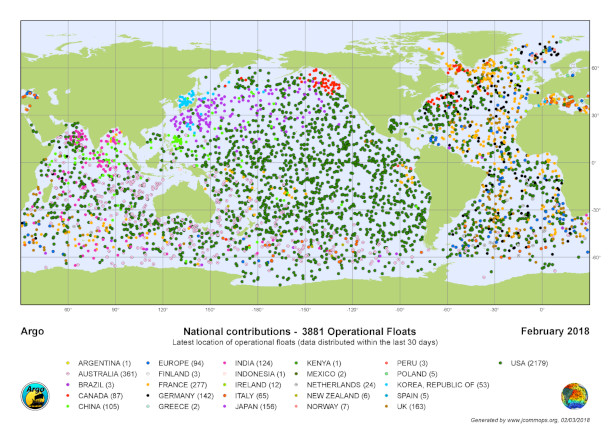
As of February 2018, the above map shows all of the operational floats that are part of the Argo system. These are mobile data collection devices, whose information Craig McLean says is bolstered by steady data from the fixed points of the OOI. (Photo: Hjfreeland, Wikimedia Commons, CC BY-SA 4.0)
DOERING: And just to drill down on this, how useful is the information that's gathered by this ocean monitoring network, this Ocean Observatories Initiative, not just for scientists but for the average American? How do we see this in our everyday lives?
MCLEAN: Unfortunately, the average American doesn't focus on what these types of measurements are generating for us, but when we look at measurements of the ocean temperature, something that's stationary, sedentary, like the ocean observatory components that we have in the OOI, they're resident, and they look long-term at what's happening, and that key question of what's happening tells our insurance companies what levels of risk we are going to have to buy and pay for in the coming season, in the coming decade. We're noting 500-year storms taking place twice in a decade nowadays. Certainly, what people should be concerned with is what is the period of your mortgage? How will your rates be determined for insurance on your property? That's an economy that's based on risk. Risk is determined to a major extent by the insults of the natural system, and we are perturbing the natural system. Agriculture, industry, all of the components that are reliant on any aspect of weather, and I could almost defy somebody to identify something that isn't a function that's influenced by weather. By analogy, I could show you an illustration of how many data points on the continental United States are used to make the daily weather forecast. These are National Weather Service, and these are private homeowners. These are meteorology stations from news broadcasts. Everyone contributes to these; oil companies, they all contribute to these data points. If you put that on a map, you just about cover the United States. It's a little bit light in the Midwest, but you just about cover the United States. If I were to do the same thing with ocean-based measurements, we're hardly scratching the surface. So, for us to have invested so much money of US taxpayer dollars to design, implement, and install this system, and now to flippantly, without any meaningful analysis or discussion of merits, decide to take it out on the simple and naked phrase that this activity is not consistent with the president's policies, but clearly there's no explanation by the Trump administration as to why this is a good idea. There are plenty of richly analytical explanations as to why installing it, leaving it, monitoring it, and abiding by the congressional instruction in an appropriation to do this work, spend this money, collect that information, and reveal it to the scientific community.
Under the Trump administration, the National Science Foundation has decided to start the process of removing the OOI’s in-water infrastructure from the Irminger Sea, Station Papa, Endurance and Pioneer Arrays. This is an estimated 85% of OOI instrumentation. (Photo: Official White House Photo, Wikimedia Commons, public domain)
DOERING: That's right. As I understand, the Trump administration has actually tried to cut this funding before, the annual budget of some $48 million a year, and Congress said no, we want to keep this funding in place.
MCLEAN: That's right, and it brings up the question of whether or not the president has the authority to ignore appropriations law, and that issue is headed to the Supreme Court, not based on OOI, but everything that is part of the federal budget, certainly as we might focus on the science part of that budget. If Congress has passed as law, and a president has signed as law that thy will be done, a subsequent president is not empowered in the methods that Trump is using to go ahead and abruptly change that. So, the question that the OMB chief, Mr. Vought, and others are raising is that we've not fully explored the power of the executive, and it will be the Supreme Court that determines that. But up until then, Trump is going to continue to do what he's doing, and unless people can find other reasons beyond the definitive determination of whether a president can or cannot ignore an appropriations law, for the remainder of Trump's administration, we're going to be where we are now.
DOERING: So, this Ocean Observatories Initiative, the system takes some $48 million a year to operate. What would you say to anyone who hears that number and says, well, maybe it does make sense to strike that from the budget?
MCLEAN: The return on those investments is huge. The return is to provide information on the current and future state of our earth. And what that really comes to is letting the agricultural community know with a level of discrete measure what's happening throughout this ocean process, because the OOI installations are sedentary and constantly focusing on the same area, giving an absolutely complete data record of those locations. What is learned from the OOI can be extrapolated and provide greater reliability on what the measurements are from the mobile systems, including Argo, and what does the citizen get out of that? First of all, $48 million, if you or I had to write that check, I doubt that we'd have the funds, but when you look at other components of the federal budget and you realize how low in cost $48 million might be, it is a bargain for the benefit of the public to know and understand the components of what's happening through and in the ocean. That affects our fisheries that feed us and provide an economic opportunity for many coastal communities and inland as well, given the distribution and the abundance of fishery-based products– shellfish, fin fish, the like. It also is the explaining element of what's happening in our earth that is going to, and does now, influence the weather. So, it's a force multiplier that without it we don't have the discrete knowledge of what's happening in the ocean that we can't get through the passage of a mobile sensing device. The fact that Argo is so high in number of devices, nearly 4000, in fact, 4000 is the target number of Argo floats, the Argo floats are made to be better understood because of what we're able to measure in the OOI permanent installations.
DOERING: So, Craig, you worked under the previous Trump administration at NOAA. You were actually their acting chief scientist for a number of years, as well as under other administrations. How does the approach towards climate science under this Trump administration compare to the first?
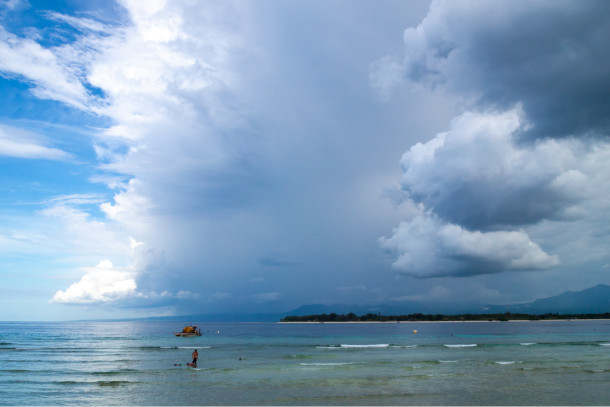
Shown above is a seascape view of the Lombok Strait in Indonesia. Ocean monitoring systems are responsible for providing data on ocean conditions, giving insight into weather patterns, carbon dioxide levels, and more. (Photo: Vyacheslav Argenberg, Wikimedia Commons, CC BY-SA 4.0)
MCLEAN: It is quite different. It's much more aggressive, it's punitive, it's even less thoughtful than the first Trump administration was. During the first Trump administration, I was approached by politically appointed figures at NOAA who told me that there was a new sheriff in town and we had to change the direction of our program and start opening up to have other voices participate in the climate discussion, and I continued to probe and to force people to commit to what they meant. I knew what they meant. They wanted basically climate deniers to be part of the climate boards, climate panels, and the like. And I explained to them that there was a grave problem with doing that, because the people that they were advising, not to the individual, but to the nature of the people they were advising to be included, they were the marketeers of disproven and fallacious theories that just don't even get on the credibility table. And while somebody might have a theological belief in it, there is no scientific fact for it. So, it continued for about another two months, three months, and I finally got to the point where I did two things; I showed them the law, I requested a memorandum be written by the General Counsel of my agency to describe the agency's responsibilities under the existing climate laws, and I showed that to them, and then I asked them if they would write on my performance plan what they expected me to do, because then I would have at their hand and in their hand, an instruction to me to violate the law. And I explained to them that I will not violate the law, but what you're asking me to do is not lawful, so therefore I'm not going to do it. But are you going to be the person that stands in front of this? And they backed down. What's different this time is that they want to be the person that stands in front of it, that wants to stand up and say yes, we're going to violate what you think is the law, but we think it's differently.
[MUSIC: Blue Dot Sessions "Sudden Courier"]
DOERING: We’re speaking with Craig McLean, former NOAA assistant administrator for research and current senior fellow at The Ocean Foundation. We’ll be right back after the break. Stay tuned to Living on Earth!
ANNOUNCER: Support for Living on Earth comes from the Waverley Street Foundation, working to cultivate a healing planet with community-led programs for better food, healthy farmlands, and smarter building, energy, and businesses.
[CUTAWAY MUSIC: Edgar Meyer, “Cello Suite No. in G-Major BWV1007: V. Menuets I & II” by Johann Sebastian Bach, Sony Classical]
O’NEILL: It’s Living on Earth, I’m Aynsley O’Neill
DOERING: And I’m Jenni Doering.
We’re back with Craig McLean, formerly the assistant administrator for research and acting chief scientist at NOAA, to discuss the Trump Administration’s order to remove most of an ocean monitoring network that tracks temperature, CO2, and more. Over decades of service at NOAA, Craig has seen shifts in how different administrations approach climate science, but he says what’s happening now is unprecedented.
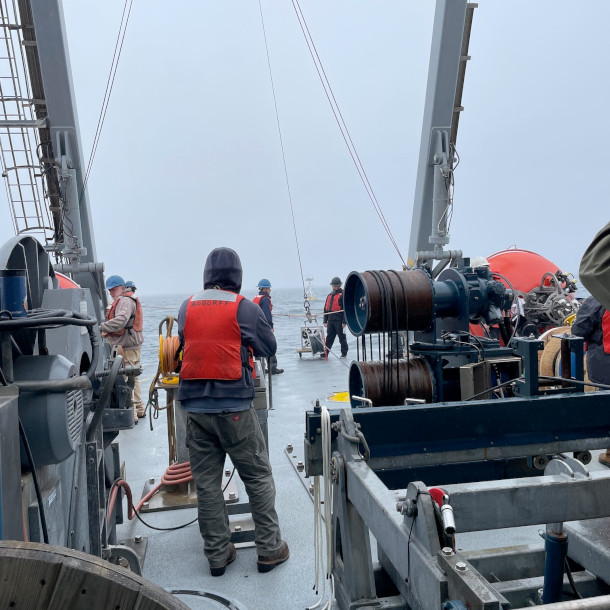
Shown above is a team in 2024, setting up a mooring at the OOI Irminger Sea Array, just before a storm hit. The mooring has wind turbines and solar panels that powered the instrument for a year during its time at sea. (Photo: Image from work supported by the U.S. National Science Foundation Ocean Observatories Initiative. Sheri N. White © WHOI.)
MCLEAN: Now I started under Reagan, and interestingly, I was in the NOAA Commission Corps. I was a uniformed officer, I was an ensign, brand new, and we had this thing called a government shutdown, which I think might have been the first one. We didn't know what that was, but all we knew was that you're in uniform, you come to work every day, and you just keep going. But now we have shutdowns with such routine rigor that we actually have plans that you just pull off the shelf when there's a shutdown. But, so from Reagan to let's say Bush, there was a question of climate as the scientific certainty continued to develop. I think the greatest lag was the conservatism of the IPCC types of reports where people didn't want to be too alarmist, and they also wanted to make sure they could carry everybody on board with what they were saying. It was a consensus-generated document, even though the science community, in the greatest levels of expertise, knew that the situation was more extreme and egregious than what would be comfortably reported in a consensus document. Along then comes George Herbert Walker Bush administration, and their choice was with what was then called global warming, because the globe is warming, therefore it's a logical term. But let's study it some more. Let's put some money into it, put more money into it, and budgets grew at that point in time, by and large, to get a better definition of the problem. It was a rational thing to be doing. Then, in between other administrations comes George W. Bush, and in the W. Bush administration, there was a verbally passed instruction from the White House. We don't call it global warming anymore, we're going to call it climate change, because that's not declaring so much that we're warming, it's just it's changing. No one, including myself, can ever recall seeing that in writing, but it was clearly distributed to us verbally in staff meetings and the like. So now go from global warming to climate change. So now, where are we? Well, it's not climate change, now it's resilience against extremes. Well, I don't care who you are. If you live in Charleston, South Carolina, if you live in Miami, your shins are getting wet when you walk on the street on the wrong day, and if you lived in LA or in Hawai'i, in Maui, your home and your town burned. These extremes are happening. You can call it whatever you want, and you could withdraw the kinds of science measuring systems that tell us how bad it's going to be in the future all you want, but it isn't going to make the problem go away.
DOERING: So, what is happening to climate science and climate research in the US these days. I mean, the Trump administration has accused that research of being alarmist. The National Center for Atmospheric Research has been targeted for dismantling. What's happening to the field, and what's your sense of the overall impact?

Craig Mclean formerly served as NOAA Assistant Administrator for Research and NOAA Acting Chief Scientist. He is now a senior fellow with The Ocean Foundation. (Photo: Courtesy of Craig McLean)
MCLEAN: The United States is being looked upon with antagonism, at the easiest, I'd say, disrespect, grave concern. The United States is losing the international reputation of excellence that it has held for 75 years, and that's hard to build. We will have to see how hard it is to recover. But climate science in the United States, the fact that the national climate assessment was taken down from public visibility, the fact that the next National Climate Assessment was shut down illegally; but once again, until the appropriations law is adjudicated by the Supreme Court, Trump will continue to be doing these things. So, the Trump people are trying to step-by-step disassemble components of the information that provides the finance market, stock futures, reinsurers, home values, etc., where risk is determined and quantified. Those erosions to that certainty has an economic consequence. Now, one thing I have to say is that quietly I do believe, and I do understand that, quietly, some professional associations of reinsurers, emergency managers, emergency response, and emergency preparation professionals, they are expressing themselves, and those expressions are reaching some of Trump's party, and that is one of the reasons why we see the appropriations continuing at a level that would fund these activities. What's disrupting it is the Trump interpretation that he, as president, is empowered to reject the law that has been passed by Congress and signed by a president and determine what he wants to do with it. And it’s destroying science. We are an embarrassment to the nation. First of all, there’s one nation in the world– one nation in the world– that is a rogue nation, and it is not a member of the IPCC. And that is the United States of America. There is no excuse for anyone to believe, with pride, that they could stand behind their president when he says climate change is a ruse.
DOERING: Craig, as someone who under the previous Trump administration ultimately stood up for what you thought was right, and you were asked to leave as a result of that. What advice would you have for any career scientists who are working in this Trump administration on oceans and on climate, for you know, making sure that the science that we need continues to be gathered?
MCLEAN: Two things: one is, know where your red line is, don't cross it, define what you're willing to accept for your own personal dignity and professional competency, and don't cross it. Leave before you cross it. But the second thing is, scientists are trained to be quiet and self-contained, and we can't be. We have to be vocal, and we have to express ourselves in plain language, clearly, to the public and offer your views as to what we should be doing rather than what we are doing.
DOERING: Craig McLean is former NOAA assistant administrator for research and NOAA acting chief scientist. Thank you so much, Craig.
MCLEAN: Thank you for having me.
DOERING: In a statement, a National Science Foundation spokesperson said the move to dismantle the Ocean Observatories Initiative “aligns with NSF's wider strategy of a nimbler approach to prioritize support for evolving scientific priorities and emerging technologies, as well as smart lifecycle management within its research infrastructure portfolio.” For the full statement, visit the Living on Earth website at loe dot org.
Links
Learn more about the Ocean Observatories Initiative here
Read about the OOI descoping here
Craig McLean’s profile at The Ocean Foundation
The New York Times | “Trump Administration to Dismantle Ocean Monitoring System”
Living on Earth wants to hear from you!
Living on Earth
62 Calef Highway, Suite 212
Lee, NH 03861
Telephone: 617-287-4121
E-mail: comments@loe.org
Newsletter [Click here]
Donate to Living on Earth!
Living on Earth is an independent media program and relies entirely on contributions from listeners and institutions supporting public service. Please donate now to preserve an independent environmental voice.
NewsletterLiving on Earth offers a weekly delivery of the show's rundown to your mailbox. Sign up for our newsletter today!
 Sailors For The Sea: Be the change you want to sea.
 The Grantham Foundation for the Protection of the Environment: Committed to protecting and improving the health of the global environment.
 Contribute to Living on Earth and receive, as our gift to you, an archival print of one of Mark Seth Lender's extraordinary wildlife photographs. Follow the link to see Mark's current collection of photographs.
 Buy a signed copy of Mark Seth Lender's book Smeagull the Seagull & support Living on Earth
© Copyright World Media Foundation. All Rights Reserved
Home | Contact | RSS | Donate | Newsletter