

May 22, 2026
Air Date: May 22, 2026
FULL SHOW
SEGMENTS
Cancer and CAFOS
View the page for this story
Living near many large Concentrated Animal Feeding Operations or CAFOs appears to raise cancer risk, according to a study from Yale researchers. CAFOs pack thousands of pigs, cows, and chickens together to produce meat, dairy, and eggs. All those crowded animals can produce a lot of waste that pollutes air and water, which may explain an association between CAFOs and cancer, though the study does not prove causation. Brian Bienkowski, managing editor of The New Lede, joins Host Steve Curwood to talk about the research and how concerns transcend politics. (14:31)
Baby Right Whales Bring Hope
View the page for this story
North Atlantic Right Whales were once so thoroughly hunted they nearly went extinct. When hunting these mammals was outlawed, they slowly started to bounce back, but today these Right whales are dealing with newer deadly threats, such as fishing gear entanglement and warming in the Gulf of Maine. So, it’s a relief to advocates to have a successful calving season like this year with 23 new calves, the most since 2009. Amy Warren, the Scientific Program Officer at the New England Aquarium, spoke with Host Aynsley O’Neill. (11:24)
Spring "Bursts" Forth
/ Mary McCannView the page for this story
Springtime in the northern hemisphere brings many migrating birds returning from their winter havens, in a series of slowly breaking waves that sweep up from the south to the north. BirdNote’s Mary McCann reports. (01:55)
Indigenous Wisdom in Science
View the page for this story
In accounts of scientific expeditions into the remotest parts of our world, indigenous people can often be depicted as mere backdrop—part of a quote “exotic” landscape, or at best, helpful sidekicks. But for Dr. Rosa Espinoza, a Peruvian chemical biologist and conservationist, the traditional knowledge and worldviews of indigenous people could be the key to unlocking some of nature’s greatest mysteries, if scientists are willing to listen—and collaborate. Host Aynsley O’Neill and Dr. Espinoza talk about her 2025 book, The Spirit of the Rainforest: How Indigenous Wisdom and Scientific Curiosity Reconnects Us to the Natural World. (19:33)
Show Credits and Funders
Show Transcript
260522 Transcript
HOSTS: Steve Curwood, Aynsley O’Neill
GUESTS: Brian Bienkowski, Dr. Rosa Espinoza, Amy Warren
REPORTERS: Mary McCann
[THEME]
CURWOOD: From PRX – this is Living on Earth.
[THEME]
CURWOOD: I’m Steve Curwood.
O’NEILL: And I’m Aynsley O’Neill.
Community concerns about cancer and concentrated animal feeding operations.
BIENKOWSKI: You can talk till you’re blue in the face about the fact that ammonia is coming from these pig farms or that nitrates are in the water. Those terms are, you know, they're largely meaningless to most people, but when you talk about cancer it affects everybody. So, I think that's what's getting people out of their house and, and into these town halls.
CURWOOD: Also, the importance of indigenous expertise in science.
ESPINOZA: Without indigenous knowledge and collaborations, there is only so far one can go, and this has been history — it's just that it's never been acknowledged as co-authors, you know, co-authors of discoveries, of explorations. We've just simply shifted that dynamic where now, instead of being bystanders, they're co-authors of everything.
CURWOOD: We’ll have those stories and more, this week on Living on Earth. Stick around!
[NEWSBREAK MUSIC: Boards Of Canada “Zoetrope” from “In A Beautiful Place Out In The Country” (Warp Records 2000)]
[THEME]
Cancer and CAFOS
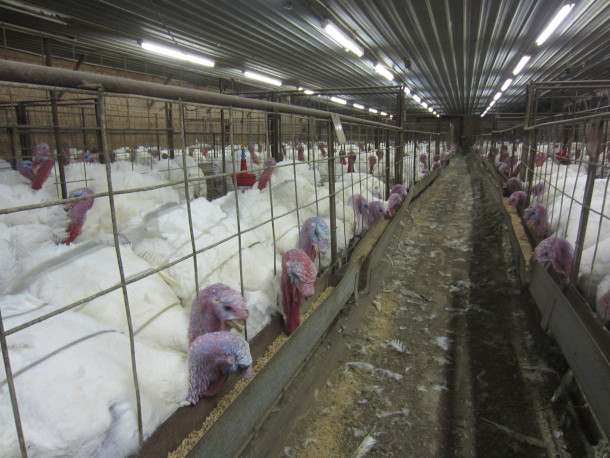
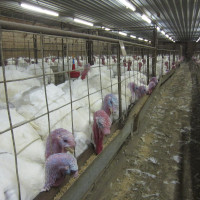
Large Concentrated Animal Feeding Operations, or CAFOs, can contain thousands of animals in tight quarters to maximize production. The EPA rates as large CAFOs with 55,000 or more turkeys. (Photo: Mercy for Animals, Wikimedia Commons, CC BY 2.0)
O’NEILL: From PRX and the Jennifer and Ted Stanley Studios at the University of Massachusetts Boston, this is Living on Earth, I’m Aynsley O’Neill.
CURWOOD: And I’m Steve Curwood.
Many people know smoking tobacco or spraying certain pesticides can elevate the risk of cancer, but few of us know that living in a county with a lot of large Concentrated Animal Feeding Operations, or CAFOs may also raise cancer risk. But that perception may be changing, thanks to experts at Yale University reporting in Environmental Research who examined cancer prevalence in three states, comparing counties with more of these massive operations to counties with less. CAFOs pack thousands of animals together to produce meat, dairy, and eggs, and large ones have more than a thousand cows, 2,500 pigs or 30,000 chickens, and supply most of the meat you buy at the grocery store. Critics have long raised ethical questions about CAFOs, the unpleasant odors and the climate costs of related methane emissions. This research showing an association between CAFOs and cancer prevalence does not provide conclusive proof, but it does ask questions about possible mechanisms such as air and water pollution. Joining us to discuss is Brian Bienkowski, managing editor of The New Lede. Welcome back to Living on Earth, Brian!
BIENKOWSKI: Steve, it's so nice to see you again.
CURWOOD: So, the other day, a study came out from Yale University, looking at these massive feeding operations. You've looked at this research, what were the main findings?
BIENKOWSKI: So, they looked at counties in Iowa, Texas, and California, and they looked at county-level cancer rates and CAFO density in the counties, and they found that cancer rates were 4% higher in high CAFO counties in California, and they were 8% higher in highly exposed counties in Iowa and Texas. And it's important to point out, I mean, Steve, you've been doing this a long time, these studies are a data point, right? This is a correlation, this is not causation. So, they didn't measure what people were exposed to in these counties, they basically said if there's more CAFOs, there's more cancer. So, it's a data point in kind of this broader body of evidence that's growing that shows that these CAFOs are putting out pollutants that could plausibly cause cancer. So, this isn't a causal study, this doesn't prove that CAFOs cause cancer, but just another data point pointing to that evidence.
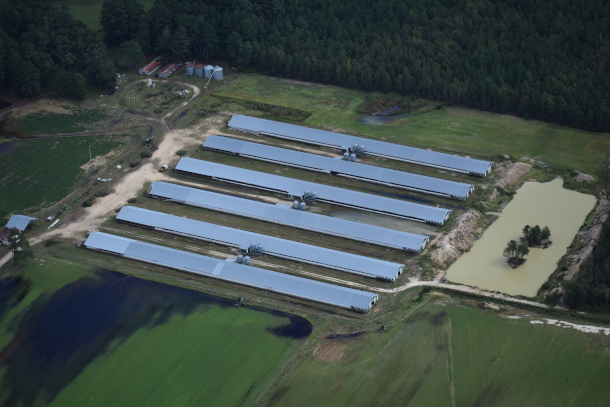
A hog CAFO in North Carolina. A recent study from Yale University found that people living near CAFOs in California, Texas and Iowa suffer from higher rates of cancer. (Photo: Waterkeeper Alliance, Inc., Flickr, CC BY-NC-ND 2.0)
CURWOOD: But it is an association, isn't it? I mean, if you have an area that has more CAFOs, and there's more cancer, it certainly bears looking into, yes?
BIENKOWSKI: Correct. Yes, and we already know that CAFOs emit ammonia, hydrogen sulfide, VOCs, fine particulate pollution. These are air pollutants that can form carcinogens in the air and induce inflammation, oxidative stress, and other things in our bodies that can cause cancer. And then, in addition to that, there's a massive amount of manure, and often that manure will find its way into nearby creeks and streams and waterways that people end up drinking, and this manure can form nitrates, which is linked to all kinds of different cancers. So, we know that CAFOs put out cancer-causing pollution, and now we know that counties with a lot of CAFOs have higher rates of cancer.
CURWOOD: So, talk to me about the state of Iowa, where there's a fair amount of research about the potential dangers of the agricultural pollution there. What's going on?
BIENKOWSKI: Yeah, Iowa has become ground zero for this, and you're seeing more and more headlines, more and more reporters paying attention to Iowa, because, I don't know if you've been there, but Iowa is corner to corner farms. They plant corn and soybean right up to the road, and then they are the top state for the amount of CAFOs, anywhere from, I think, 4,000 to 8,000 is kind of the rough estimate. There's a lot of CAFOs there, and a lot of hog farming. And lately, you may have seen this, Iowa is one of the only one of two states in the country where cancer rates are rising, so it's Kentucky and Iowa. And a massive report recently from the Harkin Institute found that one of the reasons, one of the culprits behind this is nitrates, which, as we just talked about, comes from manure. Also, they looked at pesticides, air pollution, and other problems in Iowa that could be causing this, but yeah, you're starting to see people pay attention in Iowa who haven't paid attention before and questioning whether Big Ag is impacting people's health.
CURWOOD: So, who's pushing back against these CAFOs, given that there are these growing concerns? Who's saying, "Hey, maybe we don't want these in our backyards?”
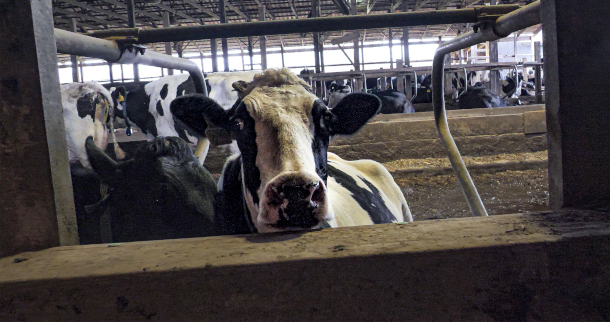
Livestock produce manure, which contains nitrates and can potentially pollute local waterways. The EPA rates large CAFOs as those with one thousand or more cows. (Photo: USDA.gov, Wikimedia Commons, public domain)
BIENKOWSKI: So, there's the usual chorus of environmental and health groups. This is in Iowa and beyond. I mean, these are organizations like Food and Water Watch, Farm Stand, Farm Forward. They've been saying for years that not only are we treating animals poorly by packing them into these tight facilities, but increasingly, beyond the animal welfare concerns, you're hearing these organizations talk about the human health concerns that we're talking about today. But we've been spending a lot of time, the New Lede, in Iowa, and they've been holding town halls over the last year as they come out with this cancer report, and they're trying to listen to residents, and you know some of this is anecdotal, but you are seeing increasingly more and more people who don't fall along the typical, whether it's the environmentalist demographic or younger or urban, the people that you would maybe anticipate to be at these town halls yelling about pollution. We saw a lot of people from rural areas, we saw farmers, I mean, a lot of farmers are upset at the fact that they cannot compete anymore, because there are, if you are a pig farmer and you want to have them grazing on grass, you cannot compete with the guy that has 2,000 of them in a concrete facility. It doesn't work. So, in addition to the pollution concerns, you have kind of a growing rural and farmer-led backlash to some of the, especially Iowa, the way agriculture has just grown at such a fast rate.
CURWOOD: And when you say agriculture, then you're saying largely sort of industrial scale "factory farming," as it were.
BIENKOWSKI: Correct. Yeah, "factory farming" is kind of looked at as a pejorative term that environmental and health groups use, but it's really accurate when you look at a facility that has thousands of animals and is keeping them in really tight, you know, tight little areas, and kind of pumping them through. It's similar to like a factory in Detroit that's doing that for auto parts. So, I think it's apt, and in Iowa, of course, you're not just dealing with CAFOs, as I said, you're dealing with massive amounts of corn and soybeans that are just, you know, this is Big Ag as well, those are not small scale farms.
CURWOOD: And of course, there must be concern based on the fact that cancer affects us all — us ourselves, or somebody we know, our family.
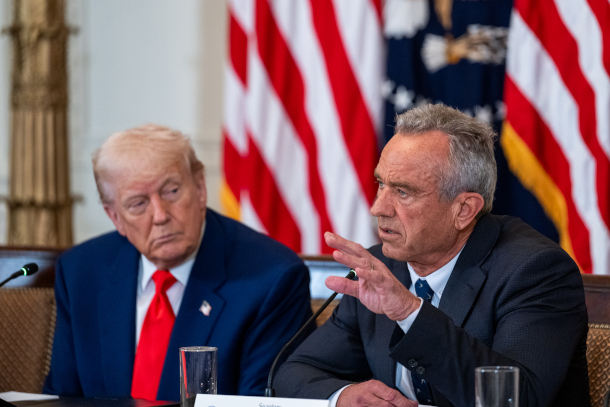
Health and Human Services Secretary Robert F. Kennedy Jr. (right) and the “Make America Healthy Again” or “MAHA” movement have called for a focus on meat as a protein source in American diets. (Photo: The White House, Wikimedia Commons, public domain)
BIENKOWSKI: I think that's a great point, Steve, you can talk until you’re blue in the face about the fact that ammonia is coming from these pig farms, or that nitrates are in the water. Those terms are largely meaningless to most people, but when you talk about cancer, as you said, it affects everybody. So, I think that's what's getting people out of their house and into these town halls, and into talking to their legislators in Iowa. I'm seeing a real shift there, where again, this isn't a red versus blue thing, urban versus rural, it's people who have been affected by cancer who want answers.
CURWOOD: So, talk to me about how CAFOs are regulated across the United States. What rules, if any, do the people who do this have to answer to?
BIENKOWSKI: Right, so there's been some controversy over that. A lot of groups think they should be regulated more tightly, so CAFOs themselves under the federal Clean Water Act are point source, so they do have to abide by certain regulations in terms of what they release into the waterways. However, as I said, when you're generating this amount of manure, it doesn't stay on-site, you have to put it somewhere, so when they spread it on fields, that's often considered non-point source pollution that is regulated in a much more lax way, and that's where a lot of people think the pollution from CAFOs is the most acute. When you spread it on these fields, if you spread it at the wrong time of year, if you spread it before a rain event, if you spread it in winter when it can run off and not be absorbed by the field, this is how it gets into nearby waterways, so and then the air pollution is just not nearly as highly regulated as, say, a factory in Detroit or Gary, Indiana. So, it's operating at a much lower level than heavy industry.
CURWOOD: I would imagine that there's a lot of manure from these operations, and that the people who are operating these places are spreading, covering large areas that then what become run off into local waterways, as you say, officially non-point pollution, but in the aggregate, probably fairly intense, huh?
BIENKOWSKI: Correct. Yeah, and if you talk to farmers, the farm bureaus, and people who are in support of CAFOs, and not more tightly regulating them, they'll say that this manure is full of good things for fields and good things for soil, you know, nitrogen and phosphorus are important, they're vital fertilizers. And as we know right now, with the Strait of Hormuz closed, getting fertilizer is a hard thing, so they're getting it where they can, so it can be a really important source of fertilizer for these fields, but the problem is the sheer amount. This is a lot of, it's a lot of poop. It's a lot of manure. So, you have to find enough places for it.
CURWOOD: So, Brian, the 2026 farm bill, the latest version has just gotten through the House of Representatives, and it's now on to the Senate. To what extent are CAFOs a point of contention in this year's iteration of the farm bill?

The 2026 Farm Bill (H.R. 7567 – Farm, Food, and National Security Act of 2026) passed through the House of Representatives 224-200, includes a provision that would override states’ rights to regulate CAFOs. The Bill will now be taken up by the Senate. (Photo: Noclip, Wikimedia Commons, public domain)
BIENKOWSKI: Yeah, it's a good question, Steve. This is a timely conversation, because the House just passed their version of the farm bill, which most people probably know is a massive piece of legislation, you know, over 800 pages that really dictates our farming policy over the next four to five years, and the House version passed a provision called Section 12006, kind of referred to as the Save Our Bacon Act, which seeks to override California's Proposition 12 and Massachusetts Question Number Three. Both of these are state laws that look to have animal welfare standards be taken into account. So, in California, there are certain basic standards that animals have to be raised in, in order to be raised in that state or sold in that state. You know, this is like very basic things like being able to turn around in their cage, lie down, things like that. And the National Pork Producers Council and legislators in heavy agricultural states don't like this, because their pork products - this is largely targets hogs, but it's for any animal. They don't like that, because their products can't be sold in California, so they want this removed. These are people who are often very for states' rights, are not for states' rights in this case. They say it violates the Commerce Clause. So that did pass the House, and now we wait to see what the Senate does with that.
CURWOOD: Okay, I know you don't have a crystal ball, but what does it look like in the Senate?
BIENKOWSKI: Senator Boozman, who runs the Agricultural Committee, said that this will not pass, he said that to a group of agricultural journalists. He doesn't think it has support. This has been in farm bills previously and has gotten shot down. So, I don't have a crystal ball. I don't know people I've talked to. They also do not want to make predictions about this, but if history is a predictor of the future, it seems like it will not pass. But we wait and see.
CURWOOD: Just how powerful is the meat and ag lobby in DC? And talk to me about where the MAHA, the Make America Healthy Again movement, comes into play here.
BIENKOWSKI: Yeah, I mean, the agricultural lobby across the board is massive. It's one of the largest lobbies in the United States. The National Pork Producers Council is the one that I most often deal with. They are constantly lobbying on these issues. When we were just talking about the Save Our Bacon Act, I mean, they took that all the way to the Supreme Court with a lawsuit. So, they're a massive lobby. They have the ear of a lot of senators and House members across the country. In terms of MAHA, this is a really important part of it. MAHA has made meat and protein a really big part of their agenda. MAHA as you know, is a kind of fractured coalition, and it's not a monolith, so we can't say everybody agrees on these things, but RFK Jr. the Secretary of HHS, when they redid their dietary guidelines, really put an emphasis on meat and whole milk, and put these things at the top of the food pyramid, and what that does, according to sources that I speak to, I mean that locks in CAFOs, right? You cannot meet the demand of meat that they want to meet with their new guidelines without these very large scale CAFO farms. So, what I find interesting is MAHA has been very vocal about the pollution concerns from pesticides, glyphosate, paraquat, and other things that we also cover at the New Lede, but they do not seem to mention or seem to be as concerned about the pollutants from the meat industry that we've been discussing today.
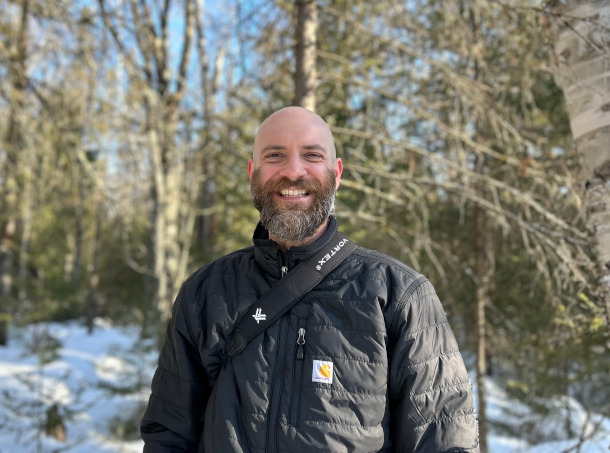
Brian Bienkowski is the managing editor for The New Lede. (Photo: Courtesy of Brian Bienkowski)
CURWOOD: What are the alternatives here? How might we do agriculture differently without admonishing people for wanting to eat meat?
BIENKOWSKI: This is a tricky one. There's a lot of people, there's a lot of demand, and protein is important, and meat tastes good, so it's a tricky one. I can speak personally, living in a pretty rural community that doesn't have a Whole Foods, that doesn't have large grocery suppliers. We try to eat locally. I think across the board, it is more environmentally friendly if you can find both meat and produce on a local level and try to support your local farmers, things that haven't traveled really far. Often, if you can find a local farmer, they are not using CAFOs. Those are sold on the wholesale market, so you could find people who are butchering their own animals or sending them to a local slaughterhouse if you want to be eating meat. Ultimately, if you want to tackle this at scale, it's going to have to be a reduced demand for meat. There's no way around that. Our demand for meat right now, and our, between exports and what we consume, it simply dictates that we need to have CAFOs to fulfill that demand if it's going to be at all affordable for people.
CURWOOD: Brian, at the end of the day, how loud are your alarm bells going off here? I mean, how concerning is all of this to you as a journalist, looking at this to serve the public?
BIENKOWSKI: Having been a journalist for 16 years, my alarm bells are very dulled at this point. However, I will say, when you see one of these CAFOs, it's jarring. It's jarring. The idea of the family farm, the idea of the red barn, cows grazing, pigs grazing, rolling around in the mud, the kids playing with them, that idea is, I mean, it exists in the country in certain places, but that is not where your meat is coming from when you go to the grocery store. And this massive amounts of pollution, if you look at, again, not to go back to Iowa, but that is the epicenter of this, and if you look at a state that has had very little guardrails with how they regulate, and just consider zoning when it comes to agriculture, and have just allowed their state to be completely full of agriculture. They're full of pollution now. Their big cities, as we mentioned, cannot keep up with the amount of nitrates that are coming into their water system. So, that is a public health crisis. And just last week, more than 80 groups sent a letter to HHS and the US EPA saying that there is a nitrate drinking water public health crisis in this country and told them they need to take immediate action. So, it's not just me saying this. There are a lot of people right now who say that this is a crisis going on across the country.
CURWOOD: Brian Bienkowski is the managing editor of The New Lede. Thanks so much for taking the time with us today, Brian.
BIENKOWSKI: Thanks, Steve. It's always great to see you.
Related links:
- Environmental Research Journal | “Density of Animal Feeding Operations, Including Concentrated Animal Feeding Operations (CAFOs), and Cancer Incidence: A County-Level Ecological Study Across Three U.S. States”
- The New Lede | “Higher Cancer Rates in Counties with More CAFOs, Study Finds”
- Watch Environmental Working Group’s Documentary on Iowa’s water crisis
- The New Lede | “WATCH: Cancer and Water Contamination Fuel Public Outcry in Iowa”
- The New Lede | “Iowa Cancer Rates Surge — Farm Chemicals Are a Key Risk, New Report Finds”
- The New Lede | “Farm Runoff Linked to Elevated Nitrate Levels in Drinking Water Serving More Than 60 million Americans”
- The New Lede | “Controversial Farm Bill Measure Targeting State Animal Laws Heads to Senate Showdown”
- Read the letter to HHS Secretary Robert F. Kennedy Jr and US EPA Administrator Lee Zeldin calling for urgent action on the “public health emergency” of nitrate contamination in drinking water
[MUSIC: Greg Brown, "The Iowa Waltz" on The Iowa Waltz, by Greg Brown, Red House Records]
O’NEILL: Coming up, A bumper crop of baby whales is bringing hope for the critically endangered North Atlantic right ones. Stay tuned to Living on Earth.
ANNOUNCER: Support for Living on Earth comes from the estate of Rosamund Stone Zander — celebrated painter, environmentalist, and author of The Art of Possibility — who inspired others to see the profound interconnectedness of all living things, and to act with courage and creativity on behalf of our planet. Support also comes from Sailors for the Sea and Oceana, helping boaters race clean, sail green, and protect the seas they love. More information at SailorsForTheSea.org.
[CUTAWAY MUSIC: Happy Ukulele Music - Summer Hawaiian Music Instrumental Background Cheerful, Joyful and Upbeat from Cafe Music BGMC]
Baby Right Whales Bring Hope
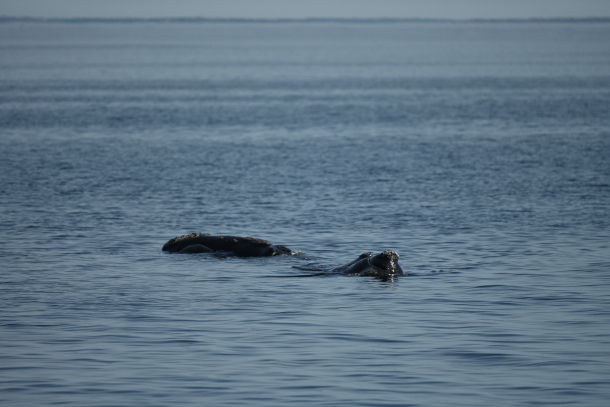
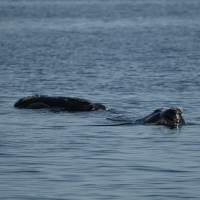
Shown above are a North Atlantic right whale mother, Bermuda (#3780), and her calf. (Photo: New England Aquarium, taken under NOAA Permit #25739-01)
CURWOOD: It’s Living on Earth, I’m Steve Curwood.
O’NEILL: And I’m Aynsley O’Neill.
North Atlantic right whales were once so thoroughly hunted they nearly went extinct. In fact, they were called right whales because they were considered the “right” ones to hunt, as they lived close to shore and floated on the surface once killed. When hunting these mammals was outlawed, they slowly started to bounce back, but today right whales are dealing with new deadly threats from humans. So, it’s a relief to have a successful calving season like this year, with 23 new calves, the most since 2009. Amy Warren is the Scientific Program Officer at the New England Aquarium and she joins me now. Amy, welcome to Living on Earth!
WARREN: Hi, thanks for having me.
O'NEILL: Tell me a little bit about your role there at the New England Aquarium. How closely do you work with our subject here, right whales?
WARREN: So, one of the things that my team does primarily is that we manage the North Atlantic Right Whale Identification Catalog, so any and all photograph sightings of right whales that happen anywhere in the North Atlantic come into our team, and we're responsible for putting those into the catalog, incorporating photos and all the data that goes with it. And so now we have this catalog that has over 800 individuals, so like all of time. The catalog goes back to 1935. So, any whale we've ever identified is in this catalog, living or dead. So, we get anywhere from 3000 to 5000 sightings a year with hundreds of thousands, really millions of photos, and so it's a lot of time and effort, but then kind of zooming in a bit, I do also get to do field work, so I'll be on boats in different areas where right whales are feeding. For example, in the month of April, I was just on the water six days when we see, you know, a bunch of whales every day, we're out there, and then in the summertime I get to go offshore on research cruises, and those usually two weeks where we're living on the boat for two weeks, we're out and we're, again, seeing whales every day.
O'NEILL: Well, so Amy, you're the perfect person for this. If somebody has never seen one of these right whales, not even a photo, how can we help visualize them? What makes these whales identifiable? What helps them stand out?
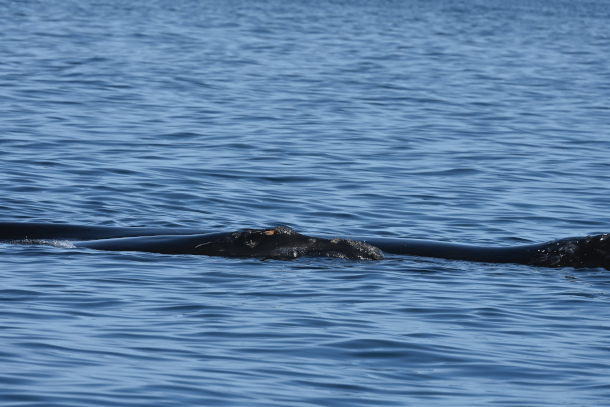
The 2025-2026 North Atlantic right whale calving season, which runs from mid-November to mid-April, saw 23 calves born, the largest number seen since 2009. Bocce’s calf, mom in the background (#3860). (Photo: New England Aquarium, taken under NOAA Permit #25739-01)
WARREN: A lot of people know humpback whales, so I think it's sometimes easiest to start with them. And right whales are similar in some ways to people who don't know them in size. They're actually a little bit bigger, a little bit heavier, 50 feet long, 50 tons, but what's unique about right whales is they have these white patches on their head, they're called callosities, and they're actually collections of whale lice, so they're actually small...
O'NEILL: Lice?
WARREN: ... white whale lice…
O’NEILL: Wow!
WARREN: …that congregate on these rough patches of skin on the whale's head, yeah, something that they're born with, and they're all kind of always in different patterns for each whale, and yeah, the whale lice like to congregate on those rough patches. It sounds bad, I know we don't have the best connotation with lice, but in this case it's perfectly fine. They're just kind of feeding off of the dead skin. It's more like a spa day, if we think about it, it's really just, it works for the lice, and it doesn't bother the whales. But the reason why we actually appreciate the lice in this case is that the lice are white and the whale's skin is black, so these rough patches without the lice would basically blend in with the skin, you wouldn't see them, but with the contrast of the white versus the black, it basically makes these like shapes and patterns, and each whale has really unique patterns on its head, and this is why we can identify them.
O'NEILL: And so, these North Atlantic right whales, they are critically endangered. I think estimates have their population at under 400 total. How much do we know about why these population numbers are so small, and how do they compare to maybe the populations in the past?
WARREN: It's actually interesting. We don't know what the populations used to be, because they were decimated so long ago. So, right whales were protected in 1932 from whaling internationally, but at the time no one can really say for sure, but the they're thinking that the population of right whales was maybe between 20 and 50.
O'NEILL: Oh my goodness,
WARREN: no extra zeros, no 1000s ...
O'NEILL: Yeah!
WARREN: ... 20 to 50, maybe...
O'NEILL: Double digits is bad!
WARREN: Yes, exactly. So their population actually did start to increase because they were no longer targeted, and this again, this is like, think of like 1930s to like 1980s but then jumping to kind of the 80s, 90s, 2000s you know, into now technology has gotten better, fishing gear has gotten stronger, it's gone further offshore, boats are bigger, boats are faster, and so all these new uses of the ocean by us have made it more dangerous for whales. So, the original decimation came from whaling. Then they came back up, and then their increase slowed again once kind of technology caught up to where they were. Add in climate change, you know, is now their food is moving, and so yes, we're part of that, but it's bigger than us. So, as their food has started shifting, it's bringing right whales into new areas, and that can bring them into areas that they have not been before and areas that are not ready for them. So, there's a lot of time and research that went on between, like, the 1980s and the early 2000s in that they like kind of discovered where whales were feeding regularly, they established these like hot spots or these habitats for them and were able to put protections in; either removing ships completely or slowing ships down, removing some of the fishing gear out of the water. In some areas, both up in the Bay of Fundy in Boston, they moved shipping lanes to go around these whale feeding areas, and so a lot of those things were helping. But as the food started shifting, the whales started shifting with them, and then whales started showing up into new places where those protections weren't there, because they didn't need to be there, and so that's kind of where we've been in recent years.
O'NEILL: And as I understand it, the problem isn't only with the whales themselves dying, but there's also an issue with the birth rates overall. How right is that?
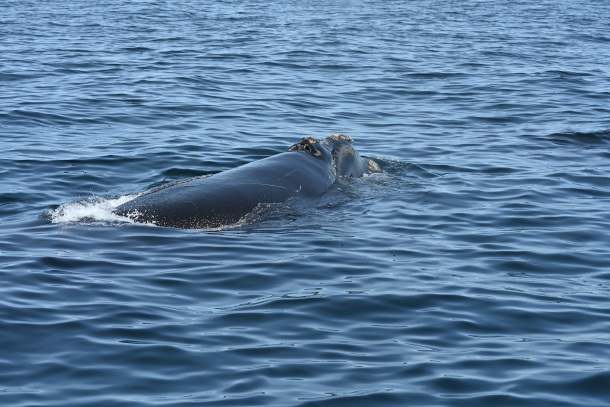
In the last decade, North Atlantic right whale mothers have gone as many as 10 years between birthing calves, but in the 2025-2026 season, several mothers had given birth only a few years prior. Shown above is Echo’s (#2642) calf. (Photo: New England Aquarium, taken under NOAA Permit #25739-01)
WARREN: Yeah, so there's a lot going into it, and it overall comes down to the health of the population, but also the health of each individual whale. So, you know, if whales aren't healthy, they're not going to be able to give birth, and when we say a whale isn't healthy, that could be for a number of reasons. It could be because they're not finding enough food, it could be that a whale was hit by a boat and it survived, but it has this injury that now its body is kind of like fighting back from.
O'NEILL: And so, tell us about this year, though, in the numbers, what did this calving season mean for the North Atlantic right whale?
WARREN: So, this year we saw 23 right whale calves born, and that is the fourth highest calf count we've ever recorded, and the highest calf count since 2009. So, that is great. One good year isn't going to save a species. We need lots of good years, and we recently had a lot of bad years, like low numbers. We had a year zero calves, a year of only like five, and so one good year kind of just makes up for a few bad years. But it's hopeful, it's good. We love to see it. We're seeing that a lot of these females were giving birth more often. So, like a healthy right whale, we think, can give birth every three to four years. But in the last, like, decade or so, we were seeing females wait 10 years between subsequent calves, potentially because it was taking them that much longer to get back to, like, a healthy weight, a healthy status before they were ready to get pregnant again. But this year we are seeing a lot of whales three, four, five, six years between calves. That's very promising. That's to us maybe a sign that they are a little bit healthier.
O'NEILL: What would need to happen for these whales to reach healthier population numbers?
WARREN: We need years and years of these very high calf counts, and years and years with no whales dying from human-caused injuries, which is a very tall order. But also, we need all of these calves to survive into adulthood, too. It was two years ago where 5 of the 20 calves born were not with us anymore by three months in, and then you know this year, just in January, we had two juveniles die from human causes, so you know they weren't even adults yet, so they couldn't even help add to the population, so that's another part of it too, that all these 23 calves born, the chances of all of them making it into adulthood... pretty low.
O'NEILL: Amy, what do you think is important for people to keep in mind when they see this headline about, oh, great year for the North Atlantic right whale?
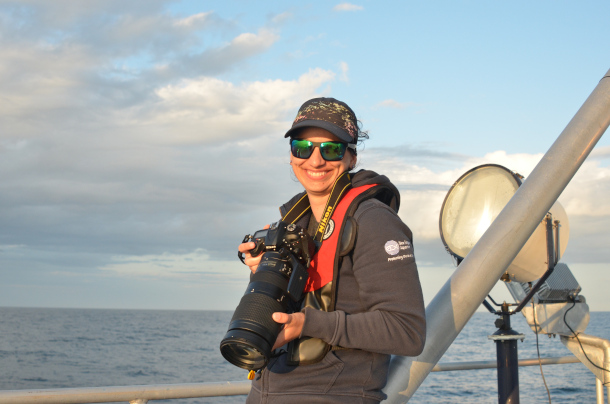
Amy Warren is a Scientific Program Officer at the New England Aquarium. (Photo: Courtesy of Amy Warren)
WARREN: I know we like to talk about numbers a lot, right? We like to talk about the population number, we like to talk about the calf numbers, but in general, I think it's important to take a step back and look at the status of the population, just 20 whales here and 10 whales there, like in the grand scheme of things, that doesn't matter as much of the population, whether it's healthy or not, whether it's doing well, and like are there things that we could do to be helping them more, and I think over the years we have established a lot of management mitigation measures that do seem to be working, and especially giving a year with some positive news, I hope that can just be incentive to keep going, like don't stop, don't fall back thinking we fixed everything, it's not that simple.
O'NEILL: Amy, what is it that these whales mean to you?
WARREN: Oh, what do they mean to me? I've always loved whales since I was a kid. So, part of it was there was just this early love for the ocean and whales and dolphins, and I just thought those creatures were so interesting. And I can't tell you how many times I've been on the water, how many trips I've done over the years, but like, it never gets old. Like, the excitement of seeing a whale does not change, and I think to go really specifically into right whales, the fact that we know so much about a wild population that lives across the North Atlantic, we know these whales individually, a lot of them have names that we've given them, we know when they were born. We know, like, who their siblings are. We know their parents and their grandparents. We know how many calves they've had. We just have all these, like, really unique stories. And I think, because we know each and every one of these whales, like, we do kind of create these personal connections with them, and you know, not to anthropomorphize them at all, but you know, you do start to see a little bit of personality, like some whales do certain behaviors a lot, and some whales don't do those behaviors at all, and some whales only show up in this one area and are never seen anywhere else, or vice versa. So, just to see that individuality, I think is really interesting, and it's relatable. I think that's another part of it too, like, yes, they're very different. They live in the ocean, but they are mammals. They give birth to young, you know, they take care of them, they live long lives, you know. It's just.. it's relatable.
O'NEILL: Amy Warren is the Scientific Program Officer at the New England Aquarium. Amy, thank you so much for taking the time with me today.
WARREN: Thanks for having me. It was great to be here.
Related links:
- CBS News Boston | ““Hopeful” Sign for Right Whales: Critically Endangered Species Sees Highest Number of Births Since 2009”
- Read more about North Atlantic right whales at the New England Aquarium website
- National Oceanic and Atmospheric Administration Fisheries Division information about North Atlantic Right Whales
- Amy Warren’s profile at the New England Aquarium website
[BIRDNOTE THEME]
Spring "Bursts" Forth
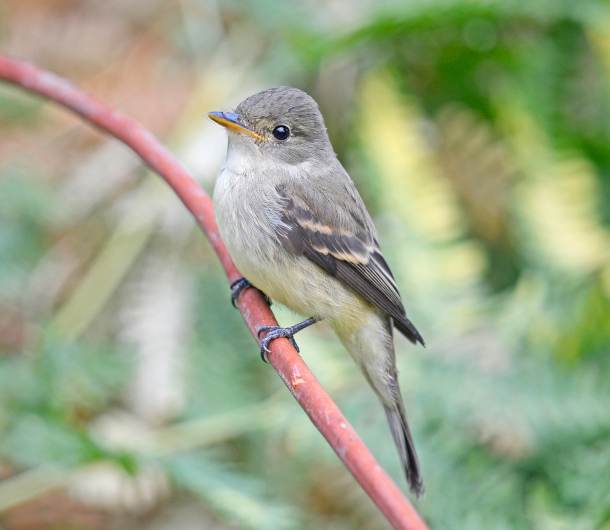
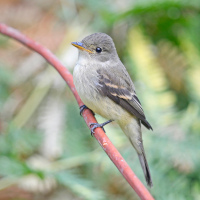
Willow Flycatchers are among the latecomers of migratory songbirds in North America, arriving as late as June. (Photo: VJAnderson, Wikimedia Commons, CC BY-SA 4.0)
CURWOOD: Springtime in the northern hemisphere brings many migrating birds returning from their winter havens. BirdNote’s Mary McCann reports.
BirdNote®
Spring Bursts Forth
Written by Bob Sundstrom
McCANN: We often hear it said that spring “bursts” forth. As if winter’s leafless trees suddenly shimmer with green. Flowers pop. Birds start singing with all their hearts.
[Northern Cardinal song, http://macaulaylibrary.org/audio/176244, 0.06-.10.]
But this seasonal change isn't instantaneous. It's a series of waves, slowly breaking waves that sweep up from the south to the north right over the continent.
[American Robin http://macaulaylibrary.org/audio/168300] ]
Early spring migrants like robins and bluebirds return north in March, some even in February. Across the whole of April week after week, new songbird migrants work north from the tropics adding bit by bit to spring’s ever-growing soundtrack.
[Intermixed songs of Black-headed Grosbeak, http://macaulaylibrary.org/audio/106598, 0.07-.10; House Wren, http://macaulaylibrary.org/audio/144011, 0.10-.12; Chipping Sparrow, http://macaulaylibrary.org/audio/191234, 0.11-.13]
By May, birds continue flooding into northerly states and Canada. And even as late as June, birds like Willow Flycatchers [song of Willow Flycatcher, http://macaulaylibrary.org/audio/106793] and Mourning Warblers are just completing the trek to northern breeding sites from South America. [Mourning Warbler, http://macaulaylibrary.org/audio/191054, 0.15-.17]
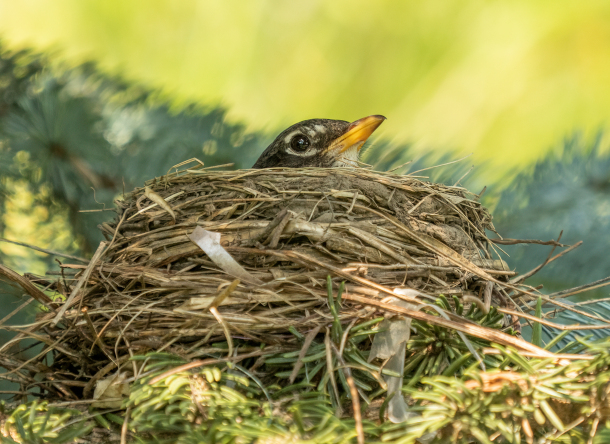
Robins, on the other hand, return north in March and may be feeding their second brood by midsummer. (Photo: Rhododendrites, Wikimedia Commons, CC BY-SA 4.0)
By this time, those early robins… [American Robin song, http://macaulaylibrary.org/audio/168300, 0.7-.11]
…may already be hard at work feeding their second brood. For them, spring has been bursting for over three months.
I’m Mary McCann.
###
Bird sounds provided by The Macaulay Library of Natural Sounds at the Cornell Lab of Ornithology, Ithaca, New York. Northern Cardinal [168300] recorded by G A Keller; American Robin [168300] Chipping Sparrow [191234] and Eastern Bluebird [107204] recorded by W L Hershberger.
Black-Headed Grosbeak [106598] House Wren [144011] and Willow Flycatcher [106793] recorded by R S Little. Mourning Warbler [191054] recorded by Jay W McGowan.
BirdNote’s theme music was composed and played by Nancy Rumbel and John Kessler.
Producer: John Kessler
Executive Producer: Dominic Black
© 2015 Tune In to Nature.org June 2015 March 2023 /2025
Narrator: Mary McCann
ID# spring-13-2015-6-3 spring-13
CURWOOD: For pictures, fly on over to the Living on Earth website, LoE.org.
Related link:
Listen to this story on the BirdNote® website
[MUSIC: Michael Jackson, “Will You Be There (Theme from “Free Willy”)” on FREE WILLY – ORIGINAL MOTION PICTURES SOUNDTRACK, SONY BMG MUSIC ENTERTAINMENT]
CURWOOD: Just ahead, weaving together Western science and Indigenous nowledge. Keep listening to Living on Earth!
ANNOUNCER: Support for Living on Earth comes from the Waverly Street Foundation, working to cultivate a healing planet with community-led programs for better food, healthy farmlands, and smarter building, energy, and businesses.
[CUTAWAY MUSIC: Basil Poledouris “Main Title” on FREE WILLY – ORIGINAL MOTION PICTURES SOUNDTRACK, SONY BMG MUSIC ENTERTAINMENT]
Indigenous Wisdom in Science
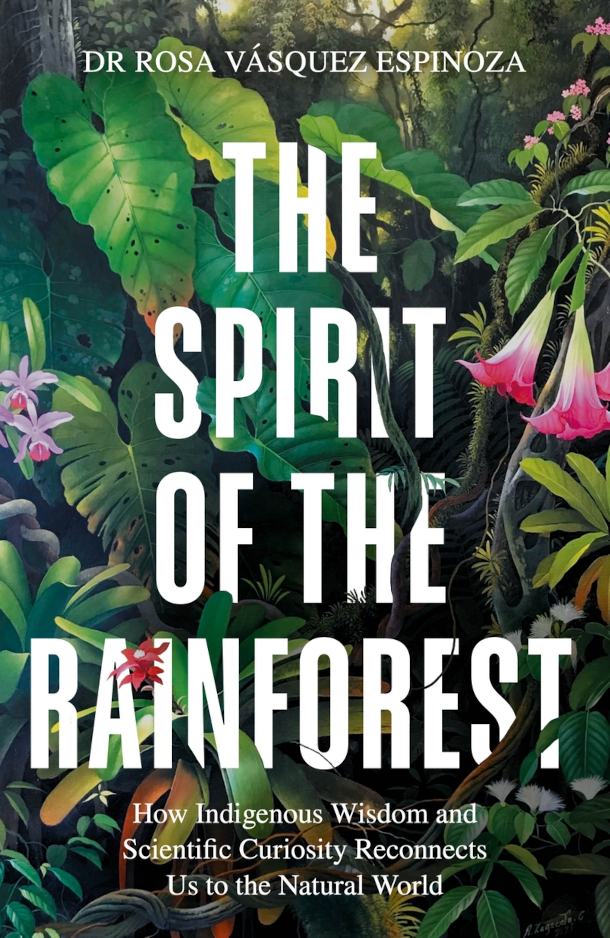
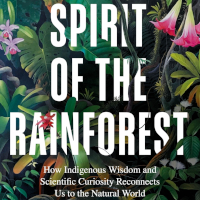
Dr. Rosa Espinoza’s book, The Spirit of the Rainforest: How Indigenous Wisdom and Scientific Curiosity Reconnects Us to the Natural World, chronicles her experiences in the Peruvian Amazon, studying the natural world alongside her indigenous colleagues. (Cover: Alfredo Zagaceta, Courtesy of Octopus Publishing Group)
CURWOOD: It’s Living on Earth, I’m Steve Curwood
O’NEILL: And I’m Aynsley O’Neill. In Western accounts of scientific expeditions into the remotest parts of our world, indigenous people can often be depicted as mere backdrop—part of a quote “exotic” landscape, or at best, helpful sidekicks. But for Dr. Rosa Espinoza, a Peruvian chemical biologist and conservationist, the traditional knowledge and worldviews of indigenous people could be the key to unlocking some of nature’s greatest mysteries, if western scientists are willing to listen—and collaborate.
Dr. Espinoza’s 2025 book is called, The Spirit of the Rainforest: How Indigenous Wisdom and Scientific Curiosity Reconnects Us to the Natural World, and she joins me now. Welcome to Living on Earth, Rosa!
ESPINOZA: Thank you so much for having me. It's such an honor.
O'NEILL: So, Rosa, please tell us a bit about how you grew up in Peru. What was your connection to both the rainforest there as well as the indigenous cultures there?
ESPINOZA: Yeah, absolutely. I had a unique upbringing. I was born and raised in the city of Lima, which is the capital of Peru, like any other busy city, New York or Buenos Aires, is just a bustling city without necessarily that much access to nature, but my grandmother made sure that she made a small natural pharmacy, a small garden that really reflected the nature she grew up with in the Andes, but also our Amazonian ancestry. Since I was a little girl, I would go visit my family members and spend summers in either the high Andes, the mountains of Peru, or the deep Amazonian forests. So, I had this very, like, yeah, triple cultural experience growing up with such depth perspectives on indigenous worldviews from my own family, and that really has allowed me to kind of see the world through these two eyes as I've delved into science.
O'NEILL: Well, because you did eventually go on to study chemical biology in a Western science tradition here in the US. How difficult was it for you to balance those two worldviews, the sort of Western worldview and your indigenous background?
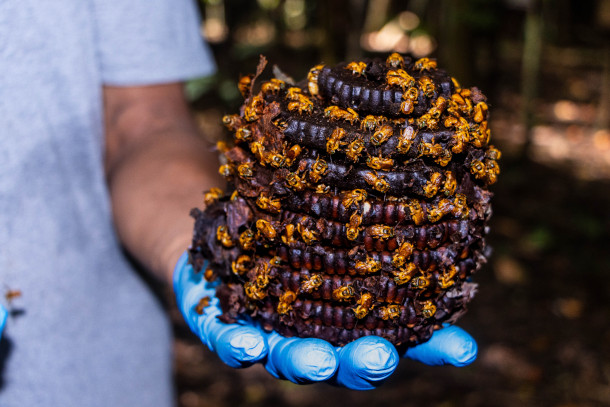
Heriberto Vela, of the Kukama Kukamiria indigenous culture, holding a colony of stingless bees. (Photo: Luis Garcia Solsol)
ESPINOZA: Yeah, that's exactly right. So, I think this indigenous connection made me have just a fascination for the natural world. While I was still in high school in Peru, I was really eager to get this additional lens on how to see nature, not just through the indigenous perspective, but through the scientific ones. So, I went on to do my undergrad and PhD in chemistry with a focus on chemical biology, and I think there are many difficulties when one tries to merge these two knowledge systems. First of all, that the indigenous worldviews have not really been considered scientific and are nowhere to be found, really, in the educational systems. So, it definitely felt conflicted, because to me, my grandmother, although she doesn't have formal education, was the first doctor I met, was the first chemist I met. I saw her apply such a method to her ways of learning and discovering and applying and reiterating, which was similar to what I was learning to do in the laboratory with these incredible academics, except that she just didn't have it in writing. So I think seeing the lack of representation was definitely something that felt heavy, and it just made me sad and a little frustrated because the farther I dove in Western science and realized that one in three medicines derive from nature and have had actually the discoveries made thanks to traditional knowledge, the fact that that still was not reason enough for us to find a stronger way to incorporate indigenous knowledge, it just made no sense, and I think that sense of injustice and awareness of lack of integration, it's definitely a big component why I decided to do what I do today.
O'NEILL: And in your book, you talk a lot about this "cosmovision," as you put it. Can you tell us what exactly is this cosmovision, and what inspired you or compelled you to incorporate it into your own personal perspective on the world?
ESPINOZA: Yeah, so indigenous worldviews, the other word we use for it is cosmovision, the vision of the world. I have actually have noticed that what I'm about to share, although I learn it through my Amazonian Andean heritage, you find similarities across indigenous groups around the world, which is in a way really beautiful, and I think reflective of a larger sense of humanity that we all share and just have forgotten about. So, the Amazonian and Andean indigenous worldviews share multiple truths. One is that nature is alive beyond just the biological definitions that we have for how nature could be alive, in the sense that a mountain is a life as well, and a tree is not just a biological resource but rather a grandfather. And so, this larger definition of life and the idea that we exist because nature exists and nature exists because we exist. This sense of continuity without any barriers to differentiate nature as separate, and so this sense of extension of self into nature plays such a key role into decision making afterwards. I think those are kind of the more comprehensive worldviews. There is another one from our Quechua heritage that I particularly love, and it's called the concept of ayni, which is, "today for you and tomorrow for me," and it actually derives from harvesting potatoes, meaning that you cannot do it alone, you need to have your whole community. So today you guys are going to help me harvest potatoes in my land, tomorrow will help you. So, it's a sense of reciprocity, that is not just practice within human forms, but also within non-human life.
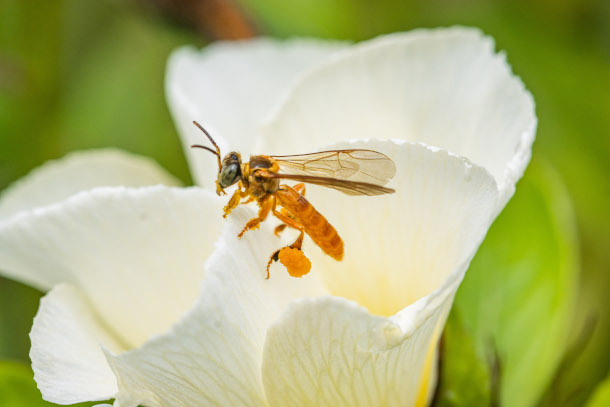
Angelita bee collecting pollen. (Photo: Luis Garcia Solsol)
O'NEILL: Well, and so there's the central perspective, essentially, that spirituality and science, they don't need to be separated when we consider the world, and in fact, we can learn so much more when we think of them jointly. What are some of the spiritual beliefs or practices that you feel can really help guide our scientific discovery?
ESPINOZA: That's a beautiful question, and that's exactly right. I think, in a way, the Western scientific world, or modern science in general, has relied on traditional knowledge for a long time. I mean, I'll give you a key example: the 2012 Nobel Prize in medicine, where it was awarded to Tu Youyou, a Chinese scientist who had discovered a drug to treat malaria that saved millions of lives back in the day when it was discovered, and the only reason why it was discovered is because these scientists went back to old Chinese traditional medicine and written records that the culture has, and from there they unlocked one single detail that their ancestors had managed to use to extract the active components from a plant. So, we have already used it, we just haven't had a system of acknowledging it. So I think to me it's a no-brainer that if we find a way to walk away from extractivism and instead work together equitably, we can not only do better by the discoveries that are already happening, but we can actually discover more, we can refine more solutions for medicine, for agriculture, for materials, for technology, for systems in general, in a way that I think if we only pursue one way of knowledge, we wouldn't arrive to those solutions, but the way I see it is that there is this new wave of explorers and scientists that, similar to me, have indigenous ancestry, can basically navigate both worlds and are facilitating this new way of conducting scientific work that actually honors both knowledge systems.
O'NEILL: What are you currently studying yourself, and in what ways has indigenous knowledge or practice influenced your current approach?
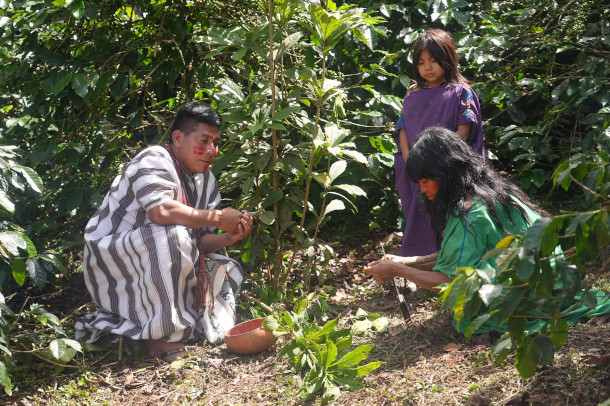
Ashaninka scientist Richar (left) with local citizen scientists, documenting medicinal flora. (Photo: Rosa V. Espinoza)
ESPINOZA: So our current main focuses for science, we have one aspect that studies stingless bees, which are the indigenous bees of the Amazon, and we are actually creating the first map as to where they exist in nature through the Amazon, and the only reason why that project is even possible is by the merging of knowledge, and by that I mean identifying these bees in the wild is really difficult. The genetic work is not quite ready yet to make it possible, and the indigenous people have their own indigenous taxonomy, which we learned early on that it matched the accuracy of insect taxonomy, and that is why we've been able to do this work. We have another program on medicinal gardens, and it's focused on creating the first compendium of scientific and cultural information on key natural medicines in indigenous languages, because traditionally that's just been done in foreign languages and not really even shared back with a community.
O'NEILL: And now in The Spirit of the Rainforest, you detail a number of these trips into the Amazon, many of which involve events that to an outsider might seem sort of larger-than-life. One that really stood out to me is this concept of the “boiling river,” which is something that I had never conceptualized before. Tell me a little bit about that.
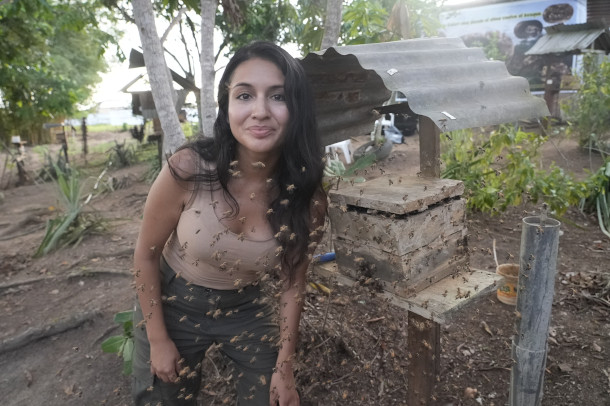
Dr. Rosa Vasquez Espinoza posing with thousands of stingless bees. (Photo: Myrian Delgado)
ESPINOZA: The boiling river, it's a place that really, I think, blows anyone's mind. So, people worldwide may be familiarized with other thermal systems, like Yellowstone National Park is such a famous one. There are some thermal springs in Iceland, Ethiopia, Japan, and others. These exist, and we know about, but now imagine that extended into a whole river that is so hot it's actively boiling, you hear the bubbles busting, and then the vapor raises so strongly that it is this constant sauna, and this happens to exist in the hearts of our planet, and unlike the Yellowstones or other thermal springs, the flora and the fauna somehow in the Amazon have managed a way to uniquely adapt, so that they grow literally right next to this extreme ecosystem that usually wouldn't accommodate any other forms of life, and it was part of my PhD work. I became fascinated with it, because it basically kind of creates this natural laboratory to start understanding climate change, and what are the life forms that can live in such an extreme place that reaches 99 Celsius, which is 200 Fahrenheit? Only microbes, a special kind of microbes. So that was part of what we did, and we actually managed to discover new species that were new to science too.
O'NEILL: And there's also a part of this story that I was truly on the edge of my seat for, that's a metaphor, usually, but I really was. It's when one of your travel companions burned his feet in scalding mud. Can you tell me a little bit more about that story?
ESPINOZA: Yeah, so you know, doing field work is dangerous and risky in general, and safety is definitely top of our priority. That doesn't mean one is free of accidents sometimes, and this was one of those that nobody could have ever predicted. And we happened to be in an area that had suffered from earthquakes over the last few years, which means the whole system had been rearranged, and part of the river was buried under thick layers of mud that, in theory, you could walk on top of, but they just happened to be this section that was a lot more fragile than any of us knew about, and one of our colleagues accidentally put both of his feet in boiling mud. I mean, he screamed immediately, it was absolutely terrifying. It also happened to be towards the end of the day, none of us had expected to stay beyond daylight. We were not really prepared for it, and we happened to be in an area where we had to open a path to enter, which means to get out, you don't have an open road to walk in, no, you are really struggling across the jungle, and it just became this unexpected, terrifying adventure and experience that, in a way, I think solidify our team effort so strongly, and reminded me that without a team we are nothing in the field.
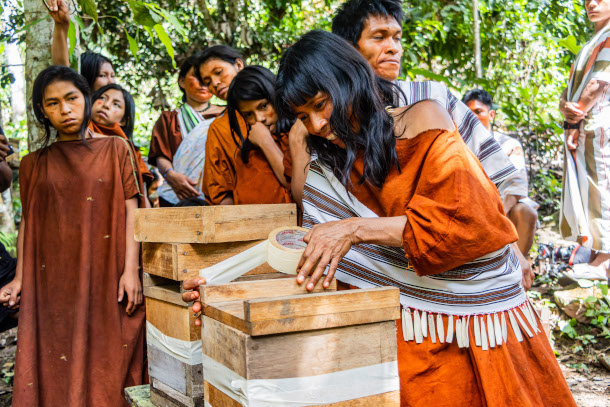
Here, a group of Ashaninka locals learn about sustainable stingless beekeeping. (Photo: Luis Garcia Solsol)
O'NEILL: I mean, and you're talking about the importance of the team. Part of that team was the local people who, in under an hour, you said built a bridge across another section of the river in order to help your teammate get the treatment that he would need. I feel like this really exemplifies the importance of this indigenous knowledge. I'm not sure that a lot of Westerners could build a bridge in under an hour in order to help somebody out.
ESPINOZA: But that's exactly my point. I think without indigenous knowledge and collaborations, there is only so far one can go. And this has been in history, it's just that it's never been acknowledged as co-authors, you know, co-authors of discoveries, of explorations. It's always been relegated to, oh, somebody help me, maybe I'll give them an acknowledgement, and in this case, I think the reason why our work is having the impact that it is having and is having this resonance with the rest of the world is because we've just simply shifted that dynamic, where now, instead of being bystanders or like mere contributors, they're co-authors of everything, you know?
O'NEILL: Well, then you, I believe, I think pioneered sort of the concept of listing your indigenous collaborators as co-authors on your published research, right?
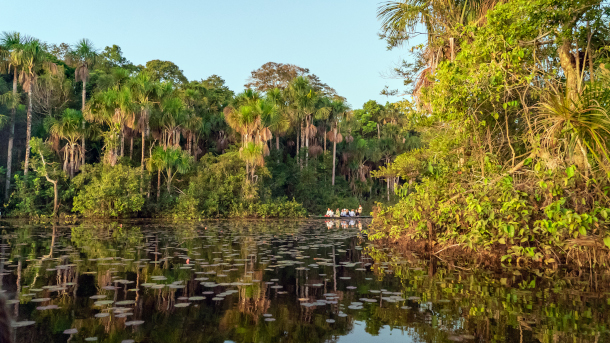
The Amazon Rainforest is one of the most biodiverse-rich places on the planet, such that it is difficult for scientists to accurately quantify. Some estimates suggest there are 3 million distinct species throughout the region. (Photo: Christopher Perry)
ESPINOZA: We definitely have one of the, I believe, the first case in Peru when a scientific article has an Asháninka community member and park ranger as the first author. We believe from what we've been able to find that he is the very first published a Asháninka scientist, which is outstanding, and I think part of that is to acknowledge that we did all the work behind the scenes for a few years to ensure he had the training needed to, you know, be in that position to be first author, although he may not have quote unquote, formal university scientific training, and yeah, I think it definitely ruffled some feathers, which we knew was going to do, because it's something new, and that is just bound to happen. I think some people were really excited to see this shift, some perhaps felt threatened or looked down upon it, but ultimately, I think it is opening these larger conversations, what you're saying. We've needed a better system. Clearly, something that we're doing collective, as you know, human society is not working for nature, because things are not necessarily getting better. So, why not let's try a better approach? And why not let's give power to those that are living in the most biodiverse areas of our planet that are suffering the worst consequences of climate change, although they have been the least ones to contribute to it?
O'NEILL: And now another thing you talk about is the idea of keeping an open mind to things that might seem fantastical or even impossible at first glance. Can you tell me about one of these phenomena that you yourself might have thought was impossible at first?
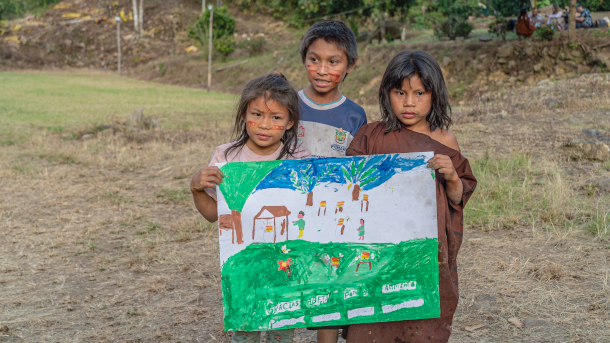
A group of Ashaninka children hold up a poster about beekeeping. (Photo: Luis Garcia Solsol)
ESPINOZA: Yeah, you know, in Western science we like to kind of boil things down to things we can measure and monitor, and it makes sense, and it is part of what we need, absolutely. At the same time, many of the discoveries we've got to, since the beginning of modern science, it's really through opening the door for a space of wonder. This is what we are missing right now. And one experience, particularly for me, was, so ayahuasca is considered a natural medicine in the Amazon. For those who have never heard about it, it is a combination of plans that shamans and elders make to be able to cure, to diagnose disease, and they drink it, and then go through this experience. Now, for many of the elders and masters that we connect with, I had heard so many times that they acquire knowledge through ayahuasca, which is a concept that I found it really hard to even just kind of conceptualize in my head. You acquire knowledge through a dream and acquire knowledge in the sense of seeing what plant to use for what disease, although nobody has ever told them that knowledge, even if sometimes being completely new plant that they have no scientific name for, and I kept an open mind in the sense of I was trying to understand what they meant and also trying to imagine what that would look like and not being able to get there and then I had an experience myself in an ayahuasca session where that happened to me. And I became a jaguar in this dream, and it sounds so bizarre to say it out loud, but in the process, I could smell medicinal plants, and what I came out from that in my own interpretation was, can animals smell medicine? It was a concept in science that I had never thought of. It made sense when you think about pheromones and other types of processes, but then that led me to an area of science that existed, which I had never heard of or knew nothing about, and it actually led to now one of the coolest new projects that we have. We've partnered with Dr. Elodie Freeman, who's an expert in an area of science called zoopharmacognosy. It's an emerging field. It's the study of how animals self-medicate, but none of this work has ever been done in the Amazon, and so, yeah, we are conducting this very cool set of experiments right now, and I think as we progress, we dream that it could guide us in understanding what medicinal flora is vital for people, yes, but also for animals.
O'NEILL: And that's just one of your many examples of how all of these scientific processes and scientific inquiries can be inspired by and considered in conjunction with something like the Ayahuasca dreams, this traditional way of knowledge acquisition. It's really incredible to see all of these get incorporated like this.

Rosa Espinoza Ph.D. is a chemical biologist, conservationist, and author of the book, The Spirit of the Rainforest: How Indigenous Wisdom and Scientific Curiosity Reconnects Us to the Natural World. (Photo: Stephanie King)
ESPINOZA: Thank you. I think, again, perhaps if someone you know keeps a closed mind and not even at least is open to have a dialogue, then we just close the doors to all of this, what may sound fantastical at first, and then we realize actually our natural world is fantastical. If we look at the details of the chemical and physical processes, many of those we couldn't have explained, you know, before we had the scientific tools we do now. And back in the day, previous cultures used to explain it, like witches, and you know, magic, and now we have some science to prove that. Have we actually discovered all the scientific tools to measure absolutely everything? I will argue no, just only, you know, in 1960s by that time, we didn't even have this thing called PCR. We thought DNA couldn't survive above 50 Celsius, and now people will laugh at the idea that that was a truth at some point. So, I think it's just kind of taking a look a little bit at the past and ourselves, and knowing that although our human minds are so extraordinary, the natural world has been here for much, much, much longer than any of us and evolved in so many deeper ways, and one way to listen to it differently, it's by looking at these ancestral civilizations that are still alive today.
O'NEILL: Dr. Rosa Espinoza is a chemical biologist, conservationist, and author of the book, The Spirit of the Rainforest: How Indigenous Wisdom and Scientific Curiosity Reconnects Us to the Natural World. Rosa, thank you so much for joining me today.
ESPINOZA: Thank you so much. It's been such a wonderful conversation, and I'm so excited to see more of the world getting to learn about this whole other reality that the Amazon is.
Related links:
- Learn more about Dr. Rosa Vasquez Espinoza
- Purchase The Spirit of the Rainforest: How Indigenous Wisdom and Scientific Curiosity Reconnects Us to the Natural World and support Living on Earth and independent booksellers.
[MUSIC: Inti-Illimani, “Takoma” on Lejania, Xenophile/Green Linnet]
CURWOOD: Living on Earth is produced by the World Media Foundation. Our crew includes Naomi Arenberg, Paloma Beltran, Jenni Doering, Abby Edgecumbe, Swayam Gagneja, Mark Kausch, Mark Seth Lender, Don Lyman, Ashanti Mclean, Sophia Pandelidis, Jake Rego, Andrew Skerritt, Bella Smith, Julia Vaz, and El Wilson.
O’NEILL: Tom Tiger engineered our show. Alison Lirish Dean composed our themes. You can hear us anytime at LOE.org, Apple Podcasts and YouTube Music, and like us please, on our Facebook page Living on Earth. Find us on Instagram, Threads and BlueSky at Living on Earth Radio. And we always welcome your feedback at comments @ loe.org. I’m Aynsley O’Neill.
CURWOOD: And I’m Steve Curwood. Thanks for listening!
ANNOUNCER: Funding for Living on Earth comes from you, our listeners, and from the University of Massachusetts, Boston, in association with its School for the Environment, developing the next generation of environmental leaders. And from the Grantham Foundation for the protection of the environment, supporting strategic communications and collaboration in solving the world’s most pressing environmental problems.
ANNOUNCER 2: PRX.
Living on Earth wants to hear from you!
Living on Earth
62 Calef Highway, Suite 212
Lee, NH 03861
Telephone: 617-287-4121
E-mail: comments@loe.org
Newsletter [Click here]
Donate to Living on Earth!
Living on Earth is an independent media program and relies entirely on contributions from listeners and institutions supporting public service. Please donate now to preserve an independent environmental voice.
NewsletterLiving on Earth offers a weekly delivery of the show's rundown to your mailbox. Sign up for our newsletter today!
 Sailors For The Sea: Be the change you want to sea.
 The Grantham Foundation for the Protection of the Environment: Committed to protecting and improving the health of the global environment.
 Contribute to Living on Earth and receive, as our gift to you, an archival print of one of Mark Seth Lender's extraordinary wildlife photographs. Follow the link to see Mark's current collection of photographs.
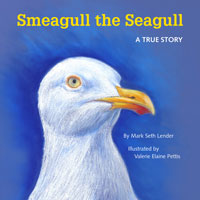 Buy a signed copy of Mark Seth Lender's book Smeagull the Seagull & support Living on Earth
© Copyright World Media Foundation. All Rights Reserved
Home | Contact | RSS | Donate | Newsletter