

June 19, 2026
Air Date: June 19, 2026
FULL SHOW
SEGMENTS
El Niño Is Here
View the page for this story
The 2026 El Niño is now officially underway, according to the National Oceanic and Atmospheric Administration or NOAA. Combined with the ongoing rising temperatures from the climate crisis, this possible “super” El Niño could spell major disruption of weather patterns and ocean circulation worldwide. Kevin Trenberth, scientist at the University of Auckland in New Zealand as well as a Distinguished Scholar at the National Center for Atmospheric Research in Boulder, Colorado, joins Host Jenni Doering to explain. (11:16)
Border Wall Threatens Sacred Mountain
/ Gustavo SolisView the page for this story
As part of its hard line on immigration, the Trump administration is building out new sections of border barriers, and one of the sections recently under construction runs across a small Southern California mountain just east of San Diego called Tecate Peak. KPBS reporter Gustavo Solis says construction crews are destroying parts of a mountain that’s sacred to the Kumeyaay people of California and Baja California. (05:23)
Note on Emerging Science: Long-Lived Greenland Sharks
View the page for this story
With a lifespan of several hundred years, Greenland sharks may be the longest living vertebrates on Earth and are estimated to reach sexual maturity at about 150 years old. Living on Earth’s Don Lyman reports in this note on emerging science about how enhanced activity of DNA repair genes may help Greenland sharks’ eyes avoid the usual degradation of aging. (02:00)
A Cemetery Buzzing with Bees
View the page for this story
While honeybees get most of the buzz, most bees don’t produce honey, and most don’t even live in colonies. Instead, they’re solitary bees who build individual nests. These are the type of bees that Bryan Danforth studies as a professor of entomology at Cornell University. He speaks with Host Paloma Beltran about his recent paper detailing an astonishing finding of several million solitary bees in a cemetery in Ithaca, New York. (11:00)
How Flowers Made Our World
View the page for this story
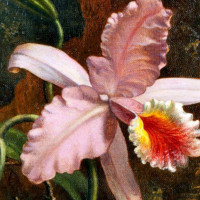
Lush peonies, delicate hydrangeas, and vibrant roses burst into bloom in early summer, filling gardens and parks with color and fragrance. But flowers are more than their beauty. They’re some of the oldest beings on Earth, and they played a large role in shaping the natural world as we know it. David George Haskell is an author and biologist whose 2026 book is How Flowers Made Our World: The Story of Nature’s Revolutionaries, and he joined Living on Earth’s Steve Curwood. (15:58)
Show Credits and Funders
Show Transcript
260619 Transcript
HOSTS: Paloma Beltran, Jenni Doering
GUESTS: Bryan Danforth, David George Haskell, Kevin Trenberth
REPORTERS: Don Lyman, Gustavo Solis
DOERING: I’m Jenni Doering
BELTRAN: And I’m Paloma Beltran.
Researchers find an astonishing abundance of bees in a cemetery.
DANFORTH: What does 5.6 million bees look like? It looks like 270 honeybee colonies – imagine what that looks like, a whole lot of white boxes scattered across the landscape. It’s also equivalent to 4 times the population of Manhattan, the human population of Manhattan.
DOERING: Also, flowers can be sweet smelling pleasures as well as ingenious ‘revolutionaries’ who remade the ecological world as we know it.
HASKELL: We often dismiss flowers as merely ornamental. They're pretty, but not powerful. They're beautiful, but not in charge. And in this book, I want to sort of reframe that and put flowers back at the center of the story of how our modern world came to be.
DOERING: That and more, this week on Living on Earth, stick around!
[NEWSBREAK MUSIC: Boards Of Canada “Zoetrope” from “In A Beautiful Place Out In The Country” (Warp Records 2000)]
El Niño Is Here
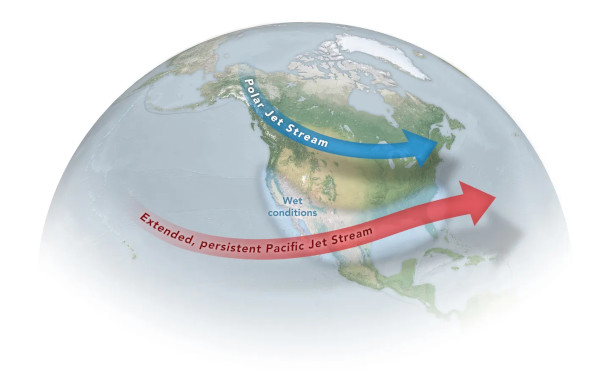
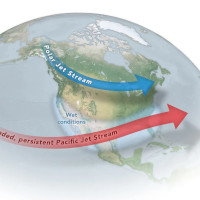
The El Niño phenomenon pulls the Pacific jet stream eastward, carrying wetter conditions to the western U.S. and Mexico and drier conditions to the north. (Photo: NASA, Joshua Stevens, modified by Michala Garrison)
BELTRAN: From PRX and the Jennifer and Ted Stanley Studios at the University of Massachusetts Boston, this is Living on Earth, I’m Paloma Beltran.
DOERING: And I’m Jenni Doering.
El Niño is a periodic phenomenon every few years in which a tropical region of the Pacific experiences unusually warm ocean surface temperatures, affecting weather patterns across the world. And a 2026 El Niño is now officially underway, according to the National Oceanic and Atmospheric Administration or NOAA, which also said this one has a greater than 50% chance of turning into a “super” El Niño. Combined with the ongoing rising temperatures from the climate crisis, a “super” El Niño could spell major disruption of weather patterns and ocean circulation worldwide. Joining us now from New Zealand to explain the impact is Kevin Trenberth, scientist at the University of Auckland as well as a Distinguished Scholar at the National Center for Atmospheric Research in Boulder, Colorado. Kevin, welcome back to Living on Earth!
TRENBERTH: Thank you very much.
DOERING: For those of us who don't remember from high school earth science, what is an El Niño?
TRENBERTH: An El Niño refers to an exceptional warming of the central and eastern tropical Pacific Ocean. El Niño can be thought of as a way of regulating the temperatures. The reason is the Pacific Ocean is huge in the tropics, and it extends more than a quarter of the way around the globe. The sun is beating down. It heats up the surface of the ocean, but there are trade winds, easterly trade winds in the tropics, and along the equator. It picks up all of that warm water and dumps it in the Western Pacific, and it forms a huge deep pool of warm water, and it gets to a point where so much heat is stored up there, the Pacific sort of says, "I can't stand it anymore. I'm going to have an El Niño." And all of that warm water starts to surge across to the Eastern Pacific, which it has done this year already, and it influences the atmosphere as it goes. And at some point during the year, usually after about September, mainly, it changes the atmospheric circulation. It changes where all of the rains occur in the tropical Pacific. It's already beginning to do that, but the annual cycle is working against it at the moment, and it tends to pick up in the Northern Hemisphere winter, and the strongest effects occur late in the year, typically peaking around December, and that's in the Pacific. And globally there is a mini global warming, which tends to peak around February of the following year, so that would be February of 2027.
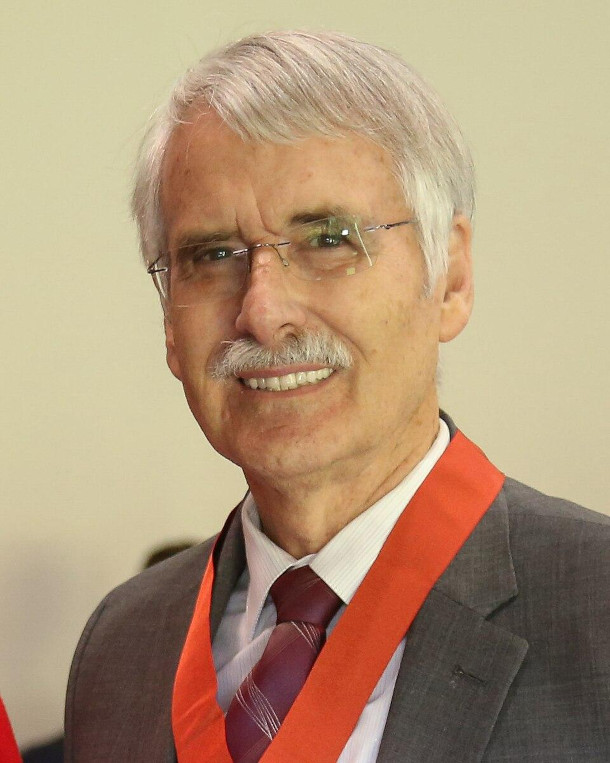
Kevin Trenberth, a New Zealand-American climate scientist studying climate variability and ocean processes (Photo: New Zealand Government, Office of the Governor-General on Wikimedia Commons, public domain)
DOERING: For an El Niño, there's all this heat building up in the Pacific Ocean, and it needs to be released. What makes an El Niño a super El Niño?
TRENBERTH: So we monitor a particular index, a tropical region in the Pacific, and if it gets to be above two degrees Celsius over this extensive area above the overall average, then we call it a very strong El Niño. And so we have these different grades of, you know, strong, moderate, weak El Niño, and very strong. There are no very strong La Niñas, which is the other phase where it's very cold, but there are these big El Niño events, and they've been about three of them.
DOERING: Why is this important? Understanding how this El Niño is working this year, and what were the impacts of previous strong El Niños?
TRENBERTH: So El Niños have strong what we call teleconnections, links, huge wave patterns that extend into both hemispheres. They change the distribution of tropical storms substantially where they occur, hurricanes and the risk of hurricanes. And in an El Niño event, there tends to be a greater risk that there will be strong storms coming into Southern California and throughout the southern parts of the United States, but probably less action in the northern parts of the US and Southern Canada, and so it has a big influence on rainfall patterns. It also can have a big influence, then, on the risk of things like wildfire, and in the western parts of the United States, it's been very warm, very dry, and the risk of wildfire is already quite high. So it's very important, actually, to get the rains in parts of this region, but there are some regions, maybe Northern Colorado, for instance, that might be at considerable risk for things like wildfire.
DOERING: So that's some of the impacts in the US. What about in the global south? I understand that in previous years we have seen pretty significant impacts from El Niño.
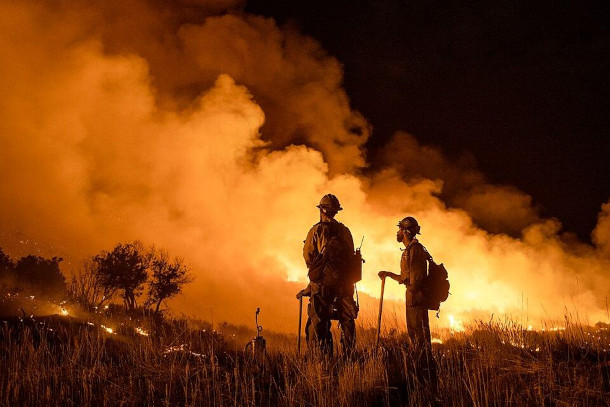
Much of the American West is vulnerable to increased wildfires during a strong El Niño year. (Photo: Kyle Miller, Wyoming Headshots via USFS, Wikimedia Commons, public domain)
TRENBERTH: So depends a little bit on how quickly this thing develops, but already this is the time of year when the Southeast Asian monsoon tends to develop, and having more action out in the Pacific, more convection, more rainfall, and so on tends to detract from the rainfall in the monsoons. And so it means that there's a real risk that the monsoons may be much weaker than normal, less rainfall all throughout Southeast Asia, and of course this has very profound influences, because eight months of the year it's dry. And they're very dependent upon the monsoon rains for all of their agriculture and growth of crops and so on, and so this is a major concern for that region.
DOERING: And then, how about Africa? What do different parts of Africa see in an El Niño year?
TRENBERTH: So it can get a bit more complicated then and it depends a bit more on just what happens in the tropical Indian Ocean, for instance. So normally warm water from the Pacific flows into the tropical Indian Ocean, and this has an influence in Eastern Africa, in particular, and it can affect drought and flooding, and also outbreaks of various kinds of diseases and insects that can cause problems, but each El Niño tends to be somewhat individual in characters to just how this plays out.
DOERING: I mean, this is incredibly complex. Would it be accurate to say that no matter what, this El Niño is going to bring variability and instability, and it's hard to predict exactly how that will play out in different regions? Is that accurate?
TRENBERTH: These things tend to occur, let's say, once every four years, or every two to seven years. That means that during the El Niño, which tends to last overall for about a year, the weather patterns are quite different than most of the time. If you can plan for that, you can take advantage of it. You can change the crops that you're growing, or the way in which you're going about your activities, like fishing, and so on, and what kind of fish you expect to get, then maybe you can take advantage of it. But otherwise, if you keep doing things the way you always do, then you could well run into major difficulties. And so pay attention to all of the information that's coming available from NOAA, for instance, or from other national weather services, including through the WMO, the World Meteorological Organization, and maybe take advantage rather than suffer the consequences.
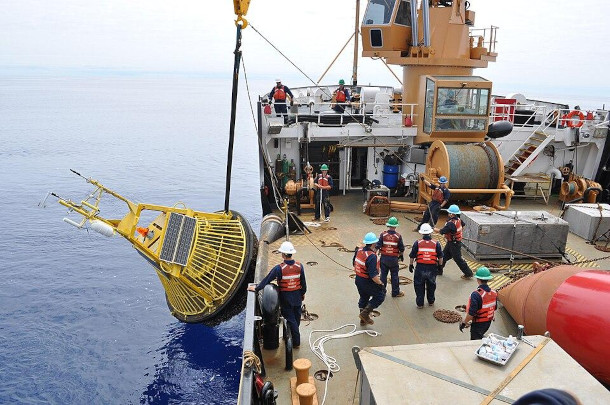
Many of NOAA’s monitoring buoys are part of the Ocean Observatories Initiative, which the National Science Foundation recently moved to dismantle. (Photo: Brad Dawson, Wikimedia Commons, public domain)
DOERING: Kevin, at this time when climate science is in the US, at least, under attack, there's been attempts to dismantle ocean monitoring systems, dismantle the research done by your professional home, the National Center for Atmospheric Research. So, how prepared do you think the US and the world is for this year's El Niño?
TRENBERTH: Yes, it's a major concern. And the key monitoring system in the tropical Pacific Ocean is a series of moored buoys. They're actually moored to the bottom of the ocean, and they have to be in the tropics, in the equatorial region, because otherwise they drift away. And those are maintained by NOAA, in particular, in conjunction with contributions from other nations, but if the NOAA contribution weakens, then the information flow also weakens. That happened during the pandemic, for instance, and there have been other instances where ship time was not available to service these and make sure that they're all up to snuff, and so this is a major concern. And so it's very important to monitor what is going on well and disseminate that information,
DOERING: Kevin, we're tracking this El Niño at the same time that we're also tracking the ongoing climate crisis, and you know, global temperature continues to rise because of our greenhouse gas emissions. And so, in the short term, what does an El Niño year mean in terms of the global temperature that we see?
TRENBERTH: So, the global temperature is certainly going to be the highest on record from about now through next June. This is sort of the El Niño year, if you like, and then that's a question as to whether it's 2026 or 2027 which ends up being the warmest calendar year. And so this is a signature that global warming is alive and well, and continuing, if you like. Global climate change is very much with us. We know it is caused primarily by human activities, the increases, in particular, of carbon dioxide in the atmosphere. Those concentrations are at the highest level ever. And we need to slow down the rates of those increases, which means cutting emissions of greenhouse gasses, and that means avoiding fossil fuel burning, in particular. This is a science question. This is not a political question, and we need to look after our homes, our global homes. The global warming, we need to get it under, under control, and there are prospects for doing that by employing more renewable energy, in particular.
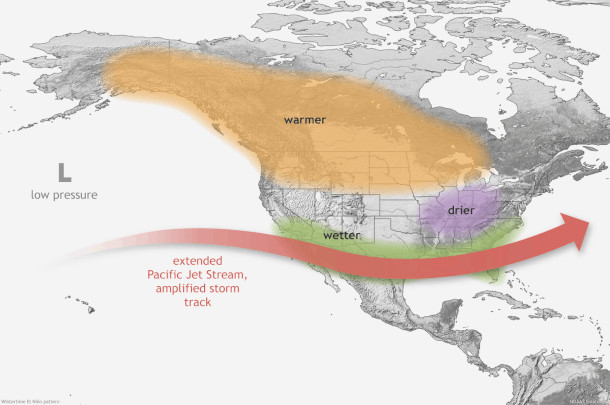
El Niño changes the Pacific Jet Stream, funneling storms into the southern U.S. and Mexico while leaving the north uncharacteristically warm and dry. (Photo: NOAA, NOAA.gov)
DOERING: Kevin, what's the number one thing that you would like listeners to take away about this year's El Niño?
TRENBERTH: The El Niño is here. It's potentially getting to be strong, and it's going to have big consequences for weather all around the globe. Big changes in where the storms go and how they develop. Paying attention to the information that's available and the forecasts that are being made can allow you to adapt to and prepare for what is going on, plan for the consequences, and perhaps even take advantage of the changes that are apt to occur.
DOERING: Kevin Trenberth is a distinguished scholar at the National Center for Atmospheric Research and a scientist at the University of Auckland in New Zealand. Thank you so much, Kevin.
TRENBERTH: You're most welcome.
Related links:
- National Oceanic and Atmospheric Administration | “El Nino Forms, Expected to Strengthen, Say NOAA Forecasters”
- The New York Times | “A Powerful El Nino Is Forming. If History Is a Guide, It Could Hit Hard.”
- National Oceanic and Atmospheric Administration | “El Niño: A Historical Perspective”
- About Kevin Trenberth
[MUSIC: Blue Dot Sessions “Set The Tip Jar”]
BELTRAN: Just ahead, The US Mexico border wall threatens a sacred Kumeyaay mountain in Baja California. Stay tuned to Living on Earth!
ANNOUNCER: Support for Living on Earth comes from the Waverley Street Foundation, working to cultivate a healing planet with community-led programs for better food, healthy farmlands, and smarter building, energy and businesses.
[CUTAWAY MUSIC: Luca Sestak, “The Final Lap” on Lighter Notes, Luca Sestak]
Border Wall Threatens Sacred Mountain
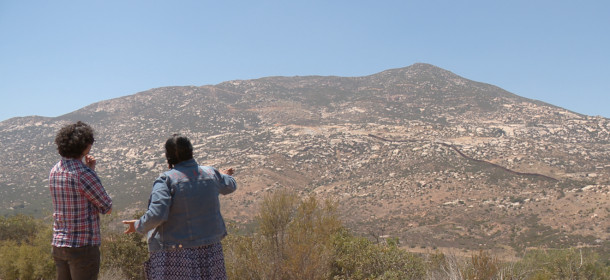
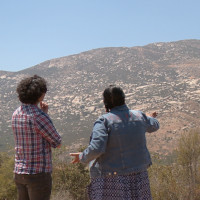
KPBS reporter Gustavo Solis (left) looks out over Tecate Peak’s new border wall construction with Norma Meza Calles (right), a Kumeyaay leader who lives in Baja California. Tecate Peak is considered sacred to the Kumeyaay community. (Photo: Carlos Castillo / KPBS)
DOERING: It’s Living on Earth, I’m Jenni Doering.
BELTRAN: And I’m Paloma Beltran.
As part of its hard line on immigration, the Trump administration is building out new sections of border barriers, and one of the sections recently under construction runs across a small Southern California mountain just east of San Diego called Tecate Peak.
KPBS reporter Gustavo Solis says construction crews are destroying parts of a mountain that’s sacred to the Kumeyaay people of California and Baja California.
SOLIS: The Kumeyaay name for Tecate Peak is Kuchamaa Mountain. And to them, the area along the U.S.-Mexico border near the Mexican city of Tecate is a sacred place.
Norma Meza Calles has spent her entire life around the mountain. She can tell you which plans cure an upset stomach and which ones help you fall asleep.
MEZA: La montaña es como un psicologo para nosotros.
SOLIS: Meza says the mountain is like a therapist for the Kumeyaay. People hike up the mountain, sit on the smooth white boulders, and mediate. As a little girl, she remembers seeing grown-ups spend multiple days in silent contemplation up on that mountain. Usually after a difficult divorce or a death in the family.
MEZA: Cuando se le moría uno, un divorsio, su familia, enfermo…
SOLIS: But some of those sacred stones – boulders that have been on that mountain for more than 100 million years – are gone. Pulverized, to make way for a new section of President Donald Trump’s border wall.
MEZA: Es muy importante la montana que estan, estan destryuendo.
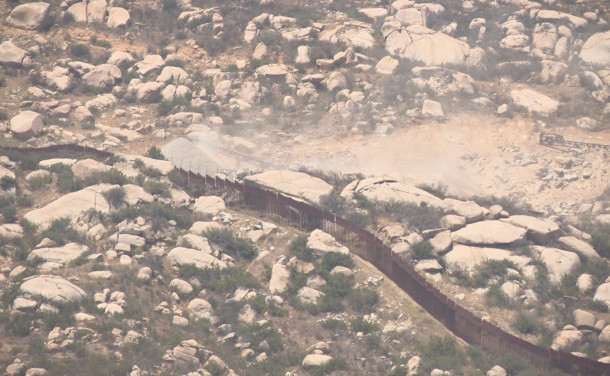
Above, stone is demolished to make way for a border wall expansion near Tecate. (Photo: Carlos Castillo / KPBS)
SOLIS: It’s being destroyed before our eyes, Meza says. Kuchamaa Mountain is technically protected in the National Register of Historic Places. Yet, this construction project was approved without a formal environmental review, which is normally required by the National Environmental Policy Act. Richard Kiy is president of the Institute of The Americas.
KIY: In recent years what has happened is that the Department of Homeland Security has been able to secure successfully through legal means waivers on some of these border projects and congress has actually authorized multi-year funding for the border fence which has allowed some of these projects to be fast-tracked.
SOLIS: Kiy worked for the EPA on cross-border affairs during the Clinton administration. He says the stones on Kuchamaa Mountain may have been saved, had there been a typical review.
KIY: That would’ve allowed for considerations related to the cultural significance of Mount Kuchumaa.
SOLIS: He understands why the Trump administration waived these requirements. The process can take years, and derail projects. For example, it took 10 years to complete a review of the CBX airport border crossing in Otay Mesa. But Kiy says skipping these reviews altogether is a missed opportunity to potentially find eco-friendly alternatives.
KIY: In the 21st century I think there are ways to explore technology solutions so that we can have a secure border but at the same time address some of the biodiversity concerns and cultural heritage concerns.
SOLIS: Like Norma Meza, Demian Vega grew up near the mountain. Vega works for the Rancho La Puerta Foundation – an organization that helped create a conservation easement on the Mexican side of the border, and part of that work involves teaching local children about the mountain.
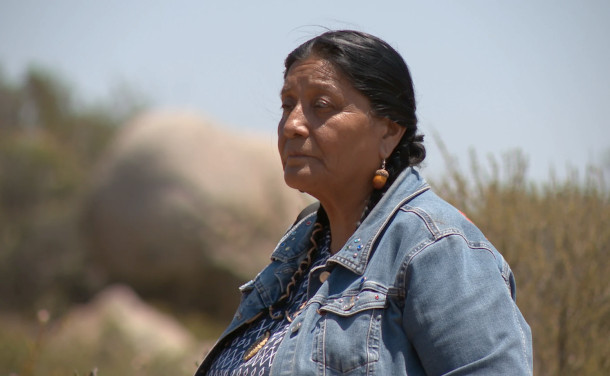
Norma Meza Calles is a Kumeyaay trail guide, interpreter and cultural ambassador. (Photo: Carlos Castillo / KPBS)
VEGA: That’s the things that the kids learned here in the trail. And they also learned to meditate along with the walk. But all of those activities have stopped because how can they meditate with the noises that we have and the construction that we have in front of their eyes.
SOLIS: The foundation worked with multiple organizations in Mexico to conduct their own environmental feasibility study. They looked at everything from wildlife, natural habitats, vegetation, cultural sites and even the risk of mudslides. Part of what makes this construction project so heartbreaking for the people of Tecate is that they thought they’d done enough to protect it. Vega says that, in the early 2000s, the Kumeyaay people and local conservationists worked hard with their counterparts in the U.S. to secure environmental protections on both sides of the border.
VEGA: Through an MOU with the Bureau of Land Management, the BLM, and with the Forestry Department, we also try to convince them to protect the land and we agree, both of the sides, both of the nations – so all of the mountain is protected in terms of nature and biodiversity.
SOLIS: Baja California’s Secretary of Culture has asked the United States to stop detonating explosives on the mountain. And Mexico President Claudia Sheinbaum said in a press conference in April that her administration is looking into the matter.
Meanwhile in Tecate, Meza does not expect construction to stop. She respects U.S. sovereignty and its right to defend their border. But views this episode as one more indignity for her people to overcome.
MEZA: Desde quando hemos sido pisotiados, hemos sido descriminados, hemos sido pues – y hemos resistido – y Tambien la montana esta resitiendo
SOLIS: She says the Kumeyaay in Baja, California have been stepped on and discriminated against most of her life. And through it all, they’ve always resisted. And the mountain? The mountain will resist too.
BELTRAN: Gustavo Solis reported this story for KPBS.
Related links:
- This story on the KPBS website
- About Journalist Gustavo Solis
[MUSIC: US Army Field Band “De Colores,” trad. Mexican folk song, perf. by 2022]
Note on Emerging Science: Long-Lived Greenland Sharks
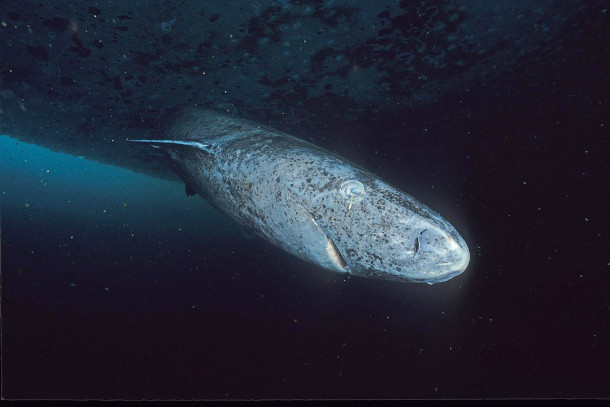
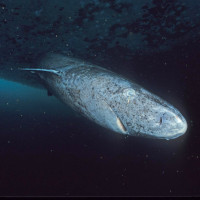
A Greenland shark spotted at the edge of Admiralty Inlet, Nunavut, Canada. (Photo: Hemming1952, Wikimedia Commons, CC BY-SA 4.0)
DOERING: In a moment, how cemeteries can be safe havens for bees. But first, this note on emerging science from Living on Earth’s Don Lyman.
[SCIENCE NOTE THEME]
LYMAN: The Latin name for the Greenland shark, Somniosus microcephalus, translates to “small-headed sleeper”, but these sluggish giants, which grow to 21 feet-long and can weigh over a ton, are the longest living vertebrates on earth. Scientists say these inhabitants of the cold waters of the North Atlantic and Arctic Oceans, can live to be hundreds of years old. Radiocarbon dating of eye lens tissue of Greenland sharks that died when accidentally caught in fishing nets revealed one specimen that was estimated to be around 400 years old. Scientists also estimated that Greenland sharks grow very slowly, approximately 1 cm (0.4 inches) per year, and don’t reach sexual maturity until they’re about 150 years old.
Biologist Lily Fogg, and her research team at the University of Basel in Switzerland, are trying to figure out how Greenland sharks live so long. To do so, they studied the sharks’ eyes. It wasn’t known if the sharks had much vision, and it was assumed that the sharks might be severely visually impaired. Fogg and her colleagues analyzed the eye tissue from 10 Greenland sharks, some of which were about 150 years old. They found that the cellular and molecular components of their eyes, that the sharks used to see in the dim light of the deep ocean were intact, probably due to enhanced activity of DNA repair genes, which likely keep tissues healthy over the long-term. The tissue in the eyes also looked like it avoided the degradation of aging.
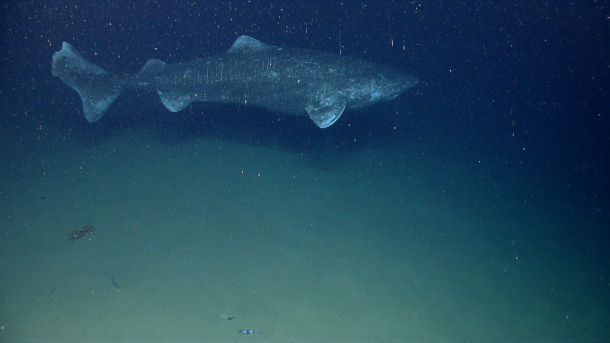
Above is a NOAA photograph showing a Greenland shark, seen during the 2013 Northeast U.S. Canyons Expedition. (Photo: NOAA Photo Library, NOAA OKEANOS Explorer Program, 2013 Northeast U. S. Canyons Expedition, Flickr, CC BY 2.0)
Fogg said that figuring out how Greenland sharks live longer than other vertebrates could possibly help to treat failing organs in aging people someday. That’s this week’s note on emerging science. I’m Don Lyman.
Related link:
Learn more at Lily Fogg’s article about the Greenland shark in Nature
[SCIENCE NOTE THEME]
A Cemetery Buzzing with Bees
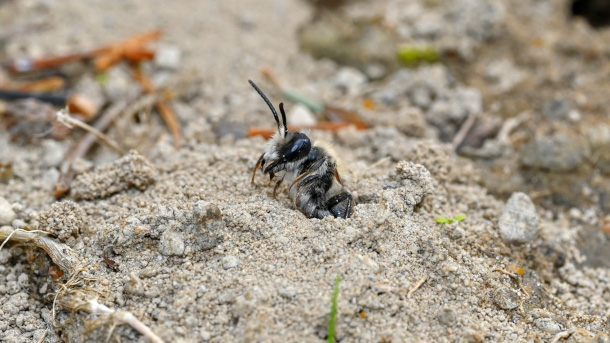
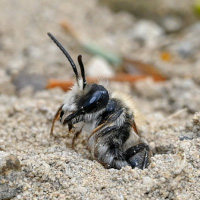
Though many of us might assume that bees always live in hives, most species of bees are solitary, and many of those live underground. Above is Adrena regularis, also known as the regular mining bee. Bryan Danforth and his team at Cornell studied a large aggregation of these solitary bees at a local cemetery. (Photo: Bryan Danforth)
BELTRAN: Many of us know the famous image of Winnie the Pooh holding onto a balloon, reaching his paw into a hive full of honeybees. But most bees don’t produce honey, and most don’t even live in colonies. Instead, they’re solitary bees who build individual nests. These are the type of bees that Bryan Danforth studies as a professor of entomology at Cornell University. His most recent paper details an astonishing finding of several million solitary bees in a cemetery in Ithaca, New York. Bryan Danforth joins me now to discuss -- Welcome to Living on Earth!
DANFORTH: Thanks very much, Paloma.
BELTRAN: So, when I picture bees, the first thing that comes to mind is a buzzing hive. But you study solitary bees. How common are these solitary bees compared to social bees?
DANFORTH: Yeah, that is the image I think many people have of a bee. You imagine a colony, you imagine a honey bee, or a bumblebee, a queen, thousands of workers, aggressive stinging. The bees that I work on, the solitary bees, are much more docile. These are bees in which each female builds her own nest, provisions her brood cells with pollen and nectar, lays her own eggs, defends her nest from enemies, parasites, and predators, and then leaves her offspring to the next generation. So, the image of a social bee is quite different from the kind of solitary bees that we work on. So, we know that there are 21,000 described bee species on Earth, and that's probably an underestimate. You know, there may be 30,000 bees total. Of those 21,000 described bee species, 77% of them are solitary, 13% of them are brood parasites of those solitary bees, and then about 10% are social. So the social bees comprise a pretty small slice of that 21,000 total species. The vast majority are these solitary bees.
BELTRAN: And you note in your study that solitary bees are important for pollination, but just how important are they?
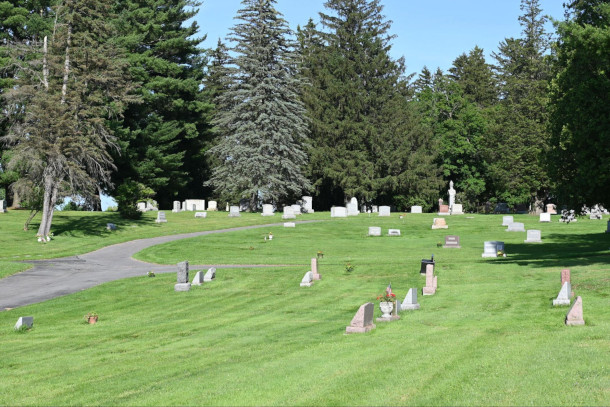
Bryan Danforth’s study took place at East Lawn Cemetery, located in Ithaca, NY. Danforth suspects that cemeteries serve as biodiversity hotspots for ground nesting bees. (Photo: Bryan Danforth)
DANFORTH: It really depends on the crop. I'll give you a few examples. So, in squash and pumpkin, for example, there is a single solitary bee species called Peponapis pruinosa, which is a narrow host plant specialist on squash and pumpkin, and those are very effective pollinators. They are early morning bees, so they get out before any of the other wild or managed bees, visit squash and pumpkin, and they're doing most of the squash and pumpkin pollination. We did a lot of work on the role of wild bees as apple pollinators in New York because New York is a big producer of apples. It's... we're the second largest producer of apples in the country, and for about a decade my lab studied the role of wild bees as crop pollinators and apples. So this is something I know really well, and we were able to document 120 wild bee species visiting apples in New York state, that's about a quarter of the total number of bees in New York state, so a big slice of New York pollinators are actually visiting apple, and through the work of Mia Park, a graduate student at the time, we determined that the solitary bees are actually more effective on a per visit basis as pollinators. So, when they visit a flower, they deposit more pollen grains, and they're also more abundant in many apple orchards. So, for the apples that I worked on, the wild bees are actually more important than honey bees, but there are certain crops that are really highly dependent on managed pollinators. So, I would say the answer to your question is, it really depends on the crop, but for the crops that I have worked on, the wild bees are very, very important, and they're doing all this work for free, by the way. These are not bees that you have to manage or you have to pay for. They're just out there in the environment doing their job.
BELTRAN: Wow, amazing. So your study was conducted at a cemetery in Ithaca, New York. How did your team choose this location for your research?
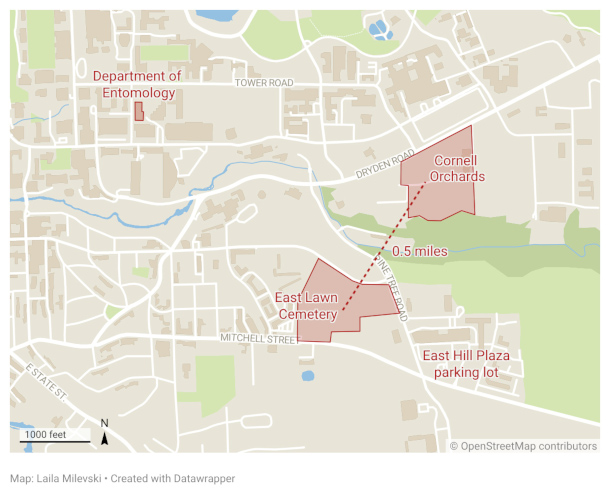
The team decided to study the bees in the cemetery when a colleague happened to see a cloud of them as she was walking from the East Hill Plaza parking lot to campus. (Image: Lalia Milevski, Created with Datawrapper)
DANFORTH: So, it turns out that the cemetery is just right off the edge of the Cornell campus, so we don't have to go very far to study these bees. But it really was just a random event. My technician at the time had the habit of parking her car at East Hill Plaza, the shopping center out there on the east side of campus, and on her way into work, she walked through the East Lawn Cemetery. And she did this in the spring of, I think it was 2022, and discovered that there were tons of bees over the lawn, clouds of bees flying over the surface of the cemetery. And she collected a few of these bees, brought them into the lab, and we immediately identified them as Andrena regularis, a solitary bee that we'd studied as an apple pollinator. We knew it was a fairly common bee in New York, but we didn't really know where it nested, and we certainly didn't know how large the nesting aggregations were. So this discovery allowed us then to dig into, no pun intended, dig into the biology of this bee. So we then did a follow-up study in 2023 where we used emergence traps to capture bees emerging from the soil at the very start of the season, and that allowed us to track the number of bees emerging over time, the sex ratio of the bees, the parasites emerging along with the host, and we were able to come up with this population estimate of 5.6 million bees.
BELTRAN: Wow, that's a huge number. How surprising was that number to you?
DANFORTH: So it was very surprising to me, although I will say that I would not at all be surprised if there were larger bee aggregations out there. It just turns out that this is the largest one that's ever been reported in the literature. And I'll put that number in perspective. So, what does 5.6 million bees look like? It looks like 270 honey bee colonies. Imagine what that looks like, a whole lot of white boxes scattered across the landscape. It's also equivalent to four times the population of Manhattan, the human population of Manhattan.
BELTRAN: Wow.
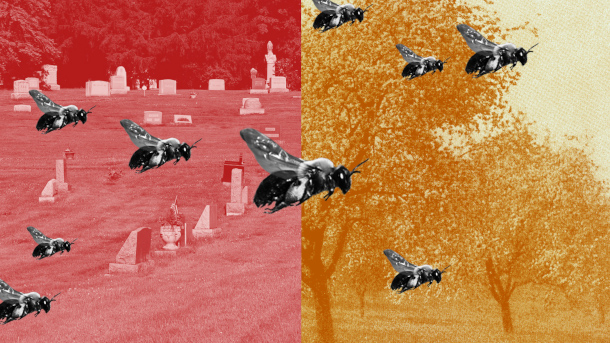
Solitary bees are crucial to the pollination of many crops, including the species of apples that grow in New York. (Photo: Lalia Milevski)
DANFORTH: It's a large number. Yes, there are a lot of bees.
BELTRAN: What were the conditions in this cemetery that led to such a high concentration of bees?
DANFORTH: We think that it's related to the soil texture. Ground nesting bees, just like humans, like to dig in soil that's kind of maintains its consistency, so the cemetery soil is what's called sandy loam. It's a very nice soil texture for digging, and we think that that's one of the reasons that these bees are particularly abundant at that site. And many cemeteries across the landscape in the eastern United States were sited on these sandy loam soils because you could dig a six foot deep hole with a shovel in sandy loam soil, and this was before the advent of the backhoe. So, we think that there is really something unique about that sort of soil texture, and now we're expanding our studies to look at other cemeteries around New York and see whether they have that kind of soil and whether they also host large numbers of solitary bees.
BELTRAN: And part of your study analyzed parasite rates among bees. Talk to me about the parasites. What do they look like, and how do they affect the bees?
DANFORTH: Yeah, so we focused on the most common parasite of Andrena regularis, which just turns out to be another bee. It's called Nomada imbricata. It's the nomad bee. We call them brood parasites, or you could call them cuckoo bees. They are very adept at sneaking into the nest of their host, laying an egg in the brood cell, and hiding that egg in the wall of the brood cell, and then leaving, so the adult would leave. Meanwhile, the host bee continues to provision her brood cell, she lays her own egg, she closes up the brood cell, and then she's done with that brood cell. She will never go back into that brood cell. Meanwhile, the nomad bee egg hatches. It crawls across the pollen provisions. It kills the host egg or larva, and then it consumes the pollen and nectar that was gathered by the host, so it's a very devious strategy. It's very much like a cuckoo bird. It's a very common strategy in bees. As I said, about 13% of bee species are brood parasites, and they specialize on individual species or individual groups of bees as their particular host. And I should point out that these brood parasitic bees are really quite different looking from your normal bee. They're not hairy. They are very wasp-like. They're yellow and black. They're heavily armored. They live their life kind of just skulking around the nest site, you know, because they don't actually build a nest. They don't need to collect pollen and nectar for their offspring, so they're kind of drifters around the nest site. And then when they see the opportunity, they dive into a nest. So, if you see wasp-like creatures flying low over the ground in an area where there are bees nesting, those might be brood parasites.
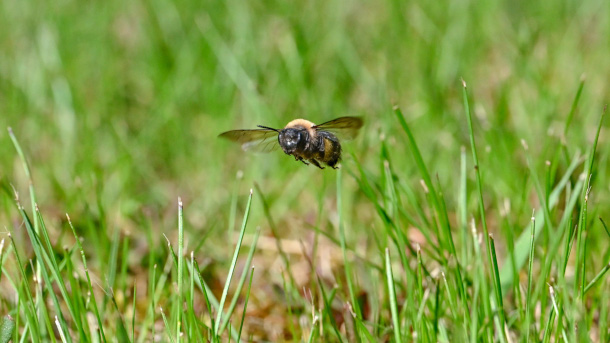
Adrena regularis is far less aggressive than many species of social bees. Each mother lays her own eggs underground and provides them with pollen. (Photo: Bryan Danforth)
BELTRAN: So, you ended your study by discussing how cemeteries could be important for preserving biodiversity. Why do you think that is?
DANFORTH: It turns out that there's a reasonable literature on this. A number of studies have been done in Europe, looking at the fauna and flora of older inner-city cemeteries in cities like Berlin, and it turns out that these cemeteries can host rare plants. They can host rare birds, rare salamanders, so cemeteries, I think, turn out to be these underappreciated biodiversity preserves, and that's because they're undisturbed. So, once the cemetery is established, and most cemeteries are at least 200 to 300 years old, even in the eastern US, so these sites become preserves. They're no longer undergoing change. There's no building. There's no construction going on. And then, in addition, there's low pesticide use in those cemeteries. So, I really think that our study, but also some previous work done in Europe, suggests that cemeteries are these underappreciated refuges for biodiversity.
BELTRAN: You know, what are the broader implications of your research in the cemetery regarding bees?
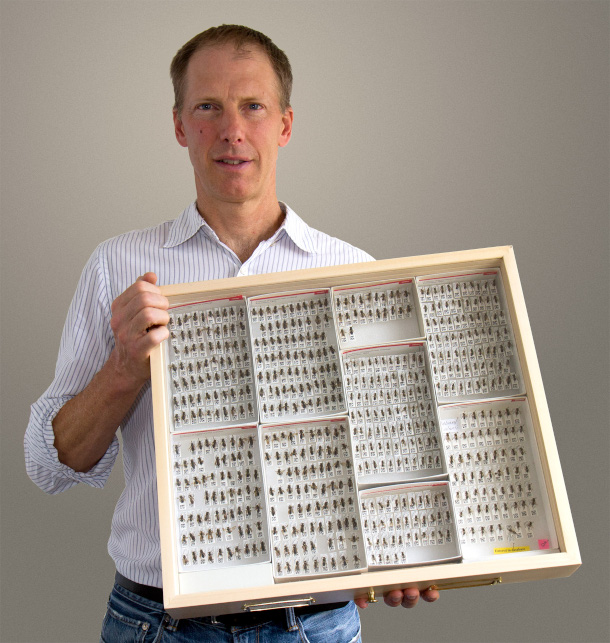
Bryan Danforth is a professor of entomology at Cornell University. (Photo: Courtesy of Cornell Media Relations)
DANFORTH: So, I think the real take home from our study at the East Lawn Cemetery is that nest sites are incredibly important conservation priorities, and that we need to be identifying these nest sites, protecting them, and educating people about their value. So, as a result of that, we started a project called Project GNB, or Project Ground Nesting Bee. It's a community science project. We run it through the iNaturalist platform. And we would like backyard naturalists, birders, people out for a walk with their dog to upload observations of nesting sites, if they see them, of these bees, so that we can map across the landscape where these nesting aggregations occur, and therefore protect them. That's, I think, the main take home from our study.
BELTRAN: Bryan Danforth is a professor of entomology at Cornell University. Bryan, thank you so much for joining us.
DANFORTH: Thanks very much, Paloma. It's been a pleasure.
Related links:
- Read Bryan Danforth’s original research paper
- Get involved with Project Ground-Nesting Bee
- About Bryan Danforth
[MUSIC: US Army Band, Nikolai Rimsky-Korsakov, “Flight of the Bumblebee” from The Tale of Tsar Saltan (1899 – 1900)]
DOERING: Coming up: Where there are bees there are flowers, and they’re much more than just nice to look at or smell. Keep listening to Living on Earth!
ANNOUNCER: Support for Living on Earth comes from the estate of Rosamund Stone Zander - celebrated painter, environmentalist, and author of The Art of Possibility – who inspired others to see the profound interconnectedness of all living things, and to act with courage and creativity on behalf of our planet. Support also comes from Sailors for the Sea and Oceana. Helping boaters race clean, sail green and protect the seas they love. More information at sailorsforthesea.org.
[CUTAWAY MUSIC: Luca Sestak, “Solfeggietto” on Lighter Notes, Luca Sestak]
How Flowers Made Our World
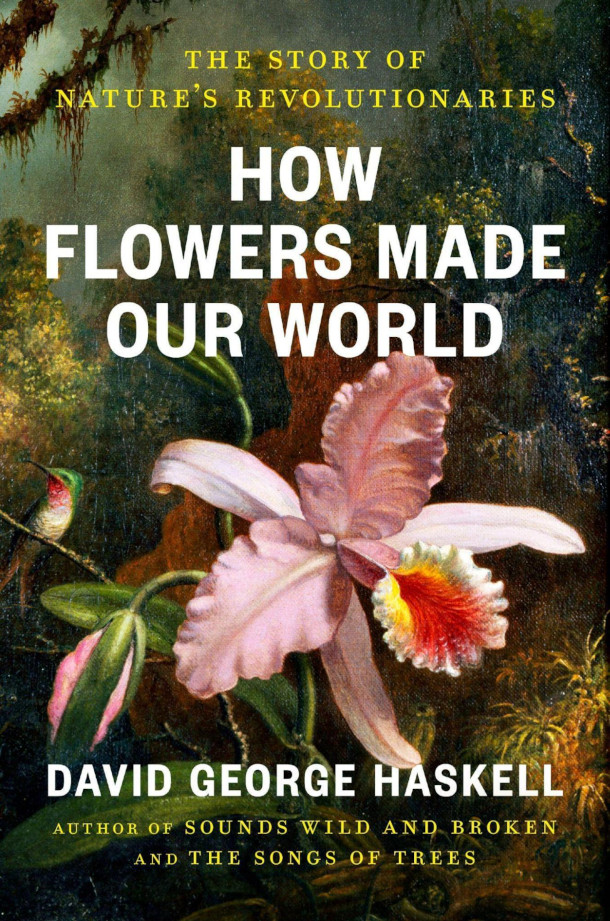
David George Haskell’s 2026 book, How Flowers Made Our World: The Story of Nature’s Revolutionaries (Photo: Courtesy of David George Haskell)
BELTRAN: It’s Living on Earth, I’m Paloma Beltran.
DOERING: And I’m Jenni Doering.
Early summer is peak flower season across the Northern hemisphere. Lush peonies, delicate hydrangeas, and vibrant roses burst into bloom, filling gardens and parks with color and fragrance. But flowers are more than their beauty. They’re actually some of the oldest beings on Earth, and they played a large role in shaping the natural world as we know it. David George Haskell is an author and biologist whose latest book is How Flowers Made Our World: The Story of Nature’s Revolutionaries, and he joined Living on Earth’s Steve Curwood.
CURWOOD: The title of your book refers to flowers as revolutionaries. Okay, what are you talking about? What's the revolution started by flowering plants? How exactly did they make our world, as you say?
HASKELL: Yes, the title sounds a little preposterous, but I really mean it. When flowers appeared on this planet, they swiftly transformed the nature of the planet and built most of the major habitats that we have with us today. Think about rainforests and prairies, they are built by flowering plants. And they catalyze the evolution of all sorts of major groups of animals, bees, butterflies, grazing mammals, and even the origin of our own species, Homo sapiens. And so they did make the ecological world as we know it, and yet, and yet, we often dismiss flowers as merely ornamental. They're pretty, but not powerful. They're beautiful, but not in charge. And in this book, I want to sort of reframe that and put flowers back at the center of the story of how our modern world came to be.
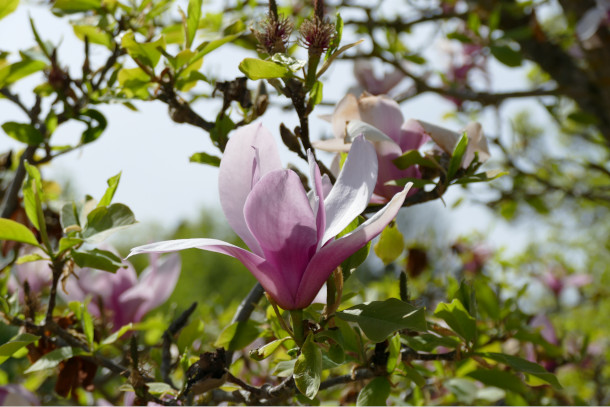
The magnolia has both male and female reproductive parts, making it an ideal pit stop for pollinators, who can pick up and drop off pollen in one stop. (Photo: Kritzolina, Wikimedia Commons, CC BY-SA 4.0)
CURWOOD: So, having pollination, having sexual reproduction, means that plants can change, adapt, evolve. What is the genetic aspect of all of this? At one point in your book, you point out that flowers sometimes have more sets of genes than we do.
HASKELL: Yeah, so the beauty of flowers, the extra motherhood of flowers, these are things that we can see. Underneath the surface, there are innovations that we can't see without modern genetics, and this is one of the revolutions that's happened just in the last 10, 20 years, is that we now understand that flowering plants go through what I think of as genetic storms, where they massively increase the number of chromosomes, they double all the chromosomes, or triple all the chromosomes inside their cells, which honestly is quite excessive. You don't need four or six copies of every chromosome to run a plant, but what those doublings do is that they mean that two of the chromosomes can do the work of running the plant, and the other two or four are free to explore, it's like a cross between a rave and a corporate brainstorming retreat. The usual rules of life have sort of loosened up a little bit, so those genes on those chromosomes can mutate and explore new ways of doing photosynthesis, new ways of growing petals, producing aromas, massively increasing genetic diversity, which is the raw material of evolution, of adaptation, of resilience, and then after this big party of exploration, natural selection kicks in and trims the genome back, keeping the good ideas, keeping the good innovations, and throwing out the rest. Now other organisms go through this kind of doubling, but it's especially prevalent in flowering plants, because they have quite flexible development, so they can tolerate a certain amount of genetic shenanigans as they're developing and growing in a way that, say, a mammalian cell could not. By repeatedly going through these genetic storms, flowering plants have given themselves these boosts of genetic diversity that have helped them, particularly in times of environmental calamity, like when a meteorite strikes the earth. These storms have been particularly important.
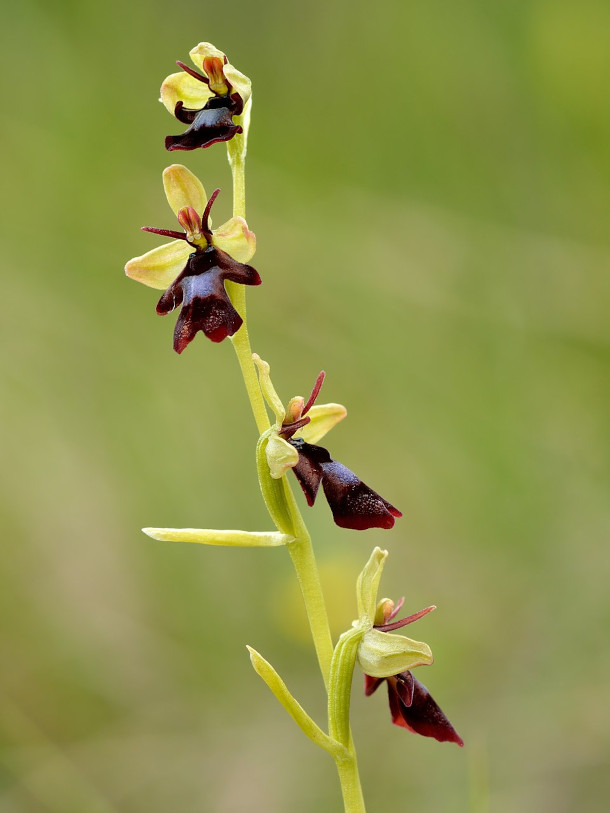
Fly orchids are sexual deceivers. They evolved to look like female wasps so that male wasps will land on them and spread their pollen. (Photo: Ivar Leidus, Wikimedia Commons, CC BY-SA 4.0)
CURWOOD: So, you spent a fair amount of your time talking about magnolias in this book. What's so instructive about the magnolia?
HASKELL: So, I start with the magnolia plant, and part of the reason for that, indeed, they're beautiful. I just love their aroma. It's like diving into a different sort of mental space to smell the magnolia flower, but magnolias also are portals into deep time, because their overall structure, a bowl of petals with both male and female sexual parts within it, welcoming all kinds of different pollinators, is very little change in nearly 100 million years. So they're biologically bisexual in the same flower, which is very efficient, because then any little insect that arrives can both bring pollen and take pollen away. And to this day 90% of flowers still keep with that old formula for success of having male and female in the same bloom.
CURWOOD: So at one point in your book, you call out Henry David Thoreau, saying that his call for self-reliance is, well, it's rather problematic in the case of flowers. What do you mean?
HASKELL: Yeah, so I mean, of course, he was a beautiful writer and had lots of great, insightful things to say, but his call to sort of go it alone, to go out into the cabin and live by the labor of his hands alone, A: was a lie, because his sisters and his mother were cooking for him and doing his laundry, and so forth. So it was a sort of fiction that he was spinning there in his writing. And B: in terms of biology, it really doesn't work. There is no species that has been able to go it alone and succeed, and what flowering plants do is give us a time-tested example over 100 million years of success through cooperation, success through building new relationships, primarily with pollinators and fruit disperses, but also below ground with fungi and microbes, extending those pre-existing partnerships. So the Thoreau way of thinking, this sort of notion that the self is the fundamental unit of innovation and of progress, I think doesn't really hold up in biology, and flowers are an extraordinary example of that.
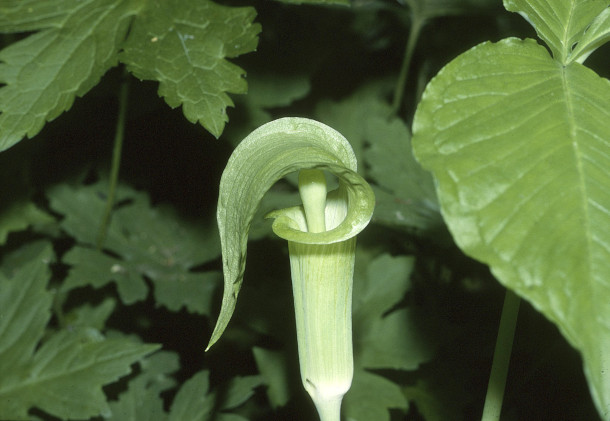
Another deceiving flower is Jack-in-the-pulpit, or Arisaema triphyllum, which traps and kills its pollinator. (Photo: Robert H. Mohlenbrock, Wikimedia Commons, Public Domain)
CURWOOD: So these plants aren't always nice to the rest of the ecosphere, I mean, what about deception and trickery by plants that are seeking pollination and the substrate that they sometimes use?
HASKELL: Absolutely, so I've emphasized cooperation, and indeed, most interactions between flowers and their pollinators are cooperative. They both, the pollinator gets some nectar and pollen to eat, and the plant gets pollinated. But there are delicious dark threads running through this, and as is true in all sorts of stories of evolution, conflict and cooperation are in creative tension with one another, and orchids are great examples of this. So many orchids pretend that they have food to provide nectar and pollen to feed the insects, but really they have none. The storefront says we're full, but once the insect goes into the store, there's no reward there. So the insect is being duped. But it gets worse, because some orchids are sexual deceivers. They look and smell just like female wasps, and so the male wasps embrace the orchid flower, thinking that they're going to mate with a female of their own species, but they're just wasting their time. Instead, they get a dab of orchid pollen on the back of their head, and they fly on into another flower. And then others, like Jack and Jill-in-the-pulpit, a common plant in much of the eastern United States, actually kills its pollinator. There are male flowers that flies fly into it and pick up pollen, but when they enter a female flower, there's no exit hole, and the little flies die inside the plant. So, this, for me, is a suggestion that we should put the brakes on allegorizing nature too much. Nature is not a moral guide, or if we want it to be, we're going to be finding a sort of Baskin-Robbins of different flavors to choose from.
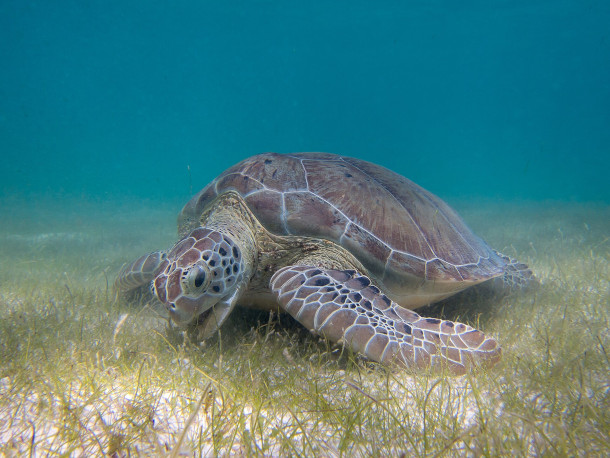
Many organisms depend on flowering plants to survive, such as the green sea turtle, which grazes primarily on sea grass. (Photo: P. Lindgren Wikimedia Commons, CC BY-SA 3.0)
CURWOOD: So we as humans, you say, owe our very existence to the evolution of one family of flowering plants. Tell me, what is so powerful about grasses?
HASKELL: Yes, I mean, many of us don't even think of grasses as flowers, but if you've got allergies, you know very well that grasses do indeed produce flowers. And grasses are a fairly late arrival on the scene. They evolved after many other groups of flowering plants, and what they did was create new habitats like savannas and prairies and the steppes, very productive habitats. They did so mostly by encouraging fire and later grazing animals. And our ancestors, say 10 million years ago, were happy primates living up in the trees of tropical forests, and then I don't know why some of them had this idea of leaving that quite pleasant life, but they moved out of the forests into grasslands to become bipedal primates, walking on two legs, either eating grasses or eating animals, like wildebeest, that were eating the grasses. So, without grasslands, our ancestors would still be up in the trees, as most other of our primate cousins are. So, both millions of years ago, in the evolution of our pre-human ancestors, grasslands were critically important, and, in fact, the main catalytic stimulus for the evolution of our species, and then in the present day, wheat, maize, and rice form two thirds of the calories we eat. So even today, we are grass apes, and we should be putting grasses on the altars of our places of worship to thank our original ecological creators. I mean, I'd encourage listeners actually to use the zoom on your cell phone camera to look at some of the native grasses that we have here in North America and around the world. And when you look close, the flowers are incredibly beautiful, particularly when they set seed, they're like these architectures made out of silvery strands and all kinds of different shades of brown. It's just absolutely gorgeous.
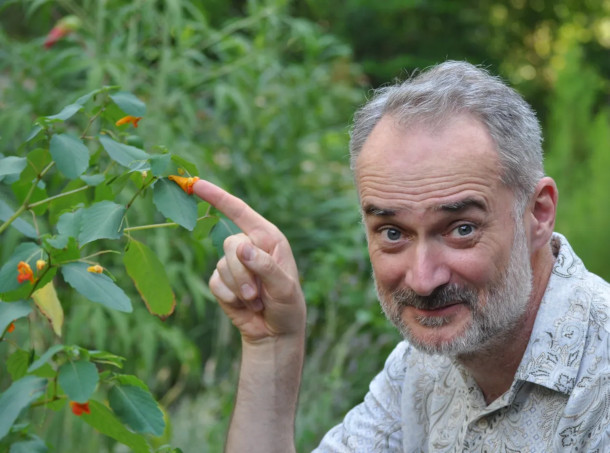
Author David George Haskell (above) invites listeners to dive into the world of flowers by observing them through all the senses. (Photo: Katherine Lehman)
CURWOOD: By the way, speaking of grasses, I was somewhat startled by your section about sea grasses, and your assertion that they're so extremely important and really not understood. So, why are they so important?
HASKELL: So, sea grass is a kind of flowering plant that blooms underwater, extraordinary creatures, right? And they have special pollen grains that are designed to catch the ocean currents and spin back down into the sea grass meadow. Sea grasses grow wherever there is mud or sand extending out into the shallows of the ocean, so they ring many continents. They form the nurseries for many fish and shellfish and invertebrates, so they're really important for biodiversity. They're also incredible storehouses for carbon. A seagrass meadow can store per acre, per year, more carbon than the richest forest on earth, sometimes 30 to 50 times more carbon. So they're great climate champions, they're biodiversity champions, but you know they don't look particularly impressive, right? They don't look as impressive as an old growth forest or a rain forest, and yet they're a vital part of the ecosystem. In the 20th century, they declined by up to 7% per year globally, and the good thing is now there are some incredibly successful restoration projects that are bringing back these seagrass meadows back to some of their former glory, and also weaving awareness of even the existence of sea grass back into human consciousness, and also it's a reminder that the revolutionary power of flowers wasn't just limited to the terrestrial world, they also revolutionized the oceans. Green sea turtles, for example, feed mostly on seagrass meadows. So, without seagrass, there'd be no charismatic marine reptiles swimming around, let alone all the fish and other creatures that depend on them.
CURWOOD: Much of the operation of flowers is done with aroma, with fragrance. What do you suppose that says about us as a species, and how important smell is, even for humans, let alone the animals that can smell flowers as part of their quest for pollination?
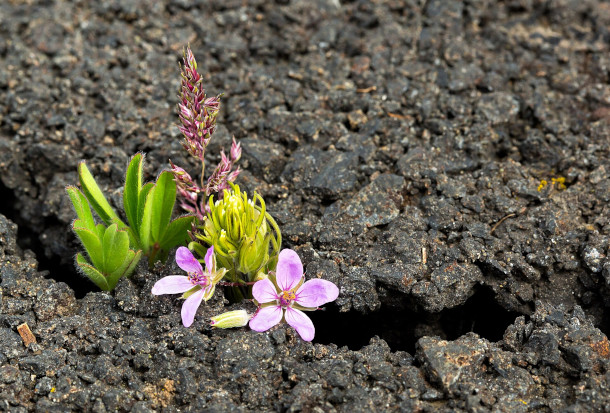
Haskell says his favorite flowers are the ones that grow in the cracks of his driveway. (Photo: Sheila Sund, Wikimedia Commons, CC BY 2.0)
HASKELL: Well, I think smell is one of the most important senses in humans, and the sense of smell goes directly to the parts of our brain associated with memory and emotion, so smell is this way of connecting in a deeply emotional way to the living world, which I think is why we like floral aftershave, perfumes, floral scented candles, is that it's a way of becoming chimeric beings. I express my individuality myself paradoxically by hybridizing my aroma with that of a flower, which to me is a beautiful enactment of what flowers do for the rest of the ecosystem, which is draw unlikely species together into partnerships. So, in my book, I repeatedly emphasize the aromas of flowers, because it's a delight that we can find in just in the middle of the city, smelling flowers that are growing in parks or in department stores through floral perfumes. And reconnecting with aroma brings us back to our senses and brings us back to the present moment, because it's an experience of the moment that you hold onto in memory, but you can't carry with you, say, the way you take a photograph with it with your cell phone. So ephemerality is especially precious to me.
CURWOOD: You invited us to play with flowers at the end of your book. What's one way to play with them?
HASKELL: So the end of the book, I really wanted to encourage people to get hands on and senses on with flowers. It's wonderful to read about flowers, and I hope people find some interesting florid tales in the book, but the book ends deliberately with flowers' power to draw us out of ourselves into relationships, so making floral perfume in your own kitchen. The simplest is just to sit with a flower and use your imagination and senses to get into the flower's world. To whom is the flower speaking? What aromas is this flower producing? How did the flower get here? What role do humans have in this flower's well-being? This is essentially a floral meditation, and we all need a little bit more flower power in our lives right now. And so I'd encourage listeners just to take 15 minutes this week to sit with a flower, open your curiosity, unself yourself into the flower's world and see where that curiosity and sensory connection will lead you.
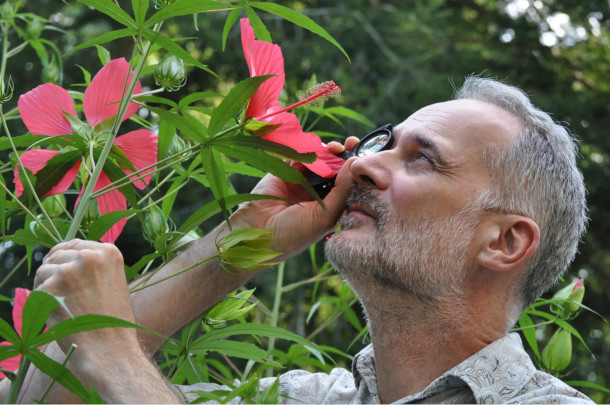
David George Haskell is an Atlanta-based author and biologist. (Photo: Katherine Lehman)
CURWOOD: Probably the first thing I'll do is sneeze, and then, right?
HASKELL: [LAUGHS] the sneezing is part of the sensory connection.
CURWOOD: David, why are flowers so important to humans in your view? Maybe you would read a section from your book about that.
HASKELL: Yeah, so I can read from page 255, this is the afterward on floral beauty and joy. When we take pleasure in a flower, we reclaim our inheritance as animals in a world made by flowers. Sensual indulgence and enjoyment of floral beauty are not frivolities, flowers give us embodied experiences of the creativity and vitality that drive the grand narrative of life on earth. Floral delight is deep, earthy beauty.
CURWOOD: Before we go, David, you can tell me. What's your favorite flower?
HASKELL: My favorite flower are the tiny little weeds that grow up in the cracks in my driveway. I've got a very old cracked driveway in Atlanta, and there are a dozen different species of weed that grow from all around the world, and I admire and love those plants so much for their resilience and for the way that they launch beauty out of these unexpected places, and to me that's embodied hope. Given half a chance, the floral world can remake the world, and we can cooperate with them. And so, in the springtime, I literally lie down in my driveway with a little hand lens and look at these tiny little blooms that we often dismiss as mere weeds. But in fact, these are our kin, and they're our creators, and I really, they lift my spirits, and I look forward to their emergence in the cracks in the driveway every single year.
DOERING: David George Haskell is a writer, biologist, and adjunct professor at Emory University in Atlanta. His book is called How Flowers Made Our World: The Story of Nature's Revolutionaries, and he spoke with Living on Earth’s Steve Curwood.
Related links:
- Purchase How Flowers Made Our World and support Living on Earth and independent booksellers
- Learn more about David George Haskell
[MUSIC: Monplaisir, “Hélice” on Bonjour from Paris, Nantes and Montreal, CC0 1.0 Universal License, 2016]
SIMARD: So, definitely we need to look after moving our energy sector to renewables, but at the same time, we need to be working with Earth. The ecosystems, the forests, the wetlands, the prairies have huge capacity to sequester and store carbon dioxide. And in fact, some scientists estimate that when we do this, that we can actually draw down CO2 within the century to reasonable levels, so we gotta be working on the reduce emission side, but we also gotta be working on the increasing the sink side. And what my research shows is that we can do this, that there is incredible regenerative capacity in the forest and all ecosystems. They're wired to do this as long as we are good stewards and we leave the seeds and the spores and the trees and the soil in good health, that Mother Earth will come back. With that recovery of the forest floor so quickly, that was to me was like, oh yeah, oh yeah, she's ready to do this. In restoring these forests which are globally we, we think that up there are about 70% of them are underperforming or are damaged in some way, that if we restore them, do the work, then we can really have a big impact on greenhouse gasses.
BELTRAN: Mother trees and more, next time on Living on Earth.
[MUSIC: Richard Wagner, “Waldweben (Forest Murmurs)” from Siegfried, 1876. Perf. by U.S. Marine Band, Lt. Col. John R. Bourgeous, conductor]
BELTRAN: Living on Earth is produced by the World Media Foundation. Our crew includes Naomi Arenberg, Mia DiLorenzo, Abby Edgecumbe, Swayam Gagneja, Mark Kausch, Mark Seth Lender, Don Lyman, Ashanti Mclean, Nhung Nguyen, Aynsley O’Neill, Sophia Pandelidis, Jake Rego, Andrew Skerritt, Bella Smith, and El Wilson.
DOERING: Tom Tiger engineered our show. Allison Lirish Dean composed our themes.
You can hear us anytime at L-O-E dot org, Apple Podcasts and YouTube Music, and like us please, on our Facebook page, Living on Earth. Find us on Instagram, Threads and BlueSky at living on earth radio. And we always welcome your feedback at comments at loe.org. Steve Curwood is our Executive Producer. I’m Jenni Doering.
BELTRAN: And I’m Paloma Beltran. Thanks for listening!
ANNOUNCER: Funding for Living on Earth comes from you, our listeners, and from the University of Massachusetts, Boston, in association with its School for the Environment, developing the next generation of environmental leaders. And from the Grantham Foundation for the protection of the environment, supporting strategic communications and collaboration in solving the world’s most pressing environmental problems.
ANNOUNCER 2: PRX.
Living on Earth wants to hear from you!
Living on Earth
62 Calef Highway, Suite 212
Lee, NH 03861
Telephone: 617-287-4121
E-mail: comments@loe.org
Newsletter [Click here]
Donate to Living on Earth!
Living on Earth is an independent media program and relies entirely on contributions from listeners and institutions supporting public service. Please donate now to preserve an independent environmental voice.
NewsletterLiving on Earth offers a weekly delivery of the show's rundown to your mailbox. Sign up for our newsletter today!
 Sailors For The Sea: Be the change you want to sea.
 The Grantham Foundation for the Protection of the Environment: Committed to protecting and improving the health of the global environment.
 Contribute to Living on Earth and receive, as our gift to you, an archival print of one of Mark Seth Lender's extraordinary wildlife photographs. Follow the link to see Mark's current collection of photographs.
 Buy a signed copy of Mark Seth Lender's book Smeagull the Seagull & support Living on Earth
© Copyright World Media Foundation. All Rights Reserved
Home | Contact | RSS | Donate | Newsletter