
This Week's Show
Air Date: October 16, 2026
FULL SHOW
SEGMENTS
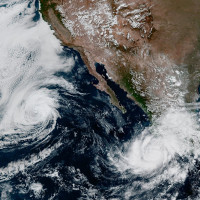
Powerful Pacific Storms Amid 'Super' El Niño
/ Seth BorensteinView the page for this story
Boosted by climate change, this year’s El Niño has intensified into a “Super El Niño,” meaning sea surface temperatures in parts of the Pacific are over 2 degrees Celsius hotter than average. Seth Borenstein of the Associated Press talks with Host Paloma Beltran about how this has brought one strong storm after another churning across the Pacific Ocean while shutting down most Atlantic storms, and what this super El Niño may bring in the months ahead. (10:38)
Pesticide Atrazine Contaminating 25% of US Rivers
View the page for this story
Atrazine is the second most widely used weed killer in the U.S. after glyphosate, which you might know from RoundUp. Much like glyphosate, atrazine can disrupt hormones and has been linked to serious health impacts, including cancer. Atrazine is also wreaking havoc on aquatic ecosystems, and a recent report from the Center for Biological Diversity finds nearly a quarter of all river miles in the US contain harmful levels. Nathan Donley, the Environmental Health Science Director at the Center for Biological Diversity, speaks with Host Aynsley O’Neill. (12:27)
A Guardian and A Thief
View the page for this story
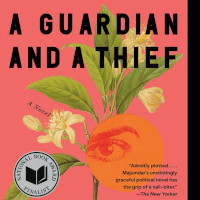
In her award-winning novel A Guardian and a Thief, Megha Majumdar places her characters in the near future in a climate-changed Kolkata, India, where she grew up. Megha Majumdar joins Host Aynsley O’Neill to discuss how the climate crisis may present the kinds of difficult moral choices her characters grapple with. (22:03)
Show Credits and Funders
Show Transcript
261016 Transcript
HOSTS: Paloma Beltran, Aynsley O’Neill
GUESTS: Nathan Donley, Seth Borenstein, Megha Majumdar
[THEME]
O’NEILL: From PRX – this is Living On Earth.
[THEME]
O’NEILL: I’m Aynsley O’Neill
BELTRAN: And I’m Paloma Beltran.
The herbicide atrazine is sprayed on corn, soybeans, and sugarcane, but it doesn’t just stay there.
DONLEY: We have tens of thousands of synthetic chemicals that are manufactured and released as pollution in this country, and to think that just one of those is single-handedly making a quarter of our rivers and streams dangerous to fish and amphibians is just outrageous.
O’NEILL: Also, a novel grapples with tough moral choices in a near-future hotter world.
MAJUMDAR: I'm very interested in how, in that new sense of scarcity, we might be forced to draw lines between the people we love and care for, and the people who are now outsiders.
O’NEILL: That’s this week on Living on Earth. Stick around!
[NEWSBREAK MUSIC: Boards Of Canada “Zoetrope” from “In A Beautiful Place Out In The Country” (Warp Records 2000)]
[THEME]
Powerful Pacific Storms Amid 'Super' El Niño
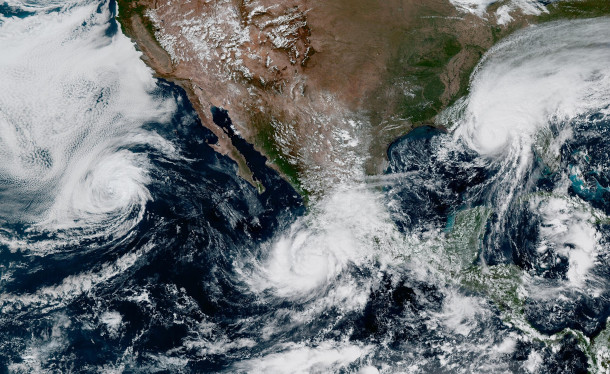
Tropical Storm Rachel, Hurricane Simon, and Hurricane Isaias simultaneously surround the United States. Due to this year’s particularly strong El Niño, the number of Pacific storms are at a record high. (Photo: NASA, Wikimedia Commons, public domain)
O’NEILL: From PRX and the Jennifer and Ted Stanley Studios at the University of Massachusetts Boston, this is Living on Earth. I’m Aynsley O’Neill.
BELTRAN: And I’m Paloma Beltran.
El Niño and La Niña are opposite phases of a natural climate cycle that shifts ocean temperatures and winds across the tropical Pacific Ocean every 2 to 7 years. Fueled by climate change, this year’s El Niño has intensified into a “Super El Niño,” meaning sea surface temperatures in parts of the Pacific are over 2 degrees Celsius hotter than average. And it’s brought one strong storm after another churning across the ocean. Seth Borenstein is a science writer at the Associated Press, and we called him up for an overview of what we can expect in the months ahead.
BORENSTEIN: This is, by all accounts, forecast to be the strongest El Niño that's been recorded in modern times, and perhaps for at least 1000 years using coral records. What El Niño does is it sort of warps weather worldwide. It just changes everything. It's sort of a chaos agent, and so during an El Niño, the biggest effect is that the globe in general gets warmer, and it's strangely - there's a delayed effect. So the El Niño has started this summer. It's expected to peak in about a month or two. Yet, that means that it usually will cause the next year to be a record-warm year. This is a super El Niño, and it is so strong that this year may be a record year. But even if 2026 is a record warm year, it is incredibly likely to be broken by 2027. But I think what we're mostly here to talk about is what El Niño does to hurricanes and typhoons, especially hurricanes in the Atlantic, which is, you know, where Florida, the Gulf of Mexico is. El Niño sort of just smothers hurricanes. Basically, you get far fewer hurricanes, and until a week or so ago, we had zero hurricanes. We had a few named tropical storms. We had our first hurricane in Isaias. I'm sorry, I'm very bad at pronouncing it, and that was the first hurricane of the season. And it was one of the latest first hurricanes of the season in decades. You have to go back to 1914, when there were no hurricanes that season in the Atlantic. But of course, they weren't monitoring as well, so there may have been, and they just didn't see it.
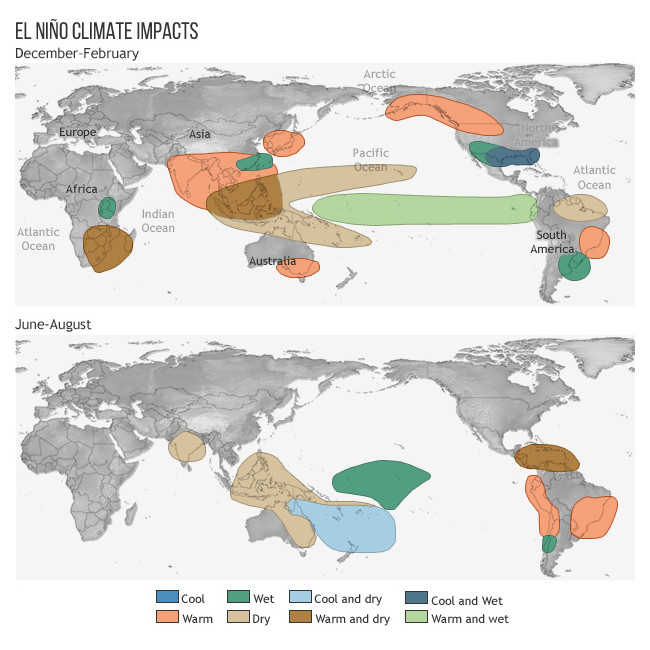
The above graphic shows global weather impacts of the El Niño pattern throughout a year’s time. (Graphic: Rebecca Lindsey and Tom Di Liberto, NOAA, Wikimedia Commons, public domain)
BELTRAN: Yeah, so it's kind of slowed down in in the Atlantic, from what I'm understanding here.
BORENSTEIN: I would say it's not just slowed down; it's in a coma in the Atlantic. And that's a good thing if you live there. But in the Pacific, it does the opposite. In the Pacific region, it is sort of like fuel for hurricanes. It makes the Pacific go nuts. The Pacific hurricane season this year has been at a record level.
BELTRAN: Seth, what are those hurricanes, and what impact have they had across the Pacific?
BORENSTEIN: Since mid-September, you've had Nolo, Odalys, Polo, Rachel, and Simon, and then we have Trudy gearing up right now. So, the best way to measure sort of the nastiness of a hurricane season is by something that meteorologists call ACE, which is Accumulated Cyclone Energy, which sounds highfalutin, but all it is is calculating how strong storms get by their wind speed and how long they last. I'm fascinated with Polo, even though Polo did very little damage. The world, especially Mexico, was very lucky with Polo. Polo passed the record from just 2018 for highest days. Polo set a record for the most days at category five in the Pacific, and it was a monster, but it luckily weakened before it hit, and it hit in an area of Baja California that is relatively less inhabited. So it it caused less damage than it could have. Basically, we were all lucky. These are storms that had they had a different track, sort of like Otis a couple years ago, they could have been incredibly deadly, so we've been lucky.
BELTRAN: So, what is it about an El Niño that makes these storms so potent?
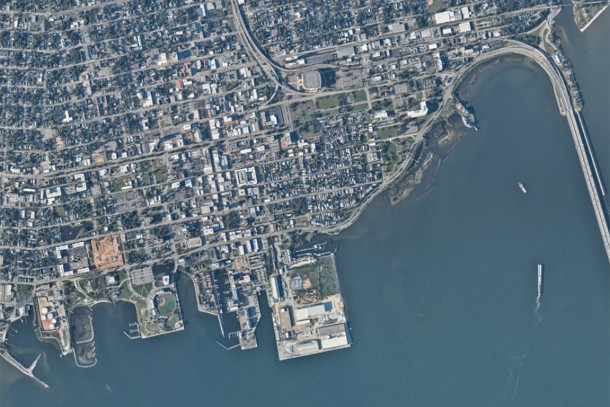
Aerial view of Pensacola, Florida, an area that suffered from heavy flooding in the aftermath of Hurricane Isaias. Photo captured on October 11, 2026. (Photo: NOAA, NOAA.gov, public domain)
BORENSTEIN: What an El Niño does is it takes away one of the things that just shuts hurricanes down, and that's winds, high-level winds that decapitate a hurricane. So if you're looking in the Atlantic, El Niño has put those winds on high, and nothing's happening. It's like a red light for cars. In the Pacific, it's different if those winds are incredibly weak, and it's like a green light, so if all the other conditions are favorable, which they are, then hurricanes just rev up and go.
BELTRAN: To what extent can we tell the impact from climate change on this particular El Niño event?
BORENSTEIN: On this El Niño event, scientists have said that there is a factor because what we are seeing is more and more large-scale El Niños. So they are seeing some factor in making El Niños stronger, but it's still not enough for them to really be conclusive. One of the odd things that they're noticing also is we get more of the La Niñas, which are the opposite ends, but when we get El Niños, they're stronger.
BELTRAN: And now I understand you recently covered a new study about El Niño. What can you tell me about that, Seth?
BORENSTEIN: So this new study looked at Hurricane Polo, which fortunately didn't cause much damage, because it weakened before it hit in Mexico. But it was a record hurricane for the number of days at the top of the scale, category five. So, the two major climate attribution teams, which are World Weather Attribution, which is an international group, and Climate Central out of Princeton, New Jersey, they teamed up and looked at Hurricane Polo and what caused it to strengthen. They didn't look at the winds that we talked about earlier that can either decapitate or not hinder a hurricane. They looked at the fuel, which is, for a hurricane, is warm water, and they looked at it two different ways and found the same thing. They found that climate change, human-caused climate change, made a storm like Polo, super strength storm, 23 times more likely. El Niño made it 14 times more likely, so they both together combined to make this storm more likely. But if you're looking at culprits, climate change was a slightly bigger culprit than El Niño, and they said that climate change added about six miles per hour to the wind strength of Polo, and that El Niño added a little bit less. Altogether, Polo would have been still at top of the category five hurricane without climate change, without El Niño, but then these sort of revved it up a little more.
BELTRAN: Seth, what can we expect in the coming weeks with this major El Niño event that we're experiencing?
BORENSTEIN: Well, I think we could expect more of the same, which is a quiet Atlantic hurricane season, a busy Pacific hurricane season. But you also see, because El Niño is that weather chaos agent, it'll cause flooding in all sorts of places and drought in other places. One of the biggest effects of El Niño is on Indonesia and South American drought, and also heavy on the fisheries in South America. And so we will see usually during an El Niño, and this is quite an El Niño, we see an increase in Indonesian fires, which we're already seeing. We'll see more drought in certain places, more flooding in other areas, and there have been economic studies that show El Niño, generally for the world, is incredibly expensive. Past El Niños essentially cost the economy hundreds of billions of dollars, hundreds of billions with a B. It's interesting. There are winners and losers in El Niño.
BELTRAN: Wow, who are the winners here?
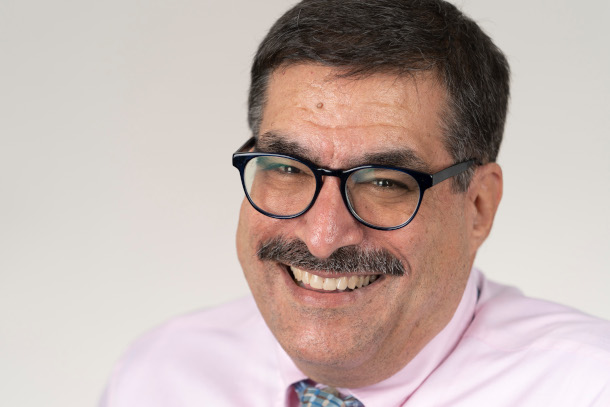
Seth Borenstein is a science writer with the Climate and Environment team at the Associated Press. (Photo: Courtesy of Seth Borenstein)
BORENSTEIN: In the United States, it means fewer Atlantic hurricanes, which are costly, it decreases the chance of costly drought in the Midwest. It increases rainfall in the West, which is, you know, the West often has a problem with drought. So now during this winter, California will have a problem with rain and mudslides, but in general, some studies have shown that the United States actually does better in an El Niño than it does in a La Niña, which brings in more hurricanes and some drought. But the world definitely does not do better in an El Niño.
BELTRAN: So this is really intense, you know, how long is this El Nino sticking around? When can we expect an end to this?
BORENSTEIN: The El Niño should stick around until spring of next year of 2027. It is supposed to peak November, December, maybe January, and then weaken. Luckily, Pacific hurricane season is supposed to end at the end of November, but El Niño has ways of just making things a little chaotic, and it wouldn't be surprising to see one of the Pacific hurricanes go into December. But after the spring, we are forecast to be out of an El Niño, probably into a neutral, and then into a La Niña, or we might double dip back into El Niño.
BELTRAN: Seth Borenstein is a science writer at the Associated Press. Thanks so much for joining us today.
BORENSTEIN: It was a pleasure talking with you, Paloma.
Related links:
- The Associated Press | “Pacific Hurricane Region Sets Record for Big, Long-Lasting Storms Thanks to El Niño”
- The Associated Press | “As Super El Niño Strengthens, Study Suggests That Climate Change Is Intensifying El Niños”
- PBS News | “How a Super El Niño Is Fueling Extreme Weather Patterns”
[MUSIC: Baja California]
O’NEILL: Coming up, an award-winning climate fiction book - but no spoilers here! Stay tuned to Living on Earth!
ANNOUNCER: Support for Living on Earth comes from the Waverley Street Foundation, working to cultivate a healing planet with community-led programs for better food, healthy farmlands, and smarter building, energy and businesses.
[CUTAWAY MUSIC: Sammy Price, “Salute To Basie” on Fire (The Definitive Black & Blue Sessions), Disques Black & Blue]
Pesticide Atrazine Contaminating 25% of US Rivers
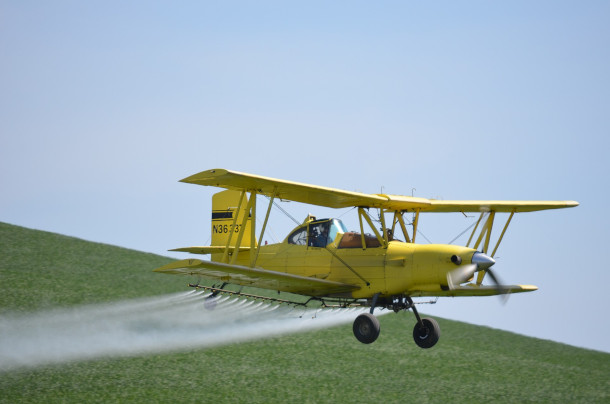
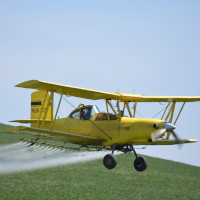
Atrazine is the second most used weed killer in the U.S., where 70 million pounds of the herbicide are deployed each year. Above, a crop duster sprays a wheat field in the Pacific Northwest. (Photo: Carolyn Parsons, Wikimedia Commons, CC BY-SA 4.0)
BELTRAN: It’s Living on Earth, I’m Paloma Beltran.
O’NEILL: And I’m Aynsley O’Neill.
Atrazine is the second most widely used weed killer in the U.S. after glyphosate, which you might know from RoundUp. Much like glyphosate, atrazine can disrupt hormones and has been linked to serious health impacts, including cancer. In early October, California’s Office of Environmental Health Hazard Assessment announced that it plans to list the herbicide as a known carcinogen. Atrazine is also wreaking havoc on aquatic ecosystems, and recent research from the Center for Biological Diversity has been tracking the extent of the contamination. Nathan Donley is the Environmental Health Science Director at the Center for Biological Diversity, and he joins me now. Nathan, welcome back to Living on Earth!
DONLEY: Yeah, thanks for having me. Glad to be here.
O'NEILL: So, for listeners who aren't familiar, what exactly is atrazine, and what are the known consequences on human health?
DONLEY: Right. So, atrazine is an herbicide, so it targets unwanted plants or weeds. It's a pesticide, and it is the second most widely used pesticide in this country. We use about 70 million pounds each year, year after year, which starts to add up pretty quickly. It's used mainly on corn and sorghum and sugar cane. Those are the main crops it's used on. And atrazine is a carcinogen, and atrazine is linked to multiple cancers like certain lymphomas and breast cancer. Atrazine is also linked to reduced fertility. Things like decreased sperm counts, irregular menstrual cycling, multiple birth defects are associated with atrazine. So you know, really terrible things like that associated with this pesticide. We're talking about harms that can have really very tangible consequences and effects on people's lives.
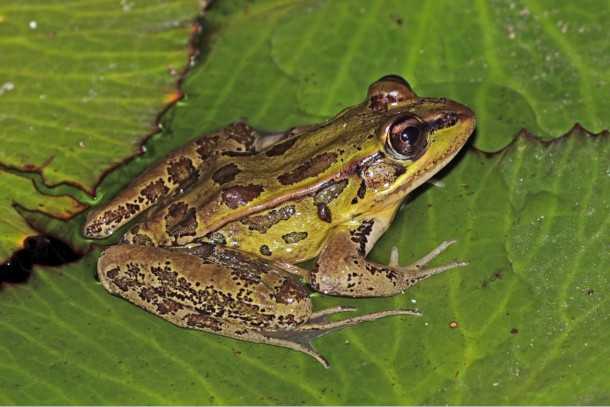
Previous studies have shown the adverse effects of atrazine on aquatic wildlife, such as endocrine disruption in the leopard frog, which is native to North America (above). (Photo: Charles J. Sharp, Wikimedia Commons, CC BY-SA 4.0)
O'NEILL: And now, a study out of the Center for Biological Diversity recently found that nearly a quarter of all rivers in the continental United States contain levels of atrazine that are found to harm wildlife and human health. So help us understand the scale of this. How much water are we talking about here?
DONLEY: Yeah, it's really a striking figure, and one that even as someone who studies pesticides, it just surprised the heck out of me. We're talking about nearly a million miles of rivers and streams have really harmful levels of atrazine in them. Keep in mind these rivers don't just contain some level of atrazine, they have levels that the EPA identifies as high enough to destroy aquatic ecosystems. So that is striking. You know, we have tens of thousands of synthetic chemicals that are manufactured and released as pollution in this country, and to think that just one of those tens of thousands is single-handedly making a quarter of our rivers and streams dangerous to fish and amphibians and migrating birds is just outrageous, and it makes you just want to scream out the window because so many people live in these areas that are highly contaminated, and the water that they drink and bathe in and prepare food with comes from these highly contaminated rivers. About 20% of all drinking water intakes from surface water comes from these rivers that are highly contaminated, so this is is really an issue that hits on human health just as much as it does the health of our planet and our natural resources.
O'NEILL: And what regions of the country are seeing the most impact from this?
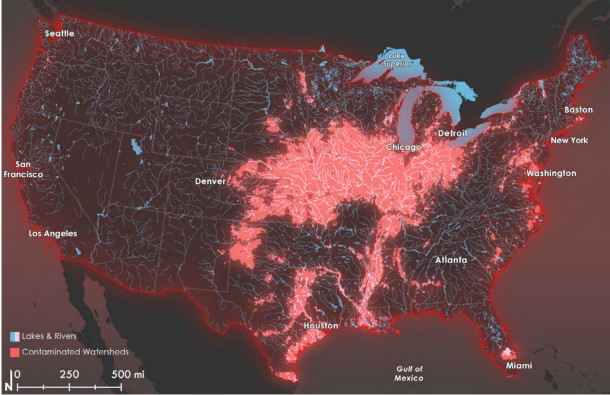
Atrazine is mostly concentrated in the Corn Belt, but smaller hotspots in the Chesapeake Bay, Mississippi River, Florida, and Texas also persist. Above, a map of atrazine contamination in the continental U.S., made by the Center for Biological Diversity using EPA data. (Photo: Center for Biological Diversity)
DONLEY: Good question. You know the thing about atrazine is it's not spread out evenly across the country. I live in Olympia, Washington, for instance, and I have almost zero exposure to atrazine because there's really none used around me. But I grew up in Kansas, where I was probably drinking gallons of this stuff every week during my formative years. So the big hot spot tends to be in the Corn Belt, states like Nebraska and Kansas, Missouri, Iowa, Illinois, Indiana, those places. That's really ground zero. But there are also smaller hot spots around the country. One of those places, for instance, is the Chesapeake Bay watershed. Not many people know this, but corn is very widely grown up there in the watershed of the Chesapeake Bay. The Mississippi River, you know where all the runoff from the Corn Belt goes to, is also very highly contaminated. Lake Okeechobee in Florida, which is the second largest freshwater lake in the U.S. happens to be surrounded by half a million acres of sugarcane plantations where a lot of atrazine is used, and then a place where I used to vacation as a kid, between Galveston and Corpus Christi along the Texas Gulf Coast, is also one of these really highly contaminated regions.
O'NEILL: And atrazine has now been banned in 63 countries, including the European Union. Yet it's one of the most widely used pesticides here in the United States, just after glyphosate. Why do you think the United States government is so reluctant to ban this pesticide?
Syngenta, atrazine’s primary manufacturer, maintains that when properly applied the pesticide is not harmful to humans or the environment. (Photo: Syngenta Group, Wikimedia Commons, CC BY-SA 4.0)
DONLEY: We have a very powerful industry lobby in this country: the agrochemical industry, corporate agriculture. They want this pesticide because it lines the pockets of their corporate benefactors, so they lobby hard. They get lawmakers in their pockets, they get presidential administrations to turn a blind eye, and this has been happening for decades. And it's nearly impossible to get the government to do anything meaningful on atrazine because every time it tries this powerful lobbying arm comes down on them hard. You know, the sheer amount of money and power wielded by the corporate agriculture lobby rivals the oil and gas industry, and even when the will of the people want change, the levers, you know, remain seized and change never comes. So ultimately, what this does is it allows corporations to profit from the pollution that is harming people in this country.
O'NEILL: But there has been pushback. In 2020, the Center for Biological Diversity, alongside some other public interest groups filed a lawsuit against the Trump administration's EPA for reapproving atrazine. Where does this litigation stand today?
DONLEY: Right now, this litigation is on hold. Atrazine was reapproved in 2020 at the end of the first Trump administration. My group and others promptly sued, and that litigation was ongoing for a little while, and then when the Biden administration came in, they decided to say, "Hey, wait a minute! We recognize some things may not have been above board here," and they asked the court to put the litigation on hold while they went back and did some reanalysis. So that's where things stand right now. Their reanalysis, unfortunately, looks like it's coming up very short, but until they make a new approval or fingers crossed, hopefully decide not to reapprove atrazine, then our litigation will stay on hold until that time.
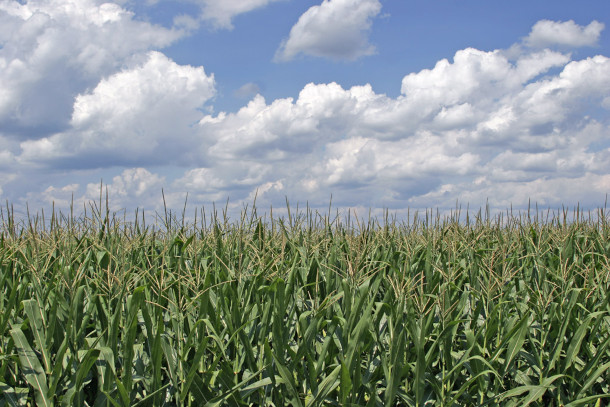
Donley emphasizes that a ban on atrazine would not affect our national food security, since the majority of crops that are sprayed with atrazine do not go directly to human consumption. Above, a cornfield in Ohio. (Photo: Graylight, Wikimedia Commons, CC BY 2.0)
O'NEILL: And tell me a little bit more about the Biden administration EPA response to this. As I understand it, there was a December 2024 atrazine mitigation plan, but this study suggests that that plan was insufficient. So, what's going on there?
DONLEY: Yeah. So, this was a really interesting study we just published, and what we did was we analyzed the Biden administration's proposal to reduce the amount of contamination of atrazine in rivers and streams. So this is pretty unique. Usually, you wait until a mitigation proposal is implemented until you find out whether it works or not. But we were able to ground-truth this proposal before it's actually even gone into effect. So what the Biden administration did was they put in place a few things that they believed would reduce the amount of atrazine contamination in rivers and streams in this country. We then analyzed that plan and found that it would actually only reduce atrazine pollution to safer levels in about 1% of the highly contaminated rivers and streams out there. Like I said, we have almost a million miles of rivers and streams that are highly contaminated with atrazine, and if we're just remediating 1% of those, that is an insufficient plan, right? You've got a 99% failure rate. That is not a good thing. So unfortunately, the plan came up incredibly short, but there is still time to turn this terrible plan around and come up with a plan that actually works for this country and brings down atrazine levels to much lower levels that aren't going to impact human health or aquatic wildlife.
O'NEILL: And Nathan, if atrazine is such a widely used pesticide, I'm sure there are concerns regarding the impact of a ban on farmers, on food, on the economy. What do you say in response to concerns along those lines?
DONLEY: Yeah. So the thing about atrazine is it's used on three crops, none of which are widely eaten by people. Corn is used mostly to make ethanol as a fuel additive, and to feed to animals in concentrated animal feeding operations. Same with sorghum, and then sugar cane, as well as some corn, is used mainly to make sugar for processed foods that many medical professionals say that we should be eating a lot less of, so there really isn't a food issue here at all. We're going to still produce the same amount of food with or without atrazine. Half of corn growers don't use atrazine, so you can grow corn in this country without atrazine just fine. And again, seeing as 63 other countries around the world have banned this pesticide and still produce an abundant amount of food and agricultural crops, this really is a pesticide that no one needs.
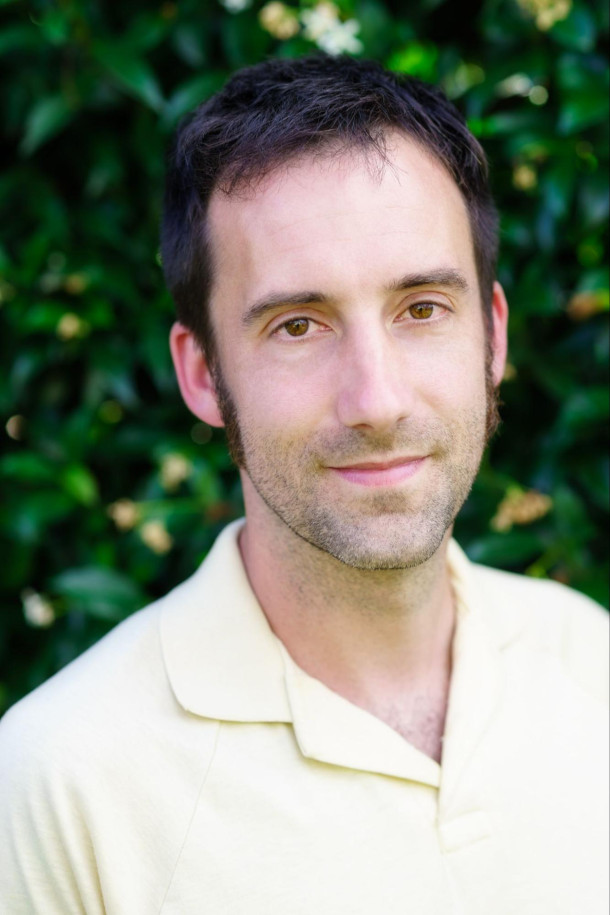
Nathan Donley is the Environmental Health Science Director at the Center for Biological Diversity and lead author of the October 2026 study on atrazine. (Photo: Nathan Donley)
O'NEILL: Nathan, what would be your hope in terms of a public response to this study, or more people finding out about the concerns with atrazine generally?
DONLEY: Yeah, that's a good question, and I would hope that people would see this report and these studies, and just absolutely be outraged and be like, "How on earth is it that a full quarter of the waterways in this country, the rivers and streams that we swim in, that we boat in, that we drink from, how is it possible that 25% of those are contaminated with a dangerous chemical, such that these waterways are no longer healthy?" But you know, I'll just say that that is hopefully changing. For the first time in my lifetime, some Republicans are talking about these issues with passion and fervor. I mean, that was not on my bingo card five years ago. The healthy food movement has gone from very niche to a political powerhouse, and there's a lot of momentum behind it right now, and that is getting many people very excited. So, the health of the next generation depends on us ultimately prevailing here, and that's what gets me out of bed every day. Our planet is not a dumping ground for the pollution of the billionaire class. It's ours, and it's time we take it back.
O'NEILL: Nathan Donley is the Environmental Health Science Director at the Center for Biological Diversity and lead author of this study. Nathan, thank you so much for joining me today.
DONLEY: Yeah, thanks for having me on.
O’NEILL: Syngenta, the main manufacturer of Atrazine, asserts in a statement responding to cancer concerns that the herbicide “is safe when applied in accordance with registered label instructions.”
BELTRAN: And on October 14, after the government declined to respond to their petition, the Center for Biological Diversity and co-plaintiffs filed an additional lawsuit against EPA over its alleged failure to protect waterways and drinking water from atrazine contamination. We did not receive a response from EPA in time for this broadcast, but you can find statements and more information on the Living on Earth website, loe.org.
Related links:
- The Center for Biological Diversity | “Pernicious Pesticide: Atrazine's Growing Threats to Drinking Water, Rivers, People, and Wildlife”
- Journal of Environmental Quality | “Evaluating the Effectiveness of EPA’s Proposed Runoff Mitigation Plan on Atrazine Surface Water Concentrations in the United States”
- Read Syngenta’s 2025 statement on atrazine’s link to cancer
- Learn more about atrazine from the EPA website
[MUSIC: Heartland]
A Guardian and A Thief
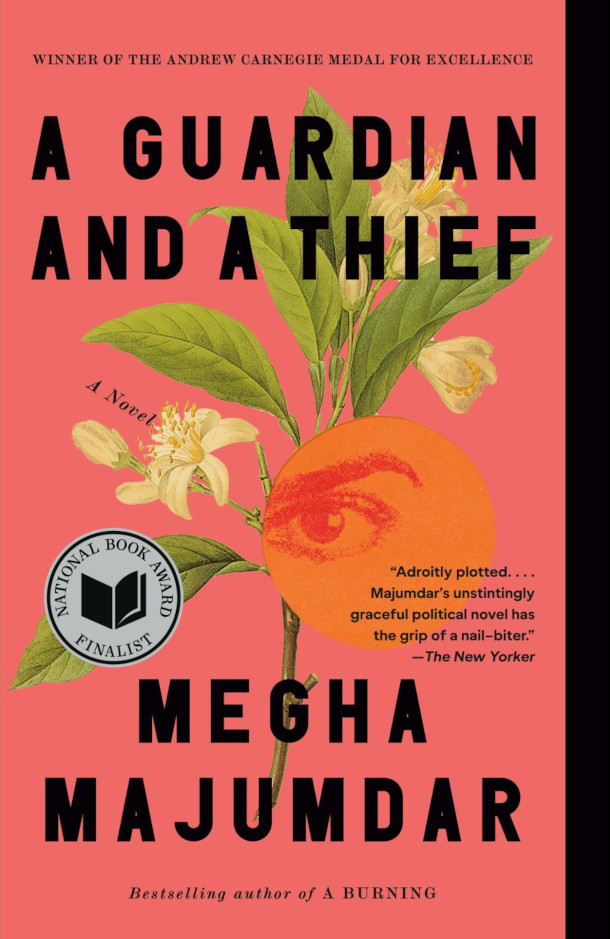
A Guardian and A Thief by Megha Majumdar. (Photo: Cover Image Courtesy of Knopf)
O’NEILL: Sometimes facts and figures simply don’t cut it when it comes to translating the human realities of the climate crisis. But stories, including fiction, are one way we can bridge that gap. In her novel A Guardian and a Thief, Megha Majumdar places her characters in a climate-changed world set in the near future. A Guardian and a Thief is Megha’s second novel and earned her several awards, including the 2026 Andrew Carnegie Medal for Excellence in Fiction. Megha Majumdar lives in New York City and she joins me now. Welcome to Living on Earth, Megha!
MAJUMDAR: Thank you so much for having me.
O'NEILL: So, in this novel, A Guardian and a Thief, it takes place in the near future in Kolkata, India, where you were born. Give us a sense of the novel version of this place. What is it like in the city where your characters live?
MAJUMDAR: In the near-future Kolkata, where this novel is set, I imagine a city which is really devastated by the effects of climate change. So there is extreme heat, for instance. People might have to wear cooling garments when they go outside, and there are protesters agitating for the right to shade from the sun. There is also a severe shortage of food. So when you go to the markets, you don't see your familiar fruit and vegetables. Instead, you see cricket protein, you see algae for sale, and it's a world which springs from a foundation of what has been predicted. Kolkata is my hometown, and it's one of the cities in the world which is very vulnerable to climate change, and I imagine what daily life in that situation might look like.
O'NEILL: Well, how close is that situation to the current reality in Kolkata?
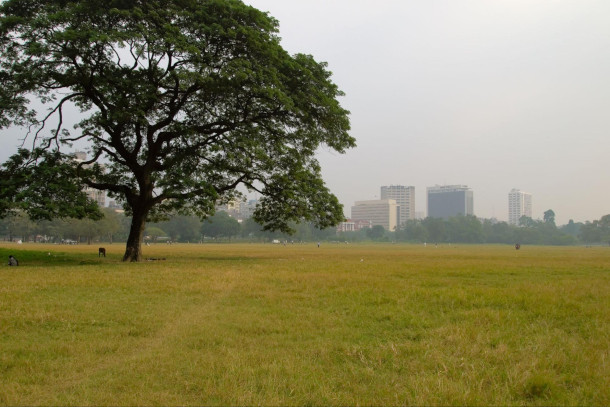
A Guardian and a Thief takes place in a near-future Kolkata, India, in which society has been deeply affected by climate change. (Photo: Vyacheslav Argenberg, Wikimedia Commons, CC BY 4.0)
MAJUMDAR: Oh, it's very far. You know, Kolkata does have problems with frequent flooding, drainage issues, and things like that. But it's a very robust city where you get everything, and all the systems are pretty much working. So it's a prediction which has been made for you know in some reports around 2100, but I was thinking about a future which is partly recognizable as ours, you know. So there are still families living in neighborhoods, and you know, with the same responsibilities, and thinking about immigration, and thinking about what to have for lunch, so with the kind of recognizable anchors in our world, I was thinking about what it looks like if some of the vital details are very different.
O'NEILL: And now, without giving too much away, give us just a taste of who your two main characters are: Ma and Boomba.
MAJUMDAR: Ma is a mother. She runs a shelter for new residents to the city, and she is a woman who is very focused on her two-year-old toddler and her elderly father. Her husband has moved away to Michigan, so she is really responsible in Kolkata for taking care of these two people that she loves. She believes herself to be a decent person, a good person, but the book is very interested in following what happens when she finds herself in a crisis, and she has to make very difficult moral choices. And on the other side, Boomba is a young man from a village which is close to Kolkata. He comes to the city looking for a foothold. He wants to be able to find an opening in the city such that he can bring his family over, and the person that he absolutely loves the most in his family is his younger brother, a small child as well. And of course, this young man, Boomba is a person of few resources. He has a much closer understanding of struggle than perhaps Ma does. So, in many ways, the clash between them is a clash of circumstances and of social classes and resources. Ma, who is middle class, lives in a really comfortable house, has the resources to apply for a U.S. visa and get it, is preparing to move to Michigan. Her approach to what migration looks like and what her pathway looks like is completely different from that of Boomba, who is much more desperate and has to be much more creative with how he forges a path forward.
O'NEILL: And now, so many of the reasons why we see these characters needing to battle with these moral choices is due to, as we mentioned, the climate crisis, the situation that they find themselves in. Why were you drawn to centering your book on the climate crisis?
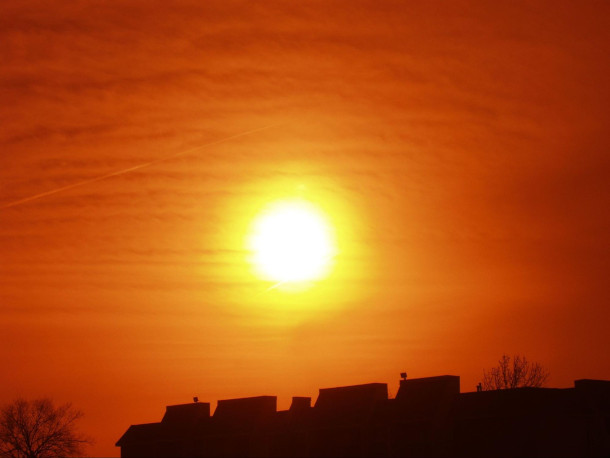
Extreme heat is ever-present in the lives of the characters in A Guardian and a Thief. (Photo: Janice Waltzer, Flickr, CC BY 2.0)
MAJUMDAR: I am very interested in how the climate crisis might bring us to very difficult moral choices. I think the question of how to be an ethical self in a time of difficulty, in a time of scarcity, is very interesting to me. I mean, it's the question that I'm kind of obsessed with, is: how can anybody be a moral person in our current world, where we are really caught among systems that are much bigger than us? Sometimes it feels like the choices we make are very limited in the impact they can have, and yet we have plenty of freedom and plenty of space to do the right thing often. And I think something like the climate crisis, in which we will see things like agriculture, water supply, change. So all of these things that we take for granted, like having clean water to drink that's freely available, going to the shops and finding, you know, pretty much the fruits and vegetables and grains you're looking for. All of that will change, I think, and I'm very interested in how, in that new sense of scarcity, we might be forced to draw lines between the people we love and care for and the people who are now outsiders, and where will we draw that line? How will this scarcity really destabilize our sense of who we are as decent people, as good people? Will it force us to become something different? I think the climate crisis has ramifications not just for the external environment of our planet, but I think it has ramifications also for who we are in our most interior self.
O'NEILL: I feel like a lot of readers will naturally be inclined to go, "Oh well, I would never do that. I would never make that decision." But you really build these characters out in such a way where you understand where they're coming from every time, and you're forced to confront, well, what would I do in that situation? And I think that's really one of the best qualities of this writing is to make you as a reader, consider how you would act in such a situation.
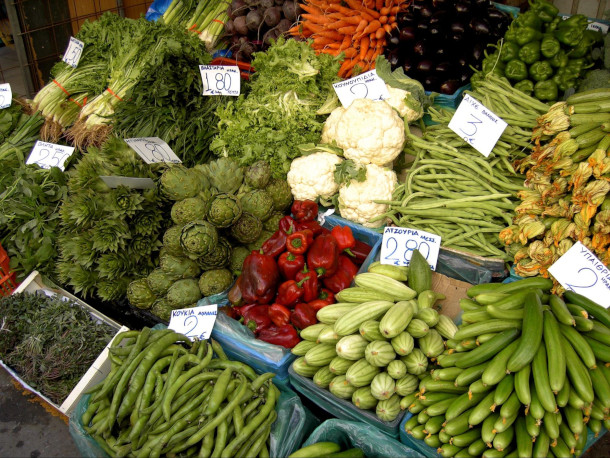
A fresh vegetable market, like this one in Crete, is almost non-existent in the imagined future of Kolkata. (Photo: Hans Hillewaert, Wikimedia Commons, CC BY-SA 4.0)
MAJUMDAR: Thank you. I hope so. I think that's part of the project of fiction is to encourage a reader to identify so closely with the characters that you really feel their troubles, you feel their worries and fears, and you feel the enormity of their love and their care and their wishes, and I think it can be slightly uncomfortable for a reader to think about, well, would I do that? You know, would I steal fruit from a child? Would I break into somebody's house? And for many of us, I think, as you're saying, the answer is, oh, of course not. But I do wonder if the things that are true in a time of abundance, in a time of relative comfort, will remain true in a time of crisis.
[MUSIC: Kolkata Twilight]
O’NEILL: We’re speaking with Megha Majumdar, author of A Guardian and a Thief, and we’ll be right back after the break with more. Keep listening to Living on Earth!
ANNOUNCER: Support for Living on Earth comes from Hansjörg Wyss in honor of Rosamund Stone Zander. Celebrated painter, environmentalist, and author of The Art of Possibility, who inspired others to see the profound interconnectedness of all living things, and to act with courage and creativity on behalf of our planet. Support also comes from Sailors for the Sea and Oceana. Helping boaters race clean, sail green and protect the seas they love. More information at sailorsforthesea.org.
[CUTAWAY MUSIC: Kolkata Twilight]
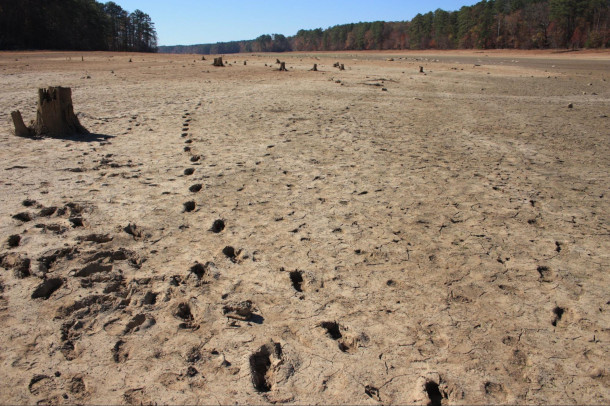
Author Megha Majumdar says she is interested in the kind of moral choices we will face as individuals in a climate-changed world. (Photo: Alabama Extension, Flickr, public domain)
BELTRAN: It’s Living on Earth, I’m Paloma Beltran.
O’NEILL: And I’m Aynsley O’Neill.
Let’s get back to my conversation with Megha Majumdar, whose 2025 novel A Guardian and a Thief is set in a near-future Kolkata, India devastated by climate impacts.
O'NEILL: And now, your book also explores the idea of climate refugee as an official immigration status. Tell us a little bit how you decided to bring immigration policy into your novel, and what the future of climate displacement looks like to you?
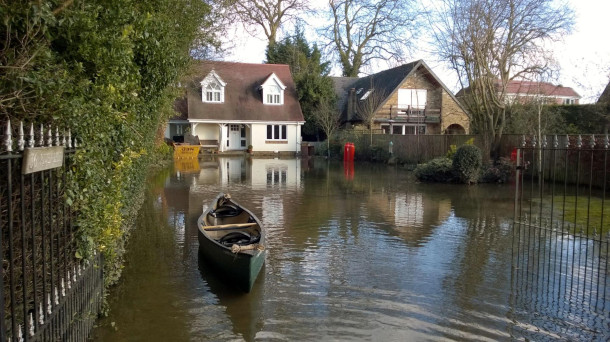
Author Megha Majumdar imagines a world where climate disaster becomes so common that it is woven into the fabric of everyday life. The above photo shows flooding in Hythe End, in England. Flooding is increasingly likely as the climate crisis progresses. (Photo: Richard, Flickr, CC BY-NC 2.0)
MAJUMDAR: Well, I am an immigrant to the U.S. I grew up in Kolkata in India, and so I think for many families in Kolkata that I saw around me, migration was a fairly common fact of life. Everybody had children moving away, and I think that that kind of migration will only continue to be more prevalent, more urgent, as some of the places in the global south are hit very hard by the effects of climate change. You know, I think that we have already seen conflict in the world where the guise of it is kind of ethnic conflict or some other form of conflict. I remember reading about the conflict in Darfur, which was quite a while ago now. Then I remember reading that at the root of that conflict, one of the things that could be traced was actually the spreading of the desert and lack of water. So what presented itself as a conflict between groups of people was actually rooted in environmental causes, and I think that this kind of conflict will perhaps become more common in the future, and people will seek to flee. But I think that in my novel, I was interested in placing the vastness of that conversation in the lives of one family and seeing how they are affected by it.
O'NEILL: And now some characters in your novel, such as Dadu, do not want to leave the city, despite the deteriorating conditions. What can characters like these tell us about the human realities of climate migration?
MAJUMDAR: Yeah, I think one of the simple narratives of migration might be that it's a pure motivation. You want to leave and you want to go somewhere else where you'll have a safer life, a better future. But anybody who has migrated knows that it is not like that at all. It is a very different, very complex reality, and there is a big part, I think, of any migrant's life and thought and reflection, where they do not want to leave; they want to stay. So Dadu, the grandfather in this novel, is a character who is very hesitant to move away to Michigan. He wants to stay in Kolkata because that is the place he knows. That is where he has friends. That is where he feels most known by others, and he is afraid of having to integrate himself into a different community, having to learn different social subtexts, so for him migration is very much bound up with a sense of grief and a sense of loss, and he's only doing it for his daughter and his grandchild. He understands the importance of this move, and at the same time, the wound of migration is very real, and he anticipates how cutting it will be to move.
O'NEILL: Something that's quite striking throughout the novel are really visceral descriptions of food that appear again and again. The food insecurity is driving so much of your character's actions. Tell us a little bit more about that.

A traditional fish dish from Kolkata called Shorshe Ilish. A Guardian and a Thief includes many visceral descriptions of food in a food-scarce world. (Photo: Sm faysal, Wikimedia Commons, CC BY-SA 4.0)
MAJUMDAR: Well, one of the roots of this novel is that I am from a family where we really care about food, and so I have grown up knowing that food has a very important emotional texture. Having dinner together is not just about putting nutrition in your body, but it's a place for the family to come together. It plays a really important role in social gatherings and in the bonds between people. Offering food is a sign of hospitality and kindness. So food has really vibrant emotional and social functions, and I was interested in bringing in the beauty of that a little bit. So talking about the foods that people love, like cauliflower or fish or oranges. I wanted to have some of the joy and delight of that present in the book, and at the same time, I also wanted to explore what happens when it's taken away, and you can no longer freely offer food to a guest, or you have to really look through a heap of discarded food to find something. So the joy of it and what happens when it's taken away were two really important focuses of this book.
O'NEILL: Now, of course, oftentimes when we are talking about the climate crisis, we talk about the extreme events: violent hurricanes, wildfires, floods--very large, very dramatic, and in the novel we of course have the extreme heat. But I feel like we view so much of it through almost a quieter desperation, this everyday struggle to find the next meal. What inspired you to focus on this perspective?
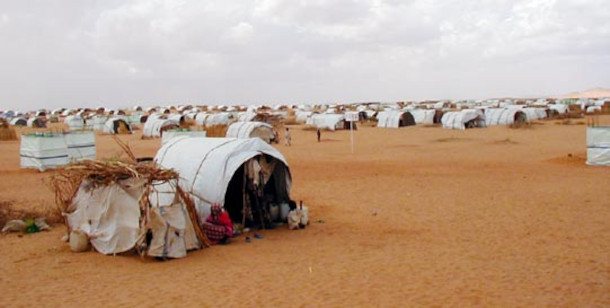
A refugee camp in Darfur, 2004. Our guest, Megha Majumdar, points out that many conflicts around the world stem from diminishing resources, a situation which will only worsen as climate change advances. (Photo: Sean Woo, general counsel to Sen. Brownback, or John Scandling, chief of staff to Rep. Wolf, per description on p. 11 of the report, Wikimedia Commons, public domain)
MAJUMDAR: That's a great question. Thank you for asking it. I guess I was very interested in how the texture of daily life can change in climate crisis. So now I think we are maybe more familiar with a rhythm where there is a big disaster. There is a huge level of destruction, and we slowly recover from that. We rebuild. But in the future there may well be a different rhythm where these crises are so frequent and so much more severe that they kind of seep into what daily life looks like. There isn't the destruction and recovery kind of cycle, but more a familiarity with well, the electricity always goes out because the grid is overburdened, or there is always, you know, this part of the city which is flooded because the storms are so frequent and the drainage is so poor. So we might see a slight shift in how we think about crisis, how we think about disaster, and I think it's that acceptance of maybe a new normal, a new state of urgency which stays. In that, I think people will learn to examine their own behavior and their own motivations differently.
O'NEILL: And now I would argue that perhaps not just the strongest theme, but one of the strongest motivators in A Guardian and a Thief would be family and parental life. How do you feel like the novel was influenced by your own experience there?
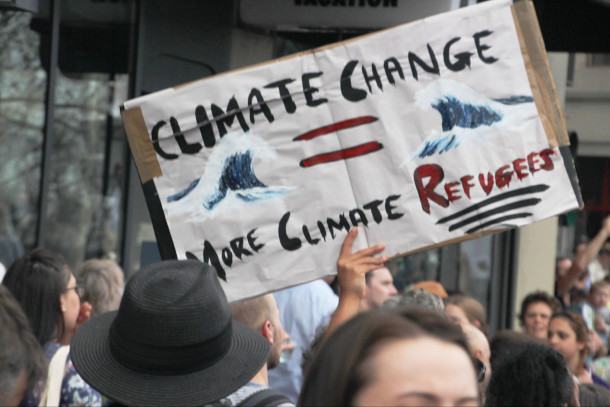
A sign from the Melbourne, Australia global climate strike in 2019. A prominent theme in A Guardian and a Thief is climate migration. (Photo: Takver from Australia, Wikimedia Commons, CC BY-SA 2.0)
MAJUMDAR: The novel completely changed after I became a parent. I have two small kids now, and for a long time, I worked on a novel which had a completely different main character. It was focused on an adolescent and her relationship with her grandparents in this kind of ruined city in crisis, but it wasn't working. I worked on this novel for several years before I realized that it simply wasn't working. Something about it was not true, wasn't resonant. And then I had my first child, and it made me so interested in the mother of this adolescent character that I had been trying to write. I became so interested in the ferocity of a mother's love, and I became very interested in thinking through what it means to confront that love. If you are forced to parent your child through a frightening crisis, what of your moral center would you perhaps give up? That became a question that really called to me, and it completely changed the shape of the book.
O'NEILL: Megha, in this novel, there are moments of despair and moments of hope, all woven together. Now, I don't want to give anything away about the plot, and especially not the ending. But I do want to ask: To what extent are you personally able to maintain a sense of optimism about the future?
MAJUMDAR: I feel very hopeful. You know, I think that our planet has weathered so many crises in the past. There have been so many moments of great alarm and danger, and remember when, I don't know if you remember, but when I was a child, we read so much about the ozone layer and the hole in the ozone layer, and turns out that cooperation among different countries coming together and do something about patching the hole in the ozone layer, it worked, and that's why we don't hear about the hole in the ozone layer anymore. Is because it was solved through international cooperation, and so I I feel very hopeful. I feel very aware that even though there is this grim future kind of looking at us, there are so many dire predictions, I think that there are also so many people who are thinking very deeply about solutions. They are thinking very deeply about how to move forward, not just with urgency, but with a sense of joy and a sense of beauty and a sense of real intent and purpose. So I am very hopeful.
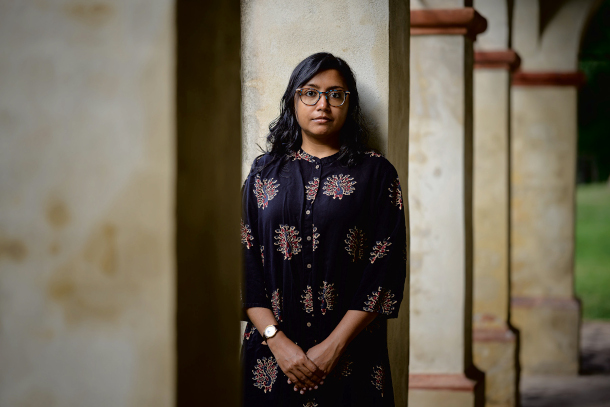
Megha Majumdar is the author of A Guardian and A Thief and A Burning. (Photo: © Marco Giugliarelli)
O'NEILL: Megha Majumdar is the author of the novel A Guardian and a Thief. Megha, thank you so much for joining me today.
MAJUMDAR: Thank you so much, Aynsley. Thank you for your beautiful, thoughtful questions. This was a real pleasure.
Related links:
- Learn more about Megha Majumdar
- Purchase your copy of A Guardian and A Thief and support Living on Earth and independent booksellers
[MUSIC: Morning in Calcutta]
BELTRAN: Next week on Living on Earth, a new graphic novel featuring the powerful stories of survivors of Hurricane Helene in North Carolina.
AYDIN: Somebody said to me the other day, “how did you know Appalachia was gonna be cool?” And I, I was kind of taken aback at first, but really my first thought was like, I always knew Appalachia was cool, it's just, we're making you see it. We're telling Appalachia story and all of a sudden now you're realizing what we already knew. I think you have people like Dolly Parton, who did so much for the region, and I think it's not a coincidence that she spent so much of her time and energy making sure that kids in Appalachia and around the country have books in their homes. I think the great leap that maybe we're making is that for the first time in a long time we're helping make books by people from Appalachia, about people from Appalachia, giving them a voice so that we carry on that work. And Congressman Lewis used to always say something to me and to others that has always just guided me and he would say, you know. Don't get down. Do not become lost in a sea of despair. Be hopeful. Be optimistic. Our struggle is not the struggle of a day, a week, a month, or a year. Our struggle is the struggle of a lifetime, of many lifetimes. I'm not going to become angry. I'm not going to become bitter, or if I do become angry, I'm going to use it as fuel to do something to help. And I think that's what we all have to do. We don't have a choice. We cannot give up. We’ve only got one planet. We’ve only got one country. We have to constantly work to make it better. Because nobody else is gonna save us. We have to save ourselves.
BELTRAN: Islands in the Sky: A People’s History of Hurricane Helene, next time on Living on Earth.
[MUSIC: Hard Times and High Hopes]
O’NEILL: Living on Earth is produced by the World Media Foundation. Our crew includes Naomi Arenberg, Claire Brandes, Jenni Doering, Abby Edgecumbe, Swayam Gagneja, Mark Kausch, Mark Seth Lender, Don Lyman, Ashanti Mclean, Nhung Nguyen, Sophia Pandelidis, Andrew Skerritt, Bella Smith, and El Wilson.
BELTRAN: Jake Rego engineered our show. Allison Lirish Dean composed our themes. You can hear us anytime at loe.org, Apple Podcasts and YouTube Music, and like us please, on our Facebook page, Living on Earth. Find us on Instagram, Threads and BlueSky @livingonearthradio. And we always welcome your feedback at comments@loe.org. Steve Curwood is our Executive Producer. I’m Paloma Beltran. And I’m Aynsley O’Neill. Thanks for listening!
ANNOUNCER: Funding for Living on Earth comes from you, our listeners, and from the University of Massachusetts, Boston, in association with its School for the Environment, developing the next generation of environmental leaders. And from the Grantham Foundation for the protection of the environment, supporting strategic communications and collaboration in solving the world’s most pressing environmental problems.
ANNOUNCER 2: PRX.
Living on Earth wants to hear from you!
Living on Earth
62 Calef Highway, Suite 212
Lee, NH 03861
Telephone: 617-287-4121
E-mail: comments@loe.org
Newsletter [Click here]
Donate to Living on Earth!
Living on Earth is an independent media program and relies entirely on contributions from listeners and institutions supporting public service. Please donate now to preserve an independent environmental voice.
NewsletterLiving on Earth offers a weekly delivery of the show's rundown to your mailbox. Sign up for our newsletter today!
 Sailors For The Sea: Be the change you want to sea.
 The Grantham Foundation for the Protection of the Environment: Committed to protecting and improving the health of the global environment.
 Contribute to Living on Earth and receive, as our gift to you, an archival print of one of Mark Seth Lender's extraordinary wildlife photographs. Follow the link to see Mark's current collection of photographs.
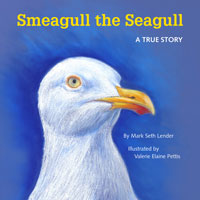 Buy a signed copy of Mark Seth Lender's book Smeagull the Seagull & support Living on Earth
© Copyright World Media Foundation. All Rights Reserved
Home | Contact | RSS | Donate | Newsletter