

Note on Emerging Science: Lightning-Rod Trees
Air Date: Week of March 20, 2026
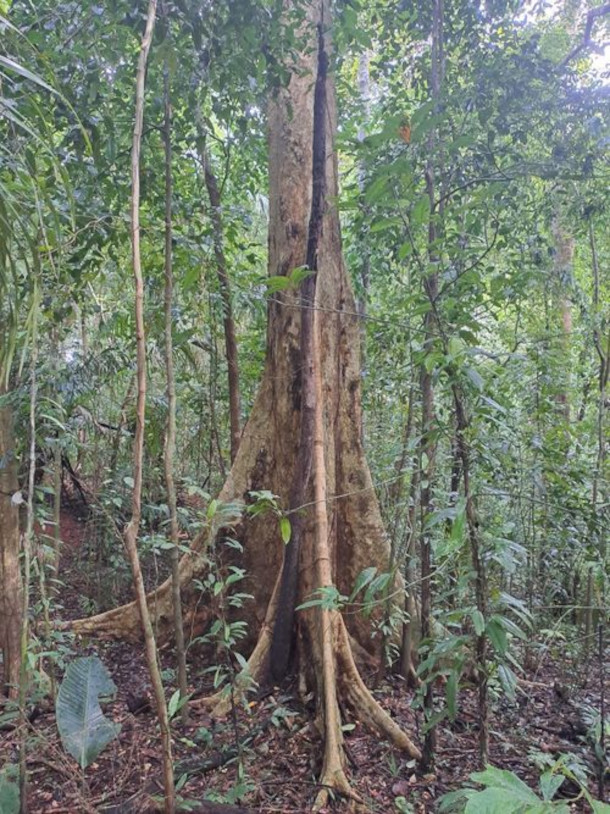
New research indicates that a species of tree called Dipteryx oleifera, also known as almendro trees, shown above, are resistant to lightning strikes and even use them to their advantage. (Photo: keesgroenendijk, Wikimedia Commons, CC BY 4.0)
An especially tall species of rainforest tree known as the almendro appears to benefit from lightning strikes, according to a 2025 study in the Panama rainforest. Living on Earth’s Don Lyman reports in this note on emerging science that the almendros seem unharmed after lightning strikes, compared to a high mortality rate among other trees and the lightning clears out parasitic vines and competing trees to free up light and nutrients.
Transcript
DOERING: It’s Living on Earth, I’m Jenni Doering.
O’NEILL: And I’m Aynsley O’Neill.
In a moment, we’ll look at how electricity from the sun and wind could provide an alternate power source for the oil-rich nation of Venezuela. But first this note on emerging science from Living on Earth’s Don Lyman about how electricity from the sky helps power the ecology of the rainforest.
[SCIENCE NOTE THEME]
LYMAN: Last spring, scientists who were studying the effects of lightning strikes on tropical forests at the Barro Colorado Nature Monument in Panama reported an unexpected finding — one especially tall species of rainforest tree — Dipteryx oleifera — also known as "almendro", actually benefited from lightning strikes, which killed off parasitic woody vines, known as lianas, as well as competing trees of other species.
The scientists documented one case in 2019 where a liana-covered D. oleifera suffered a powerful lightning strike, which damaged 115 surrounding trees, half of which died within two years. The lianas that covered the almendro tree all died. “It looked like a bomb went off,” said forest ecologist Evan Gora of the Cary Institute of Ecosystem Studies in Millbrook, N.Y. The D. oleifera tree, however, was still standing and healthy. The research team studied 93 trees struck by lightning, including nine D. oleifera. Gora reported that after two years, all the almendro trees were thriving, in stark contrast to 56 percent mortality among the other tree species.
One reason for this resilience is that aside from some ruffled leaves, D. oleifera trees somehow aren’t significantly damaged by lightning. The researchers posit that the tree’s wood might have low electrical resistance to allow the tree to safely conduct electrical current to the ground. The electric shock, however, eliminates most of the parasitic lianas that grow on them. These abundant vines can rob trees of light and nutrients. Vines that are connected from the almendro trees to branches on neighboring trees spread electrical current from the lightning strikes to the adjacent trees, causing them damage. An average of about nine adjacent trees were killed per lightning strike, which frees up space, light and nutrients for the D. oleifera trees. That’s this week’s note on emerging science. I’m Don Lyman.
Links
Living on Earth wants to hear from you!
Living on Earth
62 Calef Highway, Suite 212
Lee, NH 03861
Telephone: 617-287-4121
E-mail: comments@loe.org
Newsletter [Click here]
Donate to Living on Earth!
Living on Earth is an independent media program and relies entirely on contributions from listeners and institutions supporting public service. Please donate now to preserve an independent environmental voice.
NewsletterLiving on Earth offers a weekly delivery of the show's rundown to your mailbox. Sign up for our newsletter today!
 Sailors For The Sea: Be the change you want to sea.
 The Grantham Foundation for the Protection of the Environment: Committed to protecting and improving the health of the global environment.
 Contribute to Living on Earth and receive, as our gift to you, an archival print of one of Mark Seth Lender's extraordinary wildlife photographs. Follow the link to see Mark's current collection of photographs.
 Buy a signed copy of Mark Seth Lender's book Smeagull the Seagull & support Living on Earth
© Copyright World Media Foundation. All Rights Reserved
Home | Contact | RSS | Donate | Newsletter