

January 23, 2026
Air Date: January 23, 2026
FULL SHOW
SEGMENTS
US Leaves Top Climate Science Body
View the page for this story
The Trump Administration is withdrawing the US from the scientific Intergovernmental Panel on Climate Change or IPCC, which reports agreement about the basic scientific facts of global warming and the impact of core technologies to address it. Physicist and climate scientist Bill Hare, a lead author of the IPCC fourth assessment report in 2007, tells Host Steve Curwood about how the fossil fuel industry has long pushed for such an action. (14:11)
Health and Economic Costs of Fossil Fuels
View the page for this story
The burning of fossil fuels is linked to some 300,000 deaths in America every year, not to mention the related carbon emissions that promote global warming. Dr. Vanessa Kerry directs Global Health and Climate Policy and teaches at the Harvard T H Chan School of Public Health. She is also the World Health Organization Special Envoy for Climate Change and Health and joins Host Steve Curwood to discuss the major health costs and lost opportunities linked to pollution. (12:51)
Ice Visions
/ Erik HoffnerView the page for this story
As winter settles in over the northern hemisphere people find creative ways to get outside and enjoy nature. For environmental journalist and photographer Erik Hoffner, winter is a time for ice skating, a passion which gave rise to some unusual art, now 20 years in the making. (03:26)
Gardening for Special Needs
View the page for this story
For people with developmental or physical disabilities, growing plants in a garden may offer personal growth opportunities that unlock new possibilities outside of the garden too. This kind of transformation is something avid gardener Jill Mays has seen again and again in her work with disabled children and adults, and she speaks with Host Paloma Beltran about her book Nurturing Nature: A Guide to Gardening for Special Needs. (16:15)
Show Credits and Funders
Show Transcript
260123 Transcript
HOSTS: Paloma Beltran, Steve Curwood
GUESTS: Bill Hare, Vanessa Kerry, Jill Mays
REPORTERS: Erik Hoffner
[THEME]
CURWOOD: From PRX – this is Living on Earth.
[THEME]
CURWOOD: I’m Steve Curwood.
BELTRAN: And I’m Paloma Beltran.
The US withdrawal from the official international climate science panel the IPCC is yet another move by the White House to boost climate denial.
HARE: I don't think this position that Trump has got has just popped out of a clear blue sky this year. We've had a 30-year period now where there's been an increasing challenging of climate science by the fossil fuel industry.
BELTRAN: And also the public health dangers of climate denial.
CURWOOD: Plus, why gardening helps people with special needs.
MAYS: You really want them to feel joy. You want them to experience joy when they're in the garden, and the first thing is that they feel like they understand what's happening and they're capable of doing what is asked of them.
CURWOOD: We’ll have those stories and more, this week on Living on Earth. Stick around!
[NEWSBREAK MUSIC: Boards Of Canada “Zoetrope” from “In A Beautiful Place Out In The Country” (Warp Records 2000)]
[THEME]
US Leaves Top Climate Science Body
On January 7th, 2026 President Trump formally withdrew the United States from the Intergovernmental Panel on Climate Change (IPCC, logo shown above). (Photo: Intergovernmental Panel on Climate Change, Wikimedia Commons, CC0)
BELTRAN: From PRX and the Jennifer and Ted Stanley Studios at the University of Massachusetts Boston, this is Living on Earth. I’m Paloma Beltran.
CURWOOD: And I’m Steve Curwood.
As the Trump administration continues to go it alone in foreign relations, the US is now the only country to say it’s getting out of the scientific Intergovernmental Panel on Climate Change, as well as the climate treaty. The hundreds of scientists and more than 100 countries of the IPCC are behind the official finding that the world should not get warmer on average than one and a half degrees Celsius over preindustrial times. The IPCC reports agreement about the basic scientific facts of global warming and the impact of core technologies to address it. Bill Hare is a leading physicist and climate scientist who was a lead author of the IPCC fourth assessment report in 2007, the year its scientists and Al Gore were jointly awarded the Nobel Peace Prize. He’s now the CEO and founder of Climate Analytics, a non-profit based in Berlin and joins me now. Welcome back to Living on Earth, Dr. Hare!
HARE: Thanks, G'day.
CURWOOD: So before we delve into the US's recent actions, please talk us through why the IPCC was formed back in 1988.
HARE: Well, look, the vision behind the IPCC being formed was to have a place where governments had to agree in common the scientific understanding of climate change. That was the vision that Professor Bolin of Sweden had in initiating the IPCC, that the scientists could do their work, but the question was, would the governments hear the message, and what would they understand? So his idea was to get an intergovernmental scientific body that would do the science and then negotiate an agreed summary of that science between all of the governments. That was the intergovernmental part of it, and his vision then was that there couldn't be a government walking away from that kind of process saying, I didn't know or I disagree, because they all had to sit in one room and agree.
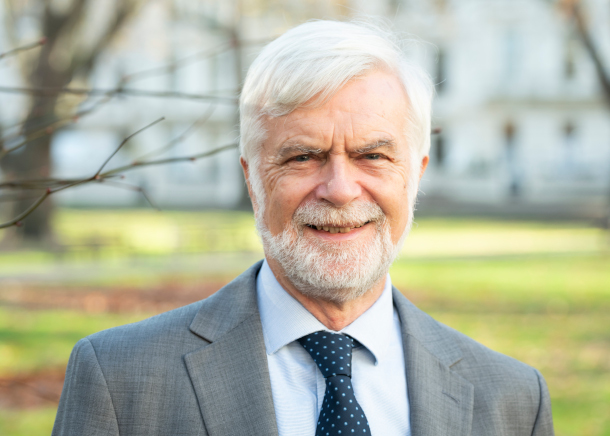
Jim Skea, current chair of the IPCC. The IPCC was formed as a way for governments to develop a consensus around understandings of climate change. (Photo: Orso3553, Wikimedia Commons, CC BY-SA 4.0)
CURWOOD: Why does President Trump want to get out of, or even get rid of the IPCC? Why now? And why is the United States the only country to do so to date?
HARE: Well, look, I would stand back a bit. Look at it from a historical point of view. I don't think this position that Trump has got has just popped out of a clear blue sky this year. It's been, I guess, 30 years in development. We've had a 30-year period now, where there's been an increasing challenging of climate science by the fossil fuel industry, and fossil fuel industry-funded, primarily US, but not only US, think tanks. And during that whole period, of course, the IPCC has been a critical focus of their attention. It's a major threat, was viewed as major threat by those in the fossil fuel industry that were very opposed to action. So to de-legitimize or water down an IPCC report was one of the main games they played in the 90s and 2000s and beyond. So I see it as the logical continuation of that campaign, and that steadily increased, I would say, over the years, and has variously impacted different American administrations, and most forcefully it's impacted on the Trump administration. The Heritage Foundation mapped out what to do about the IPCC, which was more or less to get rid of it and withdraw from it. And that's actually happening, but that isn't really a very modern idea. It's been around for a long time, and it's just now reached the full force of having a president that's willing to do so for the first time in the history of the IPCC.
CURWOOD: Why is the United States the only country to do so now?
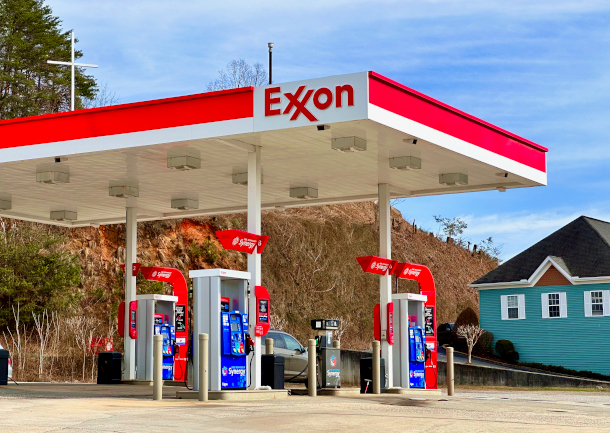
Fossil fuel companies such as ExxonMobil have viewed the IPCC’s research as major threats to their businesses. Our guest, Dr. Bill Hare, suggests that the Trump administration’s withdrawal from the IPCC may signal these companies’ outsized influence in the political process. (Photo: Harrison Keely, Wikimedia Commons, CC BY 4.0)
HARE: Well, I think you've got a really extreme case in the US where big money, and fossil fuel money in particular, has an outsized impact politically on government. I think that's at least looking from the outside and observing the US over many years, I say that is probably the main reason, whereas other governments might not like what the IPCC says, but they don't feel able to walk away from it, and parts of their government, all governments are complicated, parts of government really want to see IPCC reports. They need them. So there's a big momentum behind having an IPCC and an IPCC report cycle from the 100 plus governments that belong to the IPCC, and that creates an interest in it continuing, and the US is a bit of an outlier now, in walking away from it.
CURWOOD: What's the impact of the US getting out of the IPCC? I mean, how big a deal is this?
HARE: Well, it's obviously not good. It's quite bad. There's no doubt about that. Is it catastrophic? No. Is it going to undermine and block the IPCC assessment? No. I look at this in a bigger way. I look at the US withdrawal from the climate convention, climate treaty, the Paris Agreement, IPCC, as a cluster of issues going on that are quite negative. The thing that's not really clear yet is, is this going to be really damaging to the international system of acting on climate change, or is it going to be a nuisance, right? And right now, I would say it looks more like a nuisance than a fundamental problem. We haven't had the US engaged in the climate negotiations now for a year, the system didn't fall over. It's moving forward. I don't see it having the same kind of damage that it would have had 30 years ago. When the IPCC first started, I think the US, UK, Germany, and a few others, Brazil, were really, really important in providing the scientific firepower and governmental backing to get the IPCC going. I think if the US had withdrawn at the time of the second assessment report in 1995 or even the third in 2001, I'm not sure the IPCC would have survived in the way that it has. Now it's 2026, and the IPCC is a much bigger thing. It has a lot more support. Half the authors are from the global south. So many governments see it as a universal source of standard advice on what's going on with climate, what to do about it, how much it's going to cost, how fast we can do it, what the adaptation options are and so on, that it just has so much support, it's going to be very difficult to kill it off, if that is indeed the ambition of those that are behind President Trump's push to exit from it. So I don't think it's going to be really critically damaging right now. I think there's going to be ways of compensating for the US absence. I fear the damage is going to be greater within the US than anywhere else. Why do I fear that? Because I have a lot of friends in the US, a lot of scientific friends, and I fear that what Trump is doing may have very long-lasting consequences. Not going to be really easy to reset and rebuild a lot of the things that have been taken down and destroyed. And economically, I think the US is going to be in a more difficult position in the longer term, because of the pushback to fossil fuels while other countries move on with clean tech. So I think there's different dimensions to how I see it. I see it as a big problem. It's damaging, but I don't see it as a fundamental or catastrophic threat right now.
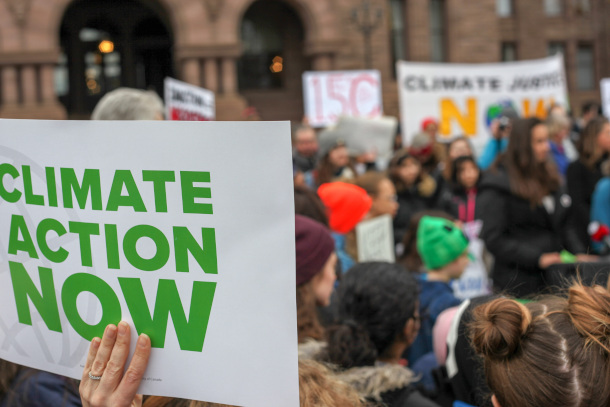
Bill Hare suggests that it is currently unclear whether the U.S.’s withdrawal from the IPCC will stall or limit global climate action. Hare believes that the U.S. is likely to experience threats to its economic stability as it returns to fossil fuels, while other countries move forward with renewable energy. (Photo: Jasmin Sessler, Wikimedia Commons, CC BY 4.0)
CURWOOD: Bill, over the years, the IPCC has been criticized for being a bit too timid with its assessments and in terms of sounding the alarm about what was going on with climate disruption. That has changed, I think, from assessments to assessments. How valid is that criticism and to what extent might it pertain today?
HARE: Well, look that criticism's been out there ever since the IPCC started, in a way, when the first assessment report came along, and I know Greenpeace at the time, I wasn't working for Greenpeace then, was making a big point that the IPCC should be giving a much sharper, risk-based assessment. At the time, I felt that was correct. But I must say, over the years, I've come to understand, or my own feeling is that the IPCC has done a reasonably good job of providing a very solid assessment, given its limitations. By that, I mean, if you're going to have 500 scientists try and agree something, and then you've got 120 governments trying to agree how to describe it. You are not going to get a scary risk assessment, even though you probably should have. On the other hand, the benefit of the IPCC is it does provide a very strong basis for the quite, let's say, strong risk assessments that you can make based on the climate science. Now, I think what you're also hinting at is that the science is moving on, and scientists are getting more and more concerned and alarmed by what they're seeing. And I think that's a fact, and I think you're seeing a lot of progress now on understanding the risks of really extreme events, earth system tipping points, such as meltdown of ice sheets or the collapse of coral reefs. And so now we're observing that, the meltdown of our forests, for example, from drought and fire, putting more carbon in the atmosphere, accelerating warming, these kind of risk assessments, which you could have made back in the 1990s, now are much sharper and much more solidly backed by science than they would have been 30 years ago. I remember George Woodwell from the Woods Hole Center, he's passed away now, but he wrote a whole book about the risk of feedbacks affecting forests and so on. And at that time, it was seen very much as an outlier in the field, didn't really enter the mainstream of IPCC assessments, but the work that's been done in the intervening generation is now showing that we have such a big risk, and we're already seeing it in the atmosphere now as CO2 concentration keeps increasing, even though fossil fuel emissions are flat because of the way in which our natural carbon cycle is weakening. So, yeah, I think the IPCC plays a role. It's a very important one. But you could never expect an intergovernmental body to really come up with a very, very sharp risk assessment unless it's an absolute catastrophe, I'm afraid.
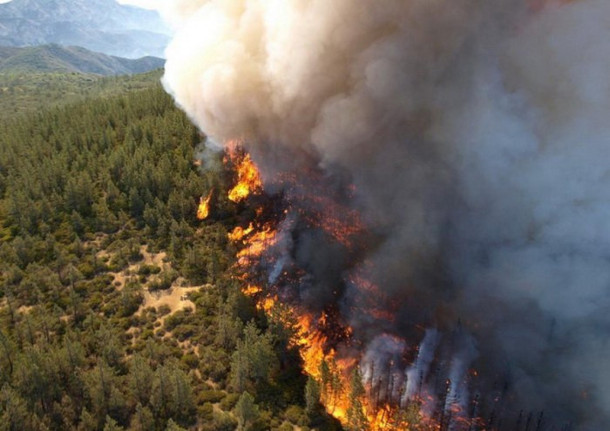
The IPCC has faced criticism that its reports do not state the risks of climate change severely enough, particularly as risk assessments around catastrophic events like wildfires, drought, and melting ice caps now have more solid backing from scientific research. Hare said that he expects to see a greater emphasis on systemic risks in the next Synthesis Report, which will be published in late 2029. (Photo: Salam2009, Wikimedia Commons, CC BY-SA 4.0)
CURWOOD: And today, though, I mean, how close to the risk of catastrophe is the IPCC talking? We're, what, at the sixth assessment report now?
HARE: Well, you can read the sixth assessment report, and there's some pretty strong messages there, in a way, about the risk that we're running. And it depends how you read it. You know, we know that by the time you get to two degrees warming, we're running out of adaptation options in many places. We know that we run the risk of multimeter sea level rise, two degrees warming or a bit above from ice sheet disintegration. Those messages came very strongly through the sixth assessment report in a way they never had before. But the word "catastrophe" was not used because a catastrophe might mean something much bigger than what I've just described. Everyone's going to have their own view about it. It's not really a good, strong scientific definition of what a catastrophe is, apart from maybe the earth running into an asteroid or something like that. So that's, that's always going to be difficult for the IPCC to deal with. But on the other hand, the IPCC has got a lot better at grappling with these issues, I think, and I think we will see a bigger emphasis on these big, systematic, systemic risks, earth system risks coming through this next assessment. There's going to be a lot more work on it, because there's a lot better science now than there was even, say, 15 years ago.
CURWOOD: Bill Hare, what gives you hope, both about continuing the data gathering of the IPCC and its process, but also getting the world to act quickly enough to avoid the worst of the climate disruption that we seem to be on track to experience?
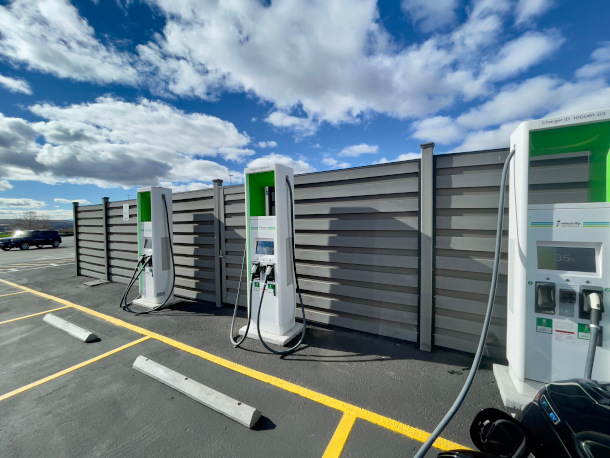
Despite the U.S.’s retreat from the global stage, as of now climate action continues to move forward around the world. Particularly, new mitigation technologies, such as batteries and renewable energy infrastructure, continue to be developed and deployed at a rapid rate. (Photo: Gregory Varnum, Wikimedia Commons, CC BY-SA 4.0)
HARE: You know, that's quite a profound question, in a way, because I think anyone who follows the climate change problem closely or even just reads the news, is entitled to get a bit panicky and scared about what's happening. And I think that's quite a common phenomenon now. So it's quite natural then I think, given what we're observing, for people to be fearful, scared, worried, even fatalistic. The question is, where does hope come from? And hope comes from trying to do something about it, I think. I think it's the message that Jane Goodall left us all, is that you make hope, it doesn't just happen. So I get my hope from seeing what is happening and looking at the at the things that are working and that are happening at scale, and working out how to contribute to making that go faster. And there are some positive things happening out there, particularly in the mitigation space, reducing emissions space. We're seeing the massive rollout of renewable energy globally. We're seeing the acceleration of electric vehicles. We're seeing cost of batteries dropping, which is affecting energy markets from California to Southern Africa in a very profound way. So that's positive. That's happening. It's going to be hard for any one government to stop.
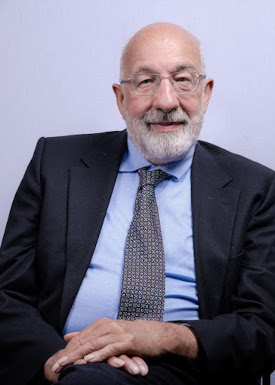
Dr. Bill Hare is a physicist and climate scientist who has contributed to international climate negotiations for over thirty years, including serving as a lead author of the IPCC fourth assessment report. He’s now the CEO and founder of Climate Analytics, a non-profit based in Berlin. (Photo: Climate Analytics)
The fear, of course, on the other side, is it happening fast enough? But I think if one gets too focused on the drama, if I might put it, of the Trump administration, and you could begin to imagine that the actions of the Trump administration and the US could significantly slow down climate action, and they definitely are, in the United States. I don't see a lot of evidence yet of that translating into a slowdown in many other places. It could happen, and probably in some places will happen. But in general, we see still forward movement in the energy markets on the clean energy tech that I've mentioned. So I think there are grounds for optimism. There's also grounds for profound concern, and the way that I get my hope is focusing on what to do about accelerating those things that will make a big difference.
CURWOOD: Bill Hare is a physicist and climate scientist who was one of the lead authors of the IPCC Fourth Assessment. He is now the CEO and founder of Climate Analytics, a nonprofit based in Berlin, Germany. Thanks so much, Dr. Hare, for taking the time with us today.
HARE: Yeah, thanks for the talk. It was great.
Related links:
- IPCC | IPCC Statement on US Withdrawal (8 Jan 2026)
- The White House | “Withdrawing the United States from International Organizations, Conventions, and Treaties that Are Contrary to the Interests of the United States”
- Nature | US Quitting 66 Global Agencies: What Does This Mean for Science? (20 Jan 2026)
- Read the full IPCC sixth assessment report published in 2023
[MUSIC: Vusi Mahlasela, “Silang Mabele (Ilivi Lebanitfu)” on The Voice, Traditional arr. Vusi Mahlasela and Lloyd Rose, ATO Records/BMG]
BELTRAN: Coming up, researchers say the health benefits of reducing fossil fuel use are being largely ignored, at our peril. That’s just ahead on Living on Earth.
ANNOUNCER: Support for Living on Earth comes from the estate of Rosamund Stone Zander - celebrated painter, environmentalist, and author of The Art of Possibility – who inspired others to see the profound interconnectedness of all living things, and to act with courage and creativity on behalf of our planet. Support also comes from Sailors for the Sea and Oceana. Helping boaters race clean, sail green and protect the seas they love. More information @sailorsforthesea.org.
[CUTAWAY MUSIC: Stan Samole, “Inch Worm” on Childish Dreams, Public Domain/arr. Stan Samole and David Antonacci, MCA Records/Jazz Inspiration]
Health and Economic Costs of Fossil Fuels
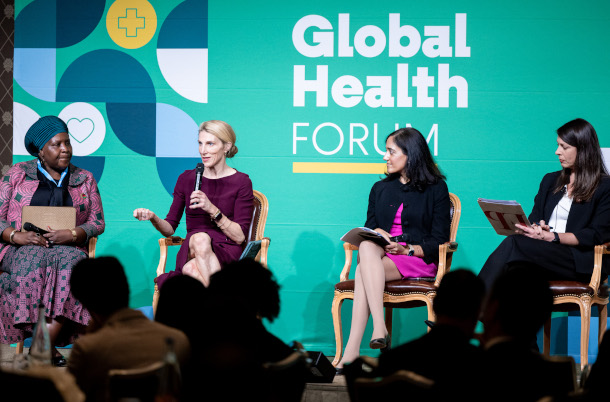
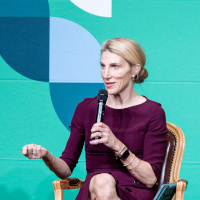
Dr. Vanessa Kerry (second from left) speaks at the Foreign Policy event at the World Health Assembly in Geneva in May 2025. Under her leadership, Seed Global Health has helped educate more than 45,000 doctors, nurses, and midwives in seven countries, helping to improve health care for more than 76 million people. (Photo: Courtesy of Seed Global Health)
BELTRAN: It’s Living on Earth, I’m Paloma Beltran.
CURWOOD: And I’m Steve Curwood.
Ever since the Six Cities study led by Harvard’s public health experts first found in the Nineties that coal power plant smokestacks were sources of deadly and serious health effects for people living downwind, there have been debates about what to do about it. This first research and its iterations supported by federal funds suggested as many as 70,000 Americans were dying prematurely from the tiny particles emitted. Today the most recent work led by Harvard links as many as 300,000 deaths in America every year to the burning of fossil fuels, not to mention the related carbon emissions that promote global warming. Joining us now from Boston is Vanessa Kerry, a critical care physician who directs Global Health and Climate Policy and teaches at the Harvard T. H. Chan School of Public Health. She is also the World Health Organization Special Envoy for Climate Change and Health and is speaking out about the major health costs and lost opportunities linked to pollution. Welcome to Living on Earth, Dr. Kerry!
KERRY: Thank you so much. I'm really honored to be here with you.
CURWOOD: So, there's been a shift in messaging from environmental groups regarding the impact of air pollution on environmental health. Discuss what that means in terms of the effectiveness of helping people understand the impact of the environment on their daily lives?
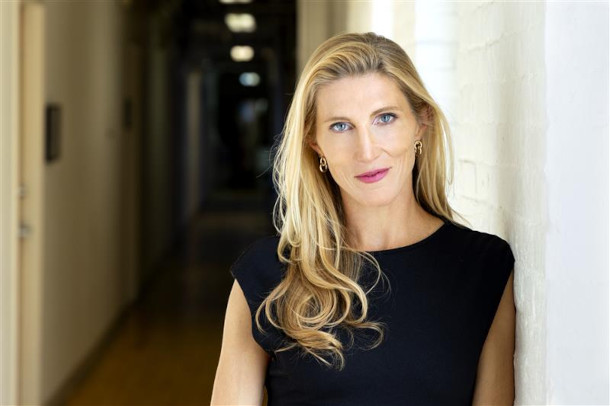
Harvard and the WHO’s Vanessa Kerry MD is the founder and CEO of Seed Global Health. (Photo: Courtesy of Seed Global Health)
KERRY: Well, I think the shift in messaging that we're experiencing around the environment and climate change, the dreaded two words, I think it's twofold. It's getting very, very divided now in terms of how we think about it. I think there's a group that is trying to the calls it the greatest hoax in, you know, of our time, and there are others that are really trying to think strategically about how we understand what is happening on this earth and this planet and in our changing climate, in ways that we can really relate to that aren't just numbers or degrees Celsius, but are in the numbers of lives lost or saved, and health has been a really important piece to being able to make that transition, I think, and having people understand that you walking down the street are very well going to be impacted by what is happening, be it a moment of extreme heat, or if it, you know, and how that affects you and puts you at risk of flaring your diabetes or your lung disease or your heart disease, or in terms of understanding how extreme weather impacts us. I mean, I think when you have these massive events like the wildfires in Canada that turn the air orange in New York, it's very hard to deny that we are facing new and different challenges. And health is a very important tool to be able to do that. But I think there's another step that we can also take to help people really understand what we're up against in climate change, which is that these health impacts that we're seeing cost us money, because if you are too sick to go to work, or you can't breathe, or your child has an asthma attack, and you can't go to work because you're taking them to hospital, that's lost income. We know, for example, that the United States is losing 100 billion in productivity from extreme heat already now, and that's supposed to go to 500 billion in the next 20 years. So these, it's very real. And I think for those that can't even think about health, understanding the economic bottom line and how it affects your pocket is something that I think is universally related and understood and very real.
CURWOOD: So, let's talk about some of the research that we were told from folks at Harvard. Studies show that there are some 300,000 excess deaths in the United States each year, and maybe 7 - 8 million globally because of the fine particulate matter that's in the air due to the air pollution from the fossil fuel industry. Burning fossil fuels makes people sick. To me, it seems, if it's that much of a health danger, climate change is almost an aside. You know, you could argue about climate change, and some people want to, but that kind of health impact seems to me that people should really be acting on not burning fossil fuels just because of that. What do you think?
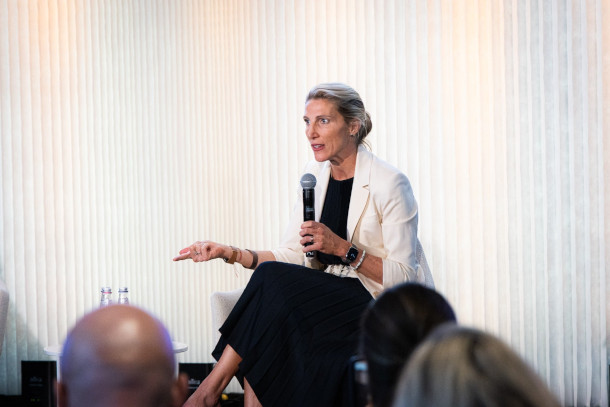
Dr. Vanessa Kerry speaking at Devex at UN General Assembly 80 event in New York, Sept. 2025. (Photo: Courtesy of Seed Global Health)
KERRY: So, the data on fossil fuels and what it does to our health are profound, and I think that fossil fuel burning in addition to what it is doing to the climate and extreme heat and there's a whole host of health burdens that come from what we're seeing in terms of extreme heat and the changes in weather that we're seeing that are being climate change driven. So without question, the burning of fossil fuels is driving our risk through multiple pathways. But in terms of the air pollution in the particulate matter. Particulate matter is co-emitted with the greenhouse gasses and particulate matter that is being spewed out by fossil fuels or by coal plants and the type fossil fuels that are affecting us have very direct impacts on your health. Not only do you breathe it in and can it cause issues in your lungs, but actually particulate matter 2.5 and lower, which is what is very frequently seen, is something that actually can cross into your bloodstream, lead to increased risk of heart attacks, worsen your blood pressure, increased risk of strokes, cause all sorts of other problems in the body, and it is dangerous to our health, and it is dangerous to, you know, to keep having that continue.
CURWOOD: So recently, the U.S Environmental Protection Agency said it's going to stop calculating the health care savings from key air pollution rules, things that do focus on things like particulates. What signal does that send? What's the harm from that?
KERRY: The harm of doing that, it's basically, it's really, I think it's what it's going to do, is it's undermining, without question, the general public and scientists and everyone's understanding of really how impactful the regulations and and these protections are and so what is happening ultimately, you're not measuring the cost, you're not taking in the full stock of how humans are affected, because economic savings are a major incentive for corporations and for others, individuals, to understand sort of why we can have climate action be a win-win. And so they're just removing information to be able to tell a narrative that benefits a few. But at the end of the day, we know that when you breathe air pollution and you are unable to go to work, you lose your income. Or when you have a workforce that is not able to perform because of the reduced productivity of air pollution, a company suffers. And when you're spending a huge amount of money out of pocket, or when a government is spending money, or public sector or an insurance company is spending money to provide health care to somebody who's suffering from that, we're not giving a full picture of what the harm is here. The social determinants of health are also incredibly important. So beyond the direct impacts of fossil fuels, people who are paying out of pocket for catastrophic health costs related to this are therefore losing access to nutrition, ability to send their children to school, access to other resources that are critically important. There are deep links between poverty and poor health, and we know that we're going to see upwards, you know, 44 million people are going to fall into poverty from the health impacts of climate change alone, according to the World Bank, in the next 20 years, these are really real impacts. And history is getting rewritten, and a narrative is getting rewritten when we don't provide the full picture.
CURWOOD: So if these particulates, the air pollution, has such a tremendous impact on us, health-wise and economically as well, why aren't we talking about this more in America?
KERRY: It doesn't make sense to me. I think one of the things that I'm really eager to pursue in some of the work that I'm hoping to do at Harvard School of Public Health and Department of Environmental Health is actually to look at that exact question is to help consolidate the narrative and the deep understanding of this economic bottom line of poor health and what it actually means, so that health foundationally becomes part of our conversations about economic security, human security, and to really help shift that is not treated as a social good, but understood as a powerful investment for economic growth, right? And there's lots of data out there that tells us that investments in health actually have higher returns. So the Biden administration's EPA, the very EPA that is no longer calculating the costs of climate change, has calculated that for every dollar spent in reducing PM 2.5 overall, there could be as much as $77 in health benefits. So the cost of mitigating the problem can cause profound savings in terms of people's health and well-being.
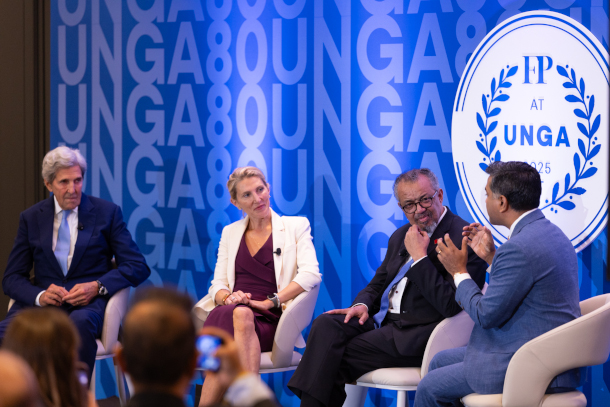
Dr. Vanessa Kerry (center) speaks at a Foreign Policy UN General Assembly event in September 2025, joined by her father, former Secretary of State John Kerry (left), and Dr. Tedros Adhanom Ghebreyesus (right), Director-General of the World Health Organization. (Photo: Courtesy of Seed Global Health)
CURWOOD: To what extent are the massive impacts of air pollution on public health part of the reason that we have such a huge economic divide in this country?
KERRY: That's an interesting question. I think that, again, the social determinants of health and the degree to which we see, there's a vicious cycle that we see. And it's actually, you know, there's a term for it, the deprivation gradient, which is this fact that climate change is actually having impacts on those that are already most vulnerable in a way that it makes them even more vulnerable, because all of their social determinants are actually getting more difficult for them to achieve health, to achieve opportunity, to see economic gain, or to have, you know, the ability to sort of move upward socially in pieces like that. So when you look at who lives in urban cities, in heat deserts, where it can be absolutely crippling to live in high heat, it's often people of color or people in poverty. And so there's a massive divide that is happening where we are exacerbating inequity without question, not just in the United States, but globally. And for me, that raises the question of, are we going to accept that? Is that a sustained, not beyond just the moral sort of unacceptableness of that to me, the question also is, you know, are we, is that a sustainable pathway for humanity?
CURWOOD: We don't have much more time now, but I have to ask you about conversation that's come out of the Heritage Foundation in Washington that claims that climate change alarmism, quote, unquote, is discouraging families from having children. Now you're not only a physician, you're a mom. For a moment, speak to that issue about how concern for climate change can have the opposite effect. I mean, how dangerous is it to have that level of environmental skepticism? How cynical is it to have that level of environmental skepticism?
KERRY: Well, I mean, I think you raise a really, it's a fascinating point, but I think the real danger here isn't necessarily concern about climate change. It's really actually the perpetuation of misinformation, and the inability to kind of communicate truth and the mixed messaging that we're seeing, and we're seeing this with vaccines. We are seeing this with public health across the board, and the destruction of trust in science and health is going to be profoundly damaging, beyond just climate change, but within all scientific pieces. And I mean, I think, you know, we saw this in COVID as well. That confusion cost lives. And I saw that very, very directly as an ICU physician during COVID, when I would have patients coming in that we'd be having to put the breathing tube in, and they would be begging for the vaccine, saying, I didn't understand. I believed what everybody said, please, just give me the vaccine. And I would have to tell them it was too late. And seeing them suddenly have the dawning of what that impact of that confusion was, is what we're facing in climate change again now. And I think that my other deep concern with this is that underlying all of this chaos is actually anxiety. People have deep anxiety and mental, you know, debilitation, which is really, it is debilitating to people's ability to live their lives, care for their children, do their jobs. And we have such a stigma against mental health, we don't talk about it. But that has profound impacts on what's happening in the world today. So I think it is really an insidious sort of disease we're seeing in terms of this misinformation, and the ability for people to just live in a silo of information. And how we communicate a conversation like this, which is fact-based, scientific, ground in truth, you know, to the right places, I think, is a really critical question that we have to also again, really tackle as a society if we're going to start to help people make the right choices for the challenges that we face today.
CURWOOD: Vanessa Kerry is a critical care trained physician and Director of the Global and Climate Health Policy at the Department of Environmental Health at the Harvard T.H. Chan School of Public Health, and co-founder and CEO of Seed Global Health. Thank you so much, Dr. Kerry, for taking the time with us today.
KERRY: Thank you so much.
CURWOOD: Tune in next week for the second part of our interview with Dr. Kerry, to hear her analysis of the global health impact of Trump administration policies.
Related links:
- Visit Seed Global Health’s website
- Associated Press | “EPA Says It Will Stop Calculating Health Care Savings From Key Air Pollution Rules”
- Frontiers in Public Health Journal | “Climate Change and Health: Rethinking Public Health Messaging for Wildfire Smoke and Extreme Heat Co-Exposures”
[MUSIC: Time For Three, “Banjo Love” on Time for Three, Universal Music Classics]
Ice Visions
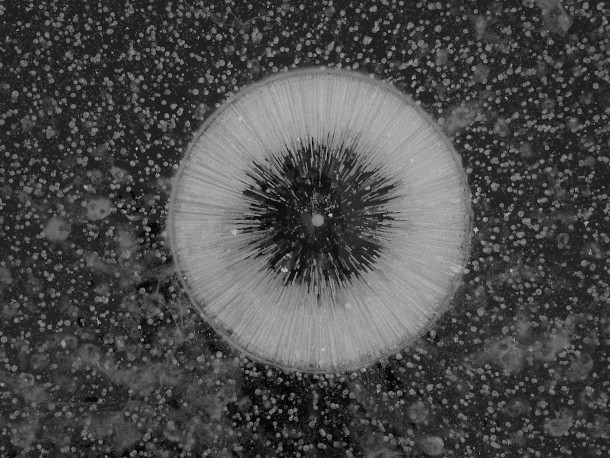
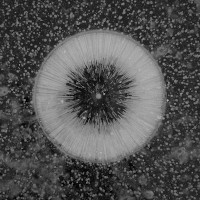
A “classic” version of Hoffner’s Ice Visions, photographs of ice-fishing holes as they re-freeze. (Photo: Courtesy of Erik Hoffner)
BELTRAN: Winters are changing as the climate warms but occasionally the ice is thick enough for environmental journalist and photographer Erik Hoffner to go skating. It’s a passion which gave rise to some unusual art.
HOFFNER: The first house I rented after moving to New England two decades ago was on a lake. I love ice skating, and felt lucky when a cold, dry December created a perfect scenario for skating just outside my door.
[ICE SKATING SOUNDS]
Most mornings I’d pull on skates and glide across that lake until my legs were shaky and sore. The hiss and scrape of blades on ice was often the only sound against the deep, cold quiet of the sleeping landscape. The ice that first year was so clear I could watch fish swimming below. In early winter as the ice formed, I could even hear its cracks, and groans, and pings through the floor of my house.
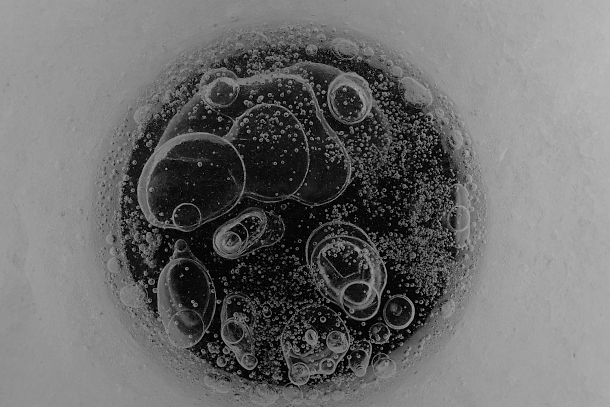
A “climate-changed” version of Hoffner’s Ice Visions. (Photo: Courtesy of Erik Hoffner)
[GROANS & PINGS OF ICE]
Then ice fishermen drilled perfectly round holes in the lake. And overnight tiny bubbles filtering up from sediments below were caught in thickening water inside those holes while inches of new ice formed. The bubbles stretched as the water refroze, creating streaks that radiated from the center outward much like the lines that radiate out in the iris of an eye. These holes seemed to become the lake’s own eyes, gazing at and reflecting the starry night sky. Formations were all different, like snowflakes. In the morning light, they just could look like stars, cells, or galaxies.
Now, every year in early winter I strap on my skates in a kind of treasure hunt for the holes and shoot black and white photos of them. Over 20 years I built up a huge collection of these “ice visions.” I don’t know what’s more fun, taking the pictures or pulling on my skates to fly over the frozen water on those quiet winter mornings. Some years, though, it snows early, before the ice reaches a safe thickness, making skating impossible. And the photos I make on this choppy, gray canvas are less captivating than when refrozen holes are framed by that smooth, black ice which resembles deep space.
Last winter started cold, and good, safe ice set early, but then the weather warmed for a long stretch well into January and what I saw inside the fishing holes surprised me.
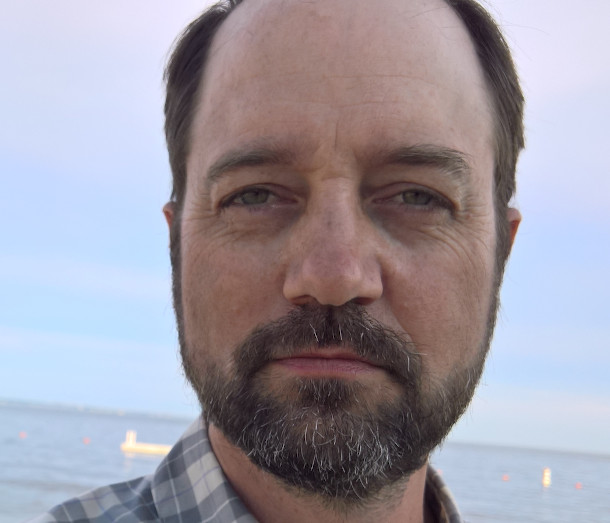
Erik Hoffner is a writer and photographer. (Photo Courtesy of Erik Hoffner)
Instead of building 2 or 3 inches of new ice in each hole overnight, there was often just a skin at the surface, so thin you could poke a finger through it. And the tiny bubbles trapped beneath that thin layer of ice pooled with others to create large, semi-frozen bubbles that oozed and flowed together. They looked entirely different, not so much like eyes or stars but rather distorted faces, and strange animals. It was like seeing the face of climate change. It’s too soon to say whether it will be too warm again this year. But there’s already safe ice on lakes in my town, so I’ve taken the cameras and skates out several times and look forward to discovering what wonders this winter will bring.
[ICE SKATING SOUNDS]
BELTRAN: That’s journalist and photographer Erik Hoffner. His work is now part of the permanent collection of the Bates Museum of Art in Maine. For links to his photographs visit the Living on Earth website loe.org.
Related links:
- Brattleboro Museum and Art Center | Erik Hoffner: Ice Visions
- Erik Hoffner’s official website
- Erik Hoffner on Instagram
- Watch Ice Visions (2020)
[MUSIC: Alan Gogoll, “Red Herring Woods” on Goldfish Ocean, Alan Gogoll]
CURWOOD: Just ahead, how gardening can help people on the autism spectrum grow confidence as well. Stay tuned to Living on Earth!
ANNOUNCER: Support for Living on Earth comes from the Waverley Street Foundation, working to cultivate a healing planet with community-led programs for better food, healthy farmlands, and smarter building, energy and businesses.
[CUTAWAY MUSIC: William Coulter & Benjamin Verdery, “Mna Na HEireann” on The Crooked Road, Gourd Music]
Gardening for Special Needs
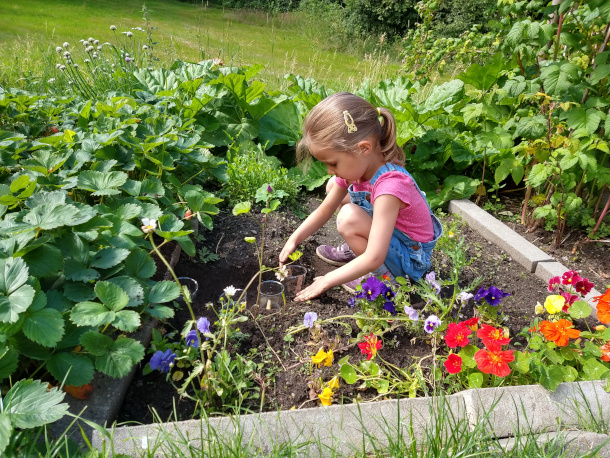
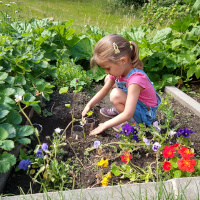
Gardening can help children regulate emotional health as well as learn mindfulness and resilience. (Photo: Elicarrera, Wikimedia Commons, CC BY SA 4.0)
CURWOOD: It’s Living on Earth, I’m Steve Curwood.
BELTRAN: And I’m Paloma Beltran.
In the late 1800s the British garden designer, writer and artist Gertrude Jekyll wrote: “A garden is a grand teacher... above all it teaches entire trust.” And for people with developmental or physical disabilities, growing plants in a garden may offer personal growth opportunities that unlock new possibilities outside of the garden too. This kind of transformation is something avid gardener Jill Mays of Cape Cod, Massachusetts has seen again and again in her work with disabled children and adults. Jill is an occupational therapist by training, and several years ago, she combined her interests and began to volunteer with the Truro Community Children’s Garden. Her book, Nurturing Nature: A Guide to Gardening for Special Needs , is relevant to people of all ages and abilities. She’s worked with people who have physical disabilities as well as those on the autism spectrum. Jill Mays, welcome to Living on Earth!
MAYS: Oh, thank you so much for having me.
BELTRAN: So Jill, you run a weekly gardening group for adults with disabilities. What is it about gardening that is so beneficial to this population?
MAYS: Well, the garden offers a smorgasbord of sensory input. You know, obviously visual, but then there's the smelling and hearing things, and then the moving around, and all of those things are very helpful and impactful to help engage this population. We have, like, millions and billions of input coming into our brain all the time, and we need filters to be able to figure out what to pay attention to and not to. And some people don't have effective filters in terms of being able to say, I can pay attention to this and not pay attention to that. And so a lot of people have hypersensitivities to touch. Others have hypersensitivities to sound. Even visual hypersensitivities can happen, where they have difficulty processing certain kinds of lights or whatever make them uncomfortable. And then there's people who, you know, have the whole ball of wax, so to speak, and you know, they're really in a very difficult state.
BELTRAN: How does participating in gardening mitigate that discomfort?
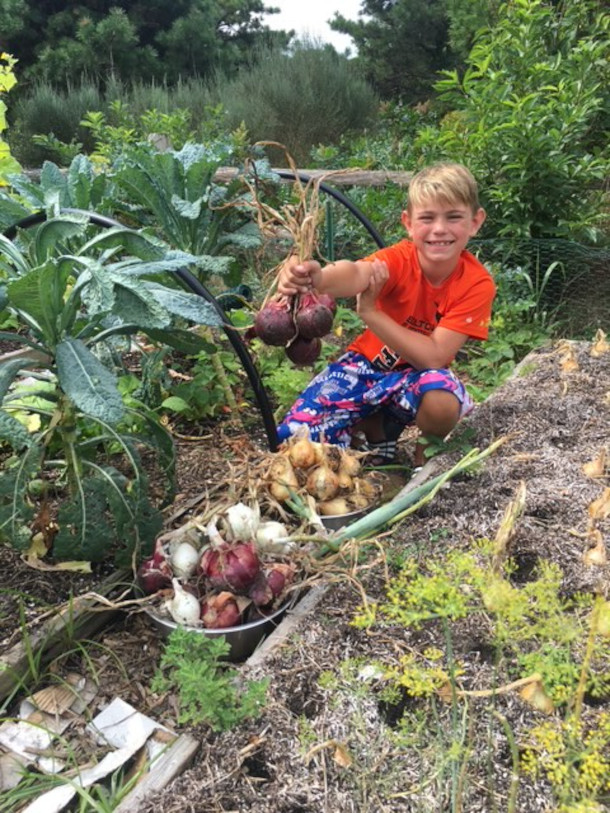
Pictured above is Jill Mays' grandson, holding onions in the garden. (Photo: Jill Mays)
MAYS: So for instance, after we have a welcoming and introductions where we're facilitating some socialization, we do a walk through an edible garden, an edible landscape. And along the way, we are looking at things and talking about our observations. And then we, there's always mint and lemon balm and things that I pull up and let them smell. And what that does is it activates the olfactory system. They love to look at the butterflies, because you can look at the details, and then they fly around. And so you're really activating the visual system in near point and then scanning. And then we always have a task to do. Usually it's weeding, and a lot of times they begin with, oh no, no, I don't want to touch the dirt, and I can't do that. And I'll say, I understand. All you need to do is five times, 12345, yay. You did a great job. The next time, it's 10 times. And so we begin to build resilience. And the other thing is, a lot of the people who are on the spectrum have a lot of hypersensitivities, especially to touch. And when they're in the garden, they're able to tolerate that, either by I, they have gloves, or I help explain to them that they're absolutely able to go wash their hands immediately. And so that's one aspect, is that they begin to tolerate in that respect, but also, because there's so much other sensory things, stimuli going on, it helps mitigate their focus on the discomfort of touch. And also, by being uncomfortable with touch, they have difficulty engaging with other people, because people are unpredictable, and they kind of want to stay in control, so the more we can help mediate that discomfort to touch, the more they're able to begin engaging socially.
BELTRAN: And can you tell us a story, Jill, you know, maybe, about a participant in the gardening group for whom you saw a significant change in their behavior over time?
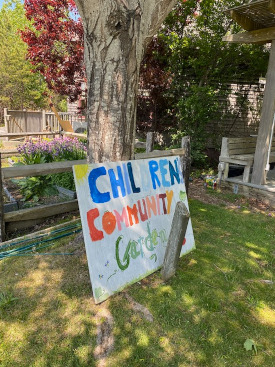
The Truro Children's Community Garden, a community project, was spearheaded by Sustainable C.A.P.E.* (Center for Agriculture, Preservation and Education) and the Truro library. Local businesses and volunteers helped build and run the group, which has been running since 2010. (Photo: Jill Mays)
MAYS: Absolutely. One young woman, very bright, on the spectrum, and has a lot of difficulty engaging with other people, so she would come to the garden group, and was very, very reticent to even, you know, always followed behind with, needed encouragement to follow our group on the tour, and was always like five or 10 feet behind. And over time, we were able to get her to be engaged in all of the tasks to the point where she became a helper. So in socialization, there's parallel work and play, where people are working alongside each other. So that was a first step. And over the course of a summer, at the end of each of our groups, we have a project that we do. And so things like potting up plants. And she was able to engage in cooperative work, helping another person and member of the group. So we went from very basic social skills to really much more engaged participation.
BELTRAN: So she really evolved in terms of teamwork, it sounds like.
MAYS: Teamwork, yeah, we actually end up with a good amount of teamwork, which is really lovely.
BELTRAN: So Jill, besides the anecdotal evidence, what does the science tell us about autism and gardening?
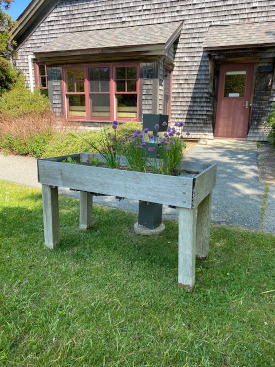
Wheelchairs can easily tuck under standing garden tables like the one pictured above, increasing gardening accessibility. (Photo: Jill Mays)
MAYS: So there have been several studies in which children participated in garden groups, and the studies have found that their emotional IQ, which includes self-awareness, self-regulation, motivation, empathy and social skills, that that improved and also social IQ, which is increased communication in this initiation and completion of tasks, and improvement in adaptive behaviors, that that also improved. So just participating for a six-to-eight-week program, they had really significant gains in those areas.
BELTRAN: And I understand that you were an occupational therapist. What are some of the experiences that inspired you to write a guide for gardening with special needs?
MAYS: Well, what I found when I started working in the garden, originally helping out with the children's garden that was in Truro, is that all of the skills that I worked at in the clinic and in classrooms were happening organically in the garden. So developing motor skills and the sensory processing, things that I talk about in terms of helping people engage more effectively, all of those things were happening in the garden.
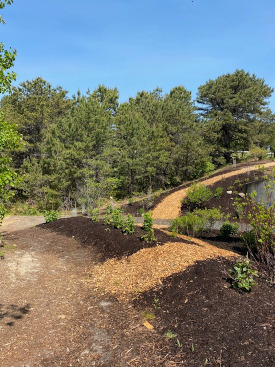
The Edible Landscape at the Truro MA Library. (Photo: Jill Mays)
And then I was invited to volunteer with a farmer in the school, in the Truro school, and what I saw was one particular event was with sixth graders. They were having to move compost from a big compost pile to the beds. You would think this would be like, oh my God. But you would think they were going to a rock concert. They were so pumped up, jumping up and down and happy. And it clicked for me that—so one of the huge things that I do in the clinic is working with children in terms of the filters that we've talked about, being able to help them with their sensory processing. And the first thing we need to do is something called heavy work, which activates nerves in the joints, and the nerves in the joints shoot up to the area of the brain that activates filters in the brain. The fancy word is inhibitory neurons, and so it's kind of like a Super Mario going [scratching sound], kind of erasing all of the extra input. So these are pre-adolescent, adolescent kids, and you know, they're like, climbing the wall. They're crazy with hormones and, you know, social anxiety and everything. And so what they did was—they were just really, really loving this. And this was a big aha moment for me, because I was like, wow, this gardening is so incredibly helpful for people to reduce anxiety and activate those filters.
BELTRAN: Yeah, nature really is healing and powerful. So if someone wanted to start a weekly gardening group in their own neighborhood, how might they make their gardening space more accessible for people with disabilities, like people on the spectrum, for example?
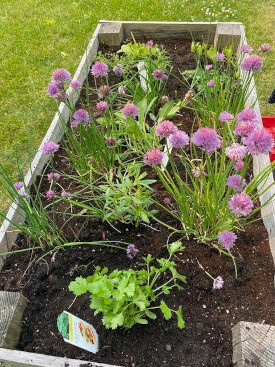
The Cape Abilities adult group cares for this herb box. (Photo: Jill Mays)
MAYS: Yes, there's certain considerations that you want to have for people who are on the spectrum and neurodiverse. The number one rule when you're forming a garden and you want to work with this population is first to make sure that it's a successful experience. That's number one. So number two is that you need to be flexible in the approach that you use with these people. So for instance, you want to take a look at what their abilities are and sort of match the activities and the tasks to what their abilities are, what their capabilities are. So for instance, let's take weeding. If an individual has a little bit of trouble, like discerning, say, visual perception -- being able to tell the difference literally, the weeds from the plants, so to speak -- you want to make sure that it's successful for them and they're not yanking up seedling tomato plants or something. So you're going to put them in an area where it's pretty much all weeds, or you're going to make very clear demarcation between what is the weeding and what is the actual plant. You know, even blocking off an area. Another example would be seeding. So that's something that requires fine motor control, and, again, visual attention. And there's a lot of people who struggle with that. And so you're going to look at a couple strategies that you might want to use. One would be looking at the size of the seeds. So for instance, bean seeds are great, and a lot of people can manage those. They can see them. They can see where they place them, and that's great. But something like a carrot seed or lettuce seeds are very small and flaky, and that would be really hard. However, that doesn't mean that individuals can't do that. You just have to be flexible in terms of what kind of sowing of the seeds that you do. And a lot of the groups that I've run, we do broadcasting, which is you take a fistful of seeds and you toss them in, and then a couple weeks later, when the seedlings come up, you have a new job, which is thinning the seeds. And that's a much easier task to do. So those are just examples of where gardeners have very specific ways that they do things, but you want to kind of think out of the box in terms of how you go about to make sure that these activities are accessible for them.
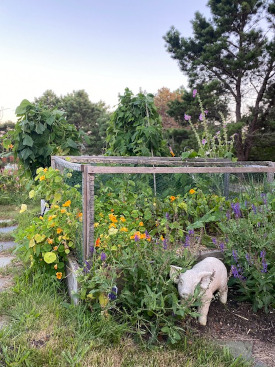
Gardens can be whimsical. This is the entrance to Jill May’s garden. (Photo: Jill Mays)
BELTRAN: You said, the number one thing for making gardening accessible for neurodiverse people is that they have a successful experience. What do you mean by a successful experience, and how do you do that?
MAYS: That's a great question. First of all, you really want them to feel joy. You want them to experience joy when they're in the garden, and the first thing is that they feel like they understand what's happening and they're capable of doing what is asked of them. You don't want them to feel overwhelmed. So you're going to make it very clear what the instructions are, and you're going to match the ability with what the individual is capable of doing. You also sort of coach them. And for instance, a lot of times, you know, the first response is, oh, I can't do that. Especially like weeding, you know, bending over, it's like, no, no, no, that's too hard. And so I measure it. I say, look it. I understand it is hard, so no worries. I'm just going to let you, you only need to do five, yank up five weeds, you know? And I say, 12345, and I give them a big hands, you know, yay, hooray. You did a great job, and you are all done. So you do incrementally, you don't start with, okay, today we're going to weed and we're going to plant, and where you just take little tiny tidbits of activities at a time. And I will say that over time, those individuals, for instance with the weeding, that are like, I can't do that, whether it was for tactile reasons or endurance reasons, by the end of the season, we're yanking up entire beds pretty successfully. So it builds over time.
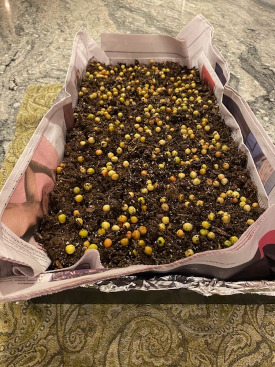
A great inside winter garden activity: pea shoots! In a few weeks you’ll have tasty 6-8 inch shoots for salads and stir fries. (Photo: Jill Mays)
BELTRAN: And then what about for people with physical disabilities, like people who use a wheelchair? How do we make gardening more approachable for those populations?
MAYS: Yes, that's a great question, and I might add that for a lot of the neurodiverse people, many of them have some physical limitations. So all the things that we just talked about are applicable and that we're going to talk about now specifically. So there's a lot of ways that you can activate making gardening accessible. One is something called a table bed, where you actually have the bed where you put the soil, and it's like, it literally is like a table with a lot of clearance, so wheelchairs can go underneath it, and they can work directly there. And obviously just having higher raised beds is helpful, but there's other strategies that you can use as well, like doing vertical gardening. So you have pots and then you have things growing, so it's much easier for someone with a walker or a wheelchair to reach. And then there's pots that you can put on dollies and move to the location that people are, as opposed to them having to go to it. And then for people who are still mobile but are starting to find their bodies are saying, this is too much for me, there's wonderful things like chairs and benches. And I just started because I needed to demonstrate at all the talks I give, you know, some examples of this. I got this beautiful purple kneeler that I absolutely love, because now I used to be able to only garden for about an hour or so, and then my body was saying, stop it. And now I am back to gardening three, four or five hours, because it distributes, I can push down with my arms so that it's not just my knees and hips. I can distribute all of the stress throughout my body instead.
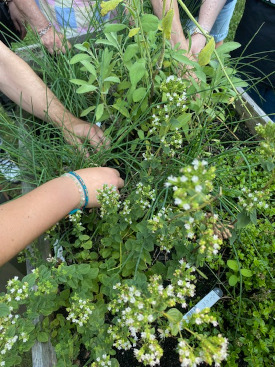
Group members from Cape Abilities at work weeding. Our guest Jill Mays says, "many hands make light the work". (Photo: Jill Mays)
BELTRAN: Yeah. One thought that came to mind when reading your book is that, you know, we will all progress into becoming differently abled people, right? So all of these tips and tricks are really useful for, for all of us, honestly, at the end of the day.
MAYS: Yeah, exactly. So the title of the book is, For Special Needs, Gardening for Special Needs . But we really all have special needs. And from the, from the birth, you know, from the cradle, children really need to be engaged, moving and outside. As we get older, we need to disconnect from our devices to help de-stress, and then way at the other end of the life cycle, it's a use it or lose it situation. So whereas children are gardening to develop skills, the elderly are gardening in a way that can help them maintain skills, in ways that, you know, just going to the gym doesn't do. It's incredibly impactful.
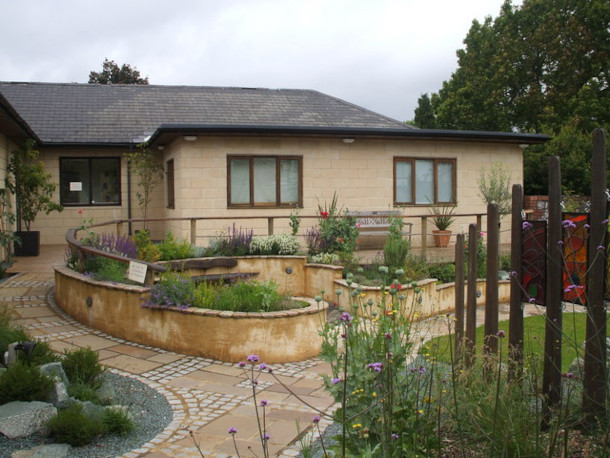
The Sensory Garden in the grounds of St Christopher's School in Westbury Park, Bristol, a school for children with special needs. (Photo: Michael Murray, Wikimedia Commons, CC BY SA 2.0)
BELTRAN: As a society, what do we lose by not incorporating differently abled people into nature-based activities like gardening?
MAYS: Well, these are the most vulnerable people, you know. They have a lot of stress in their life from internal things, and also they are oftentimes isolated. And gardening is something, as we've mentioned throughout talking, that there's so many ways that it helps to calm us down, de-stress us, it makes us healthier. And so they will be able to benefit enormously. But the other thing is that these are wonderful people, and gardening is a great equalizer, and so people of all different walks of life can garden together. And so it is an opportunity that there's more of a commingling, so to speak, and that both can share together in the joys of gardening.
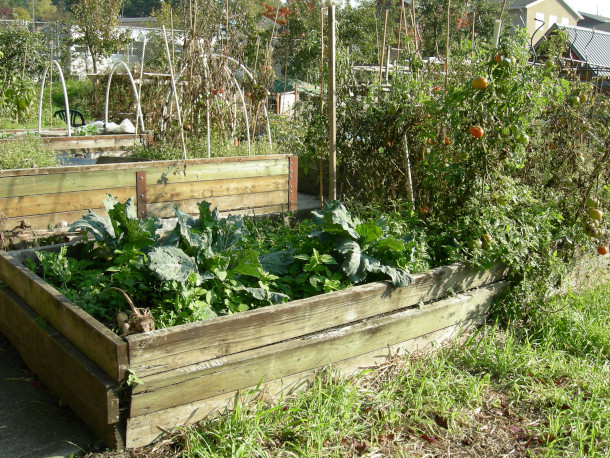
Picardo Farm, Wedgwood neighborhood, Seattle, Washington. A community allotment garden with raised beds for the physically disabled. (Photo: Joe Mabel, Wikimedia Commons, CC BY SA 3.0)
BELTRAN: Jill Mays is the author of Nurturing Nature: A Guide to Gardening for Special Needs . Jill, thank you so much for joining us.
MAYS: Oh, thank you. It was wonderful.
Related links:
- Purchase Nurturing Nature: A Guide to Gardening for Special Needs from Bookshop.org to support both Living on Earth and local independent bookstores
- Follow Jill Mays on Instagram
- Learn more about Cape Abilities
- Learn more about Sustainable C.A.P.E’s Children’s Community Garden at Truro Public Library
[MUSIC: Seckou Keita, Catrin Finch, “Listen to the Grass Grow” on SOAR, bendigedig]
CURWOOD: Living on Earth is produced by the World Media Foundation. Our crew includes Naomi Arenberg, Sophie Bokor, Jenni Doering, Swayam Gagneja, Mark Kausch, Mark Seth Lender, Don Lyman, Ashanti Mclean, Nana Mohammed, Aynsley O’Neill, Sophia Pandelidis, Jake Rego, Andrew Skerritt, Bella Smith, Julia Vaz, El Wilson, and Hedy Yang.
BELTRAN: Tom Tiger engineered our show. Alison Lirish Dean composed our themes. You can hear us anytime at L-O-E dot org, Apple Podcasts and YouTube Music, and like us please, on our Facebook page, Living on Earth. Find us on Instagram, Threads and BlueSky @livingonearthradio. And we always welcome your feedback at comments@loe.org. I’m Paloma Beltran.
CURWOOD: And I’m Steve Curwood. Thanks for listening!
ANNOUNCER: Funding for Living on Earth comes from you, our listeners, and from the University of Massachusetts, Boston, in association with its School for the Environment, developing the next generation of environmental leaders. And from the Grantham Foundation for the protection of the environment, supporting strategic communications and collaboration in solving the world’s most pressing environmental problems.
ANNOUNCER 2: PRX.
Living on Earth wants to hear from you!
Living on Earth
62 Calef Highway, Suite 212
Lee, NH 03861
Telephone: 617-287-4121
E-mail: comments@loe.org
Newsletter [Click here]
Donate to Living on Earth!
Living on Earth is an independent media program and relies entirely on contributions from listeners and institutions supporting public service. Please donate now to preserve an independent environmental voice.
NewsletterLiving on Earth offers a weekly delivery of the show's rundown to your mailbox. Sign up for our newsletter today!
 Sailors For The Sea: Be the change you want to sea.
 The Grantham Foundation for the Protection of the Environment: Committed to protecting and improving the health of the global environment.
 Contribute to Living on Earth and receive, as our gift to you, an archival print of one of Mark Seth Lender's extraordinary wildlife photographs. Follow the link to see Mark's current collection of photographs.
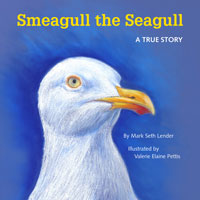 Buy a signed copy of Mark Seth Lender's book Smeagull the Seagull & support Living on Earth
© Copyright World Media Foundation. All Rights Reserved
Home | Contact | RSS | Donate | Newsletter