

February 27, 2026
Air Date: February 27, 2026
FULL SHOW
SEGMENTS
Bonaire Residents Fight for Climate Justice
View the page for this story
The Dutch special municipality of Bonaire in the Caribbean is already experiencing dangerous heat and could see a fifth of its land disappear under rising seas by 2100. But the Netherlands is discriminating against these overseas citizens by failing to adequately reduce global warming emissions and develop adaptation plans to help them cope, according to a January 2026 Dutch court decision. Greenpeace Netherlands campaigner Eefje de Kroon worked with eight Bonaire residents to bring their case and joins Host Paloma Beltran. (11:11)

The Possibility of Tenderness
View the page for this story
Poet and author Jason Allen-Paisant left his native Jamaica to gain a graduate school education and prize-winning poetry career in England and France. He now looks back with wonder at the green of Jamaica where generations of his ancestors fed and healed his family. He shares this history in his book The Possibility of Tenderness: A Jamaican Memoir of Plants and Dreams. Jason Allen-Paisant spoke with Living on Earth’s Andrew Skerritt. (14:19)

Thirsty Hummingbirds
/ Mary McCannView the page for this story
Hummingbirds are migrating north after a hot, dry winter in sunny Mexico, Central America or the Caribbean. And they’re ready for a drink. BirdNote®’s Mary McCann describes how you can help these thirsty birds by hanging a hummingbird feeder filled with the right kind of nectar. (01:51)
Note on Emerging Science: Detecting Antibiotics in Wastewater
/ Hedy YangView the page for this story
Wastewater treatment often fails to capture antibiotics, which can lead to antibiotic resistance and even “super microbes” when they end up in our waterways. Living on Earth’s Hedy Yang reports in this Note on Emerging Science that scientists in Brazil have found a novel way to improve antibiotic detection in wastewater, by using sewage sludge itself to create a coating for sensors. (01:55)
Wastewater to Wealth
View the page for this story
Urine is packed with nutrients such as phosphorus and nitrogen, which can be pollutants when they enter the environment unchecked. But these can also be turned into vital fertilizer to nourish our crops, and 2025 MacArthur Fellow William Tarpeh, an Assistant Professor of Chemical Engineering at Stanford University, is developing methods for “refining” wastewater. He discusses with Host Steve Curwood how we can turn wastewater into wealth. (13:37)
Dancing Down the Slopes
/ Andy KubisView the page for this story
Ski ballet -- kind of a mashup between ballet, figure skating and skiing -- got a little glory as a demonstration sport in the 1988 and 92 Olympic Games but never became a medal event, and some said it was just a fad. But a few winters ago, ski ballet was being kept alive on Pennsylvania slopes by a very enthusiastic, early-adopter. Andy Kubis produced this story for the Allegheny Front back in 2018. (04:02)
Show Credits and Funders
Show Transcript
260227 Transcript
HOSTS: Paloma Beltran, Steve Curwood
GUESTS: Eefje de Kroon, Jason Allen-Paisant, William Tarpeh
REPORTERS: Andy Kubis, Mary McCann, Hedy Yang
[THEME]
CURWOOD: From PRX – this is Living On Earth.
[THEME]
CURWOOD: I’m Steve Curwood.
BELTRAN: And I’m Paloma Beltran.
A landmark climate case from Bonaire, a Caribbean part of the Netherlands.
KROOM: This case is a wake up call that governments can be held to a standard of care, and really moves the conversation from should we help these islands to no governments are legally obligated to protect all citizens equally.
CURWOOD: And, the Possibility of Tenderness: A Jamaican Memoir of Plants and Dreams.
ALLEN-PAISANT: I would want readers to come away from this book feeling that the Earth wants to connect with us. The Earth wants us back. Land, wants us to be with it and to see it as kin. And that will change the way we look at a piece of land and the produce of the Earth.
CURWOOD: That and more, this week on Living on Earth. Stick around!
[NEWSBREAK MUSIC: Boards Of Canada “Zoetrope” from “In A Beautiful Place Out In The Country” (Warp Records 2000)]
[THEME]
Bonaire Residents Fight for Climate Justice
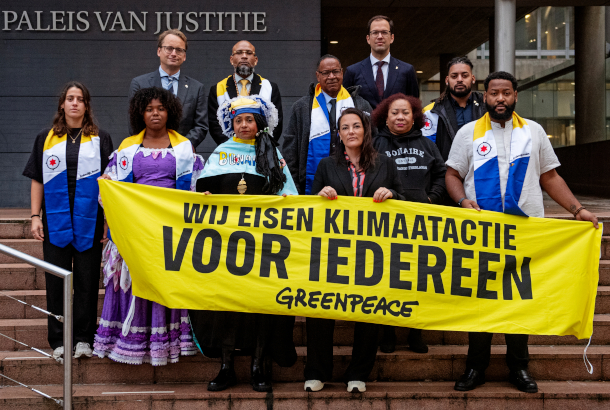
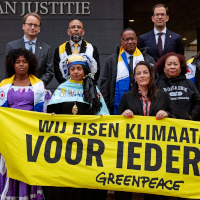
The attorneys and plaintiffs outside court July 2025. Bottom row, from left to right: Plaintiffs Daniela Siemal, Danique Martis, Jackie Bernabela, Director of Greenpeace Netherlands Marieke Vellekoop, and plaintiffs Helen Angela, and Kjelld Kroon. Middle row, from left to right: lawyer Michael Bacon, plaintiffs Angelo Vrolijk and Onnie Emerenciana, Judmar Emerenciana. Top row: Lawyer Emiel Jurjens from Prakken d'Oliveira. (Photo: Marten van Dijl, Courtesy of Greenpeace)
CURWOOD: From PRX and the Jennifer and Ted Stanley Studios at the University of Massachusetts Boston, this is Living on Earth. I’m Steve Curwood.
BELTRAN: And I’m Paloma Beltran.
Due to climate disruption scientists forecast huge rises in temperatures across the tropics. According to the IPCC tropical regions are projected to experience significant warming, nearly 6 degrees Fahrenheit by 2100. And one region that is already feeling the increasing heat is the Caribbean, where islands are facing sea level rise. One of those islands is Bonaire, a special Dutch municipality just off the coast of Venezuela. In a landmark January 2026 decision, the Hague District Court of the Netherlands ruled that its government must better protect residents of Bonaire from climate change, finding current policies are inadequate and discriminatory. The decision requires a specific, binding climate adaptation plan for Bonaire by 2030. And the case could pave the way for climate related lawsuits for other islands and territories like Puerto Rico, which has long sought justice from the US government without success. Greenpeace Netherlands Campaigner Eefje de Kroon worked with eight Bonaire residents to bring their case and joins me now. Eefje, welcome to Living on Earth!
DEKROON: Thank you, very much.
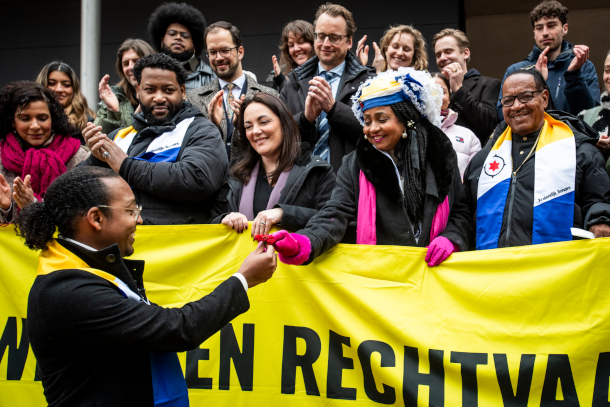
Bonaire plaintiffs, Greenpeace officials, lawyers, and supporters gathered outside District Court in The Hague in October 2025 when the court heard arguments in the lawsuit. In front of the banner: Churmer Bomba, a community mobilizer with Greenpeace. Behind the banner, from left to right: Plaintiff Kjelld Kroon, Greenpeace Netherlands Director Marieke Vellekoop, plaintiffs Jackie Bernabela and Onnie Emerenciana. (Photo: Marten van Dijl, Courtesy of Greenpeace)
BELTRAN: So the court ruled that the Netherlands breached human rights by treating Bonaire residents as second class citizens compared to residents in the Netherlands. How is the Dutch government's approach to climate change in Europe different to what happens in Bonaire? You know? What does second class treatment look like?
DEKROON: Yeah, this is a really important topic, because this was also the moment in court when the verdict was being spoken, that the mood changed. So it went from like very tense to sort of relief, a sort of like acknowledgement that what the people from Bonaire have been experiencing for years, decades, centuries, even, was finally recognized by a court against the state of the Netherlands. And this is not only the case in the field of climate protection. This is the case in almost every field of life for people on Bonaire. So, a third of people on Bonaire live in poverty. So even also the plaintiffs, they have several jobs just to maintain their families, to make enough money to protect their families.
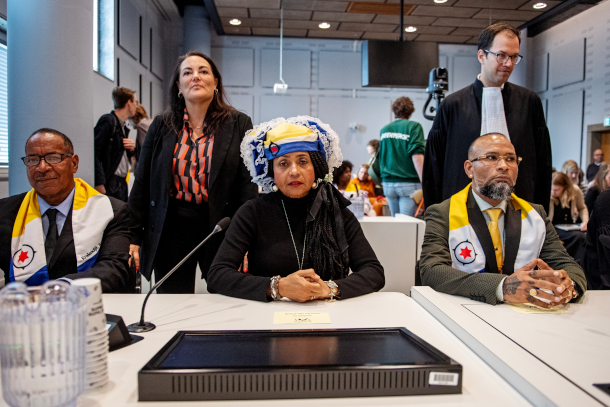
During court testimony at The Hague, plaintiff Angelo Vrolijk, a corrections officer and union leader, told the court Bonaire residents are looking for justice, not charity. In the photo, from left to right, on the bottom row, the plaintiffs: Onnie Emerenciana, Jackie Bernabela, and Angelo Vrolijk. On the second row are Marieke Vellekoop, director of Greenpeace Netherlands, and lawyer Emiel Jurjens from Prakken d'Oliveira. (Photo: Marten van Dijl, Courtesy of Greenpeace
And these people are inhabitants of the Netherlands. They deserve equal protection. But for the European part of the Netherlands, there are all sorts of researches, policies, there are plans. Measures are being taken, often also very expensive measures are being taken to protect the Netherlands from climate change. I mean, a large part of the Netherlands is six meters under sea level, but we don't experience that because we have dikes and we have, you know, we have protection against the water and on Bonaire, not even the research had been done into what the impact would be, let alone that there will be a plan, and that there will be a planning and that there will be financing for it.
BELTRAN: Just under how much threat is the island of Bonaire to sea level rise?
DEKROON: Yeah, so the study that was done by the Free University, they looked at 2050 as the first reference year for the results of the study, and they found that then the first impact of sea level rise will already be visible and will be experienced on Bonaire, so in 25 years. And according to the reports that we did on the basis of that, it shows that a fifth of the island will disappear underwater by the end of this century. And again, if no measures are being taken, right, if we keep emitting the way that we are and no protective measures are being taken. But obviously, what we hope with this campaign and with this lawsuit, which we won, that that will be prevented.
BELTRAN: So Eefje you've had the opportunity to talk with the plaintiffs in this case, you know them personally. You've you've had conversations with them. Is there a story you can share from one of your interactions about how they're experiencing climate change firsthand in Bonaire.
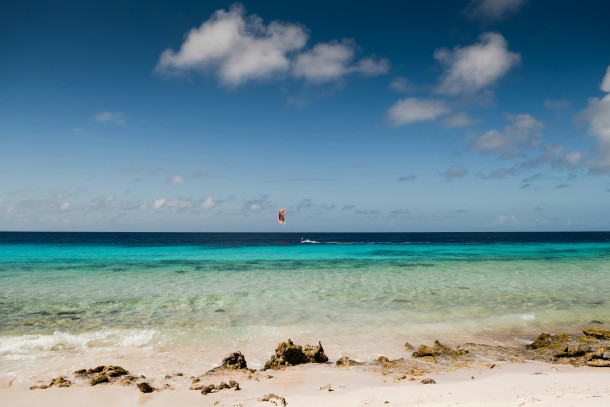
Bonaire’s white sand beaches are popular with tourists, and its protected coral reefs are especially popular with divers. However, the low-lying terrain makes the island susceptible to sea level rise. Other impacts of climate change include rapidly rising temperatures. On January 28, 2026, a Dutch district court at The Hague ruled that the state had violated the human rights of Bonaire residents and ordered the Netherlands to protect Bonaire from climate impacts. (Photo: Marcreation, Unsplash)
DEKROON: Oh gosh, there are so many, and I'm so impressed by all of them individually. So when we went to Bonaire some years ago, before the study had been done, people already complained about the extreme heat that they were experiencing. And for example, Onnie, he's a farmer, and he said, within just a few years time, I already see that my crops aren't growing as well as they used to. Like, it's too hot and also it's too dry. Water has become too expensive, also to let the crops grow. And also, for example, Helen, she is a grandmother, and she still has her own mother living on the island, who she cares for and she says it's really difficult for me now to walk to my elderly mother in the elderly home because it's too hot during the day and we hardly see kids play in the streets, like kids don't walk to school anymore, like she used to. They take busses now because it's just too hot, and also Judmar, for example, who is a graphic designer and also a taxi driver. And he said that for him, it's personally very important that the slave huts are preserved, because it's a way for him to commemorate his ancestry and where he comes from. So he made artwork as well. On the south part of the island, there is like an abandoned hotel, and there's this big wall that he made a big artwork on which shows what happens if the slave huts disappear under water. So we also try to give a lot of space for art and for expression in this case. And I think, for example, Angelo is the head of a union, a spokesperson for the union. So he's a very strong, very powerful spokesperson. So Angelo, very powerfully says in court, or said, in court, we're not asking for charity. We're demanding justice and I think that's it. I mean, they're tired of being treated as second class citizens, losing a part of their island, losing the possibility to pass it on to future generations, while the Dutch government just has such a clear moral, historical and legal responsibility to protect them.
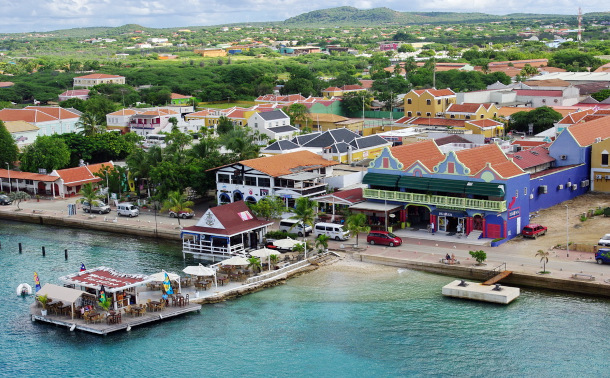
Pictured above is the harbor of Kralendijk, the capital of Bonaire. The name translates to coral dike, referring to the coral structure of the low-lying island. The Dutch court in The Hague ruled on January 28, 2026, that the Netherlands had treated Bonaire’s 26,000 residents as second class citizens by not affording them similar protections from the perils of climate change as residents of the Netherlands. (Photo: Bgabel at wikivoyage, Wikimedia Commons, CC BY-SA 3.0)
BELTRAN: So what are Bonaire residents expecting from this decision? You know, what would make them whole?
DEKROON: So that's a big job. But I think in terms of this verdict, it's quite clear that the Netherlands need to cut its CO2 emissions much more quickly than it is planning to do, and it's not even living up to the promises that it has made, but the Dutch court also said you need to pay a fair share. So tell us what your fair share is, or at least what your budget still is. So I think that is something that the plaintiffs are very curious about, how fast the Netherlands will reduce its CO2 emissions. But at least as important is what the Netherlands will now do in terms of the measures that it takes on Bonaire to actually protect people against the heat and against the rising sea levels. And for Bonaire, it still needs to be looked into. What can we do to protect the island against the rising sea levels. But in any case, and this is also something that the court found, is that you need to look at social and economic impacts of the climate crisis and have measures that alleviate that as well. So really take holistic measures that help people. When you live in poverty, like climate change is not the first thing on your mind. So the Dutch government really needs to take responsibility in getting people out of poverty, but also, for example, making sure that people have air conditioning that they can afford, so keeping the energy bills low. In addition to that, having green spaces, sheltered spaces where people can go outside, for kids to play, for people to do exercise outside, this is really important in terms of a heat measure. And you can also think about protecting the corals and the mangroves, because they are very important in terms of identity for the island and for the people. So the corals and the mangroves are really important in terms of identity and economy, because it also protects the island from incoming waves. So it's a natural sort of protective measure that the island has. So these are the kinds of measures that you could think about, and that the plaintiffs also think about in terms of the adaptation measures that need to be taken. The people from the island need to be heard in what they think is an appropriate measure, and the Dutch government really needs to pay up for it.
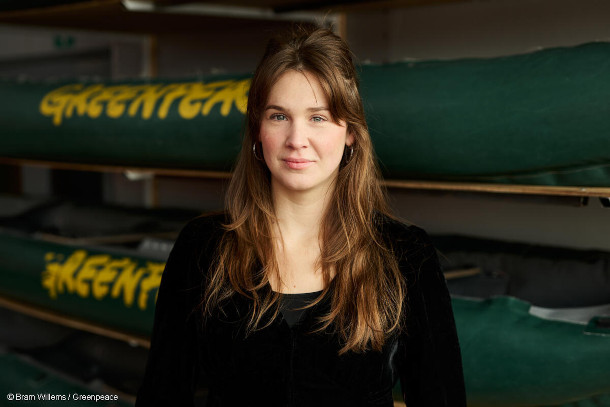
Eefje de Kroon is a Greenpeace Netherlands campaigner who worked closely with the eight plaintiffs from Bonaire to successfully sue the Dutch government in the Hague District court for failing to protect them from climate change. Bonaire is one of three Caribbean islands, with Saba and St. Eustatius, classified as a special municipality of the Netherlands. These low-lying islands are susceptible to rising sea levels and extreme heat due to climate change. (Photo: © Bram Willems, Courtesy of Greenpeace)
BELTRAN: And why is this victory significant? You know, what are the implications for other Dutch, British and even French overseas territories?
DEKROON: I really think that this case is a wake up call that governments can be held to a standard of care, and really moves the conversation from should we help these islands to no governments are legally obligated to protect all citizens equally, and this was really the first time that a court ruled that a state discriminated against its own people by failing to develop a climate adaptation plan. So it's not just about the responsibility for causing climate change, but also it's about failing to prepare for the inevitable impacts. And also the U.S. has overseas territories, I know, and in Europe, there are still a lot of countries that also have overseas territories, and we know that they know that they are on notice now, because if this holds true for the Netherlands, and this case is built on international human rights law, there's a lot of reference to United Nations standards. This is the case like this is a universal sort of standard that is being developed here. And that makes sense, because there's already been a body of law that has been developing. And I know the U.S. is often - it's a bit complicated, right by leaving the Paris Agreement, but I know that U.S. judges also look at international rulings as persuasive authority. And I think this case just shows that climate change is a fundamental human rights violation, and there's also customary law that lies at the basis of it. And I think from here on, we're going to see a lot more cases that well, this case can be copied in many jurisdictions. It is really like a blueprint. And I think we'll start to see cases that will go even further, because people are actually suffering financial and personal and health damages, and countries and people need to be held responsible for this.
BELTRAN: Eefje De Kroon is a campaigner for Greenpeace Netherlands. Thank you so much for joining us.
DEKROON: Thank you so much for having me.
Related links:
- ClimateintheCourts.com | “Court Rules Dutch Climate Policy Violates Human Rights”
- New York Times | “Court Orders the Netherlands to Protect a Caribbean Island from Climate Change”
- Greenpeace | “‘The Impact of Climate Change on Bonaire: An Analysis of Different Scenarios and Their Impact on a Dutch Caribbean Municipality’”
- Read the ruling from the Hague District Court.
- Greenpeace | “The Netherlands Violates Human Rights by Failing to Protect Bonaire Residents from Climate Crisis: Court”
- Greenpeace | “New Research: Climate Change Could Have Devastating Impact on Bonaire”
- The Guardian | “Dutch government discriminated against Bonaire islanders over climate adaptation, court rules”
- Environmental Law Alliance Worldwide | “Trailblazing Bonaire Climate Case”
- AP | "Dutch government is ordered to protect residents on Caribbean island of Bonaire from climate change"
- Vrije Universiteit Amsterdam Study | "The impacts of climate change on Bonaire"
[MUSIC: New York Ska-Jazz Ensemble, “Step Forward” on Step Forward, Ska-Jazz Productions]
CURWOOD: We’ll stay in the Caribbean as a writer reflects on his Jamaican roots. Keep listening to Living on Earth.
ANNOUNCER: Support for Living on Earth comes from the Waverley Street Foundation, working to cultivate a healing planet with community-led programs for better food, healthy farmlands, and smarter building, energy and businesses.
[CUTAWAY MUSIC: New York Ska-Jazz Ensemble, “Step Forward” on Step Forward, Ska-Jazz Productions]
The Possibility of Tenderness
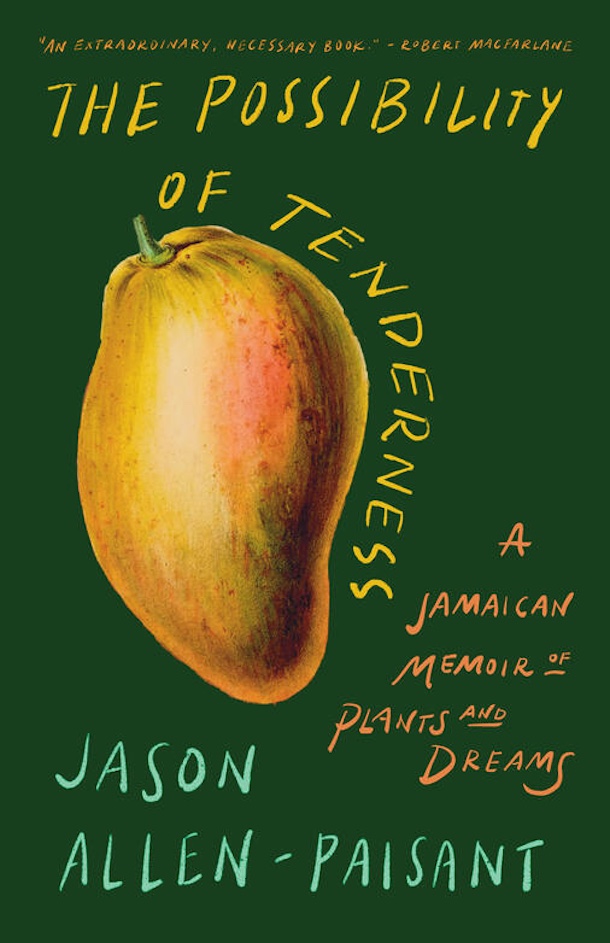
The Possibility of Tenderness: A Jamaican Memoir of Plants and Dreams, written by Jason Allen-Paisant digs beneath the surface of land kinship and accessibility through his time spent in Jamaica. (Photo: Courtesy of Milkweed Editions and Penguin Books)
BELTRAN: It’s Living on Earth, I’m Paloma Beltran
CURWOOD: And I’m Steve Curwood.
The stories of human history often involve the land, and in today's segment for Black History month we turn now to Jamaican born poet and author Jason- Allen-Paisant. From the 17th and into the 19th century the British enslaved captured black Africans in Jamaica to power the lucrative sugar, rum, spice and coffee enterprises. And when the Africans were freed in 1838 they stayed on the island and tilled the land, which is lush and plenty fertile for subsistence farming. But Jason Allen-Paisant left Jamaica to gain a graduate school education and a prize winning poetry career in England and France. He now looks back with wonder at the green of Jamaica where generations of his ancestors fed and healed his family. He shares this history in his book The Possibility of Tenderness: A Jamaican Memoir of Plants and Dreams. From his home in Leeds England, he spoke with Living on Earth’s Andrew Skerritt, who also grew up on a former British Caribbean possesion before moving to the UK and America.
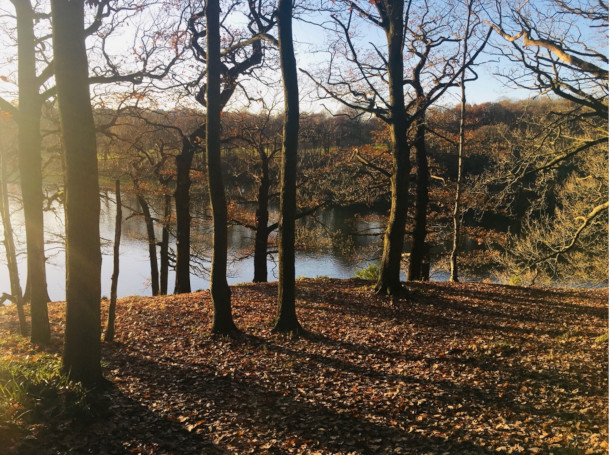
Roundhay Park in Leeds, United Kingdom is 700 acres of vegetation and recreational land. (Photo: Jason Allen-Paisant)
ALLEN-PAISANT: Thank you so much for having me.
SKERRITT: Jason, what inspired a possibility of tenderness?
ALLEN-PAISANT: I had moved to a different location in Leeds, which was a very green location on the edge of a park, in fact, inside the park itself. And all of a sudden, I was going for walks, and I had a flashback to my childhood. I grew up surrounded by trees and plants. It was also a wholesome environment. It was the wholesomeness of that space as well, with the fresh air and something that felt like privilege, something that felt like I had never had this in all my time in the UK, I'd never had access to a place like that. Access is, I think, a big word in the story. And I think what I was feeling was that here, we've got a lot of space to roam. And I started writing when I asked myself the question, isn't it a hell of a paradox, isn't it a real paradox that one needs to land in a privileged, affluent neighborhood to have access to all this green space and place to walk and roam and look at plants. Whereas I grew up with all of that, I was from all of that. So the question that generated the book was the loss, the loss of access to green space, to wholesome land plants, and all their usage. I wanted to poke at or dig below that loss. How did we lose that? How did I lose that? And how did I need to travel such a long distance and distance of time to come back to something that was fundamentally me, that I knew so that's the question, really, that opened the book.
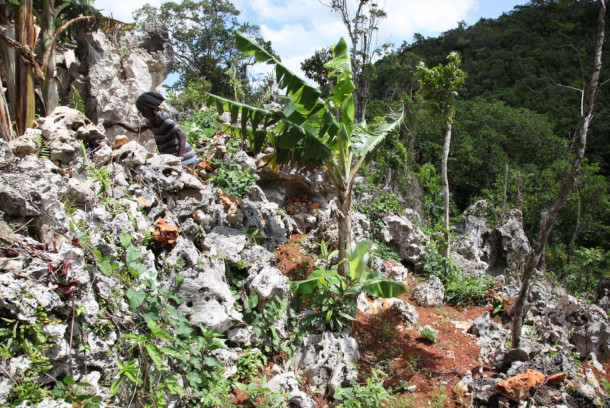
Farmers such as Congolin (top left corner) value their land immensely and often feel a deep connection to the plants and produce that it brings. (Photo: Jason Allen-Paisant)
SKERRITT: As an immigrant, I know what the loss feels like, and one of the things we say about immigrants is that a lot of our dreams are set at home. Talk about the landscape that you lost. What did it look like? What did it sound like? That landscape of your boyhood.
ALLEN-PAISANT: You know, coffee grove. Think of fields, lots of fields being tilled by men and women who earn their livelihoods from what they plant by selling it in the village or taking it to the market. So the sounds I hear are the thud or the clink of a machete or of a hoe or a fork on the ground or on stone. I also hear a lot of birds chirping and singing. I hear peeny wallies. They're these insects. They're a type of Firefly, but they make a sound. They make a scratching sound in the night. I hear a lot of silence. I hear a lot of silence. Silence is one of the main things that I hear, and I think within that silence, there is a cool breeze blowing. There's a gentle breeze that's always blowing, that's always making things flutter. The banana tree, the banana leaves, they're fluttering like like pennons, like flags. And I hear the the wind blowing through the mango trees and all sorts of trees. And I hear farmers calling to each other. I hear people passing along the dirt tracks and shouting to a farmer working his ground as we call the cultivation plots, and just shouting, oh, you know, good morning, whatever you know, how's the work? How's the day, how's the family and people just responding to each other, because the village was sparsely populated, and most of what was going on during the day was just the cultivation of the ground. So I hear that kind of familiarity and that kind of greetings that make me feel and think about the close-knit nature of the neighborhood, of the community, the district. That's the soundscape that I'm thinking of at the moment.
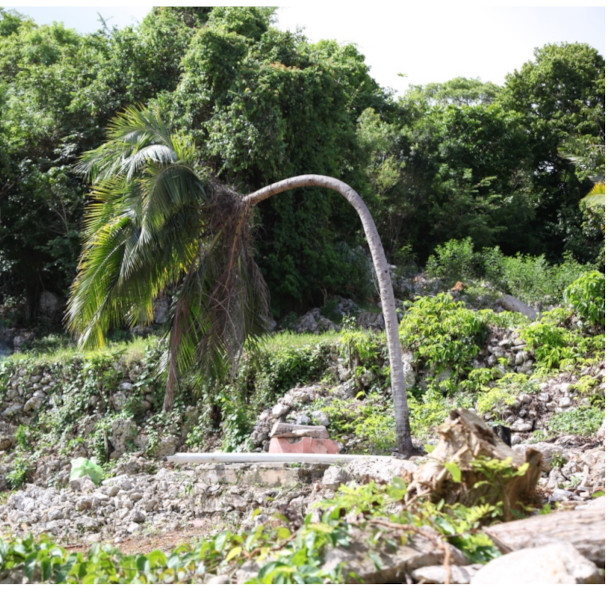
Planting a child’s umbilical cord under a tree is a Jamaican cultural practice that literalizes a connection between the families and their land. (Photo: Jason Allen-Paisant)
SKERRITT: You write about the importance of the land, you talk about people burying navel strings, what Americans call umbilical cords of their children on their land. There's also the practice of burying relatives on family land. What's the significance of these practices, and how do they help people stay connected to the home place?
ALLEN-PAISANT: The significance of burying the umbilical cord, the navel string, as we call it. It goes back to ancient rituals that some of our forebears brought with them. I've been able to read about this that in certain places in Africa, and this is not just West Africa. I met an artist, a photographer from Zimbabwe. I believe it is who was documenting this practice of the connections between the individual under the tree, this practice of burying, interring the umbilical cord and then planting a tree on top of it. That's something that we do in in Jamaica. I had a tree right, therefore I knew exactly where mine was was planted. It's, uh, the ritual has to do with affirming your connection to the land, binding you to the land, to say, as it were, this, this land is, is a part of me, and I'm a part of it. It's a physical connection, because you're bearing a part of yourself in that place, right? So it's also, I think, a sign of the cycle of life. The connection, that gesture, act of interring, is prefiguring the fact that we will be there ultimately, but the circle will continue. And that brings us then to this issue you talk about, I talk about it in the book, this practice of burying the dead on the land. It's, I think, something in the same vein and having the same sort of connections, this thing of burying your dead ones on your land. It was never something I thought about as a child, I mean, but it was so ever present in these hillside districts.
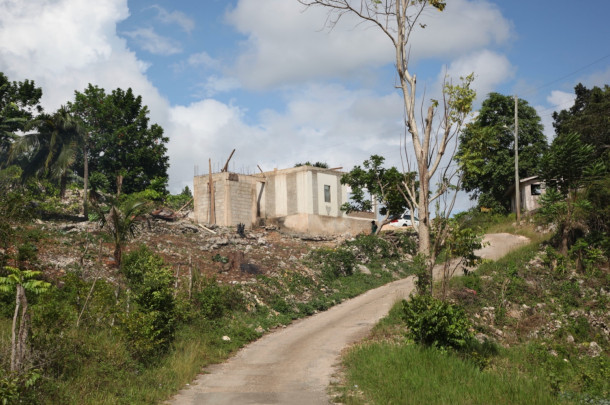
The tradition of burying loved ones on familial land shows a way of thinking of the land not as a commodity to be sold, but something that can be handed down through generations. (Photo: Jason Allen-Paisant)
SKERRITT: In America, one of the tragedies of the 20th century is the scale of black land loss. Black farmers lost more than 90% of their land between 1910 and 1997 in Jamaica, things look a little different. You write about Jamaicans holding on to the land, not for profit, but for posterity. Why is that so important?
ALLEN-PAISANT; Yes, I'd say it's quite connected to the point I articulated just now. Because if you're burying your loved ones on the land. What that clearly indicates is that you're not viewing the land as a commodity to be sold or to make a profit on. In the book, I found it interesting, therefore, to talk about an aspect of Jamaica that people don't often hear about, which is the hilly, mountainous areas, the small land holdings of farmers, these people have a different idea of land value. The importance of land is tenure. That something Commonwealth, something to be held to be exactly held, to pass down from generation to generation, which is why you can bury your dead on it without any problems, because that land is never meant to be sold to a developer. It's never meant to be sold to outside the family. That land is for the family. I think a lot of what my book does is invite people to step into a new way of thinking. I think to understand, of a lot of what I put into this book, you need to put on different lenses. And I think this is one of the things, this idea of, why would you keep your dead far from you? You need to have them close to you and and they're there, and they have to be talked about, and you have to to mention them in conversations, and it's part of the Commonwealth, and it's part of the physical community that you create with them. And I think that goes back to a different epistemology of what it is to be a part of the circle of life. It's a different cosmology as well.
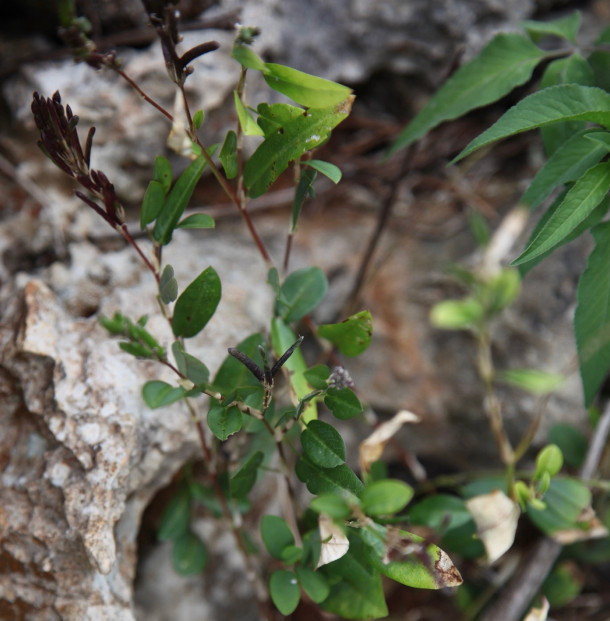
In The Possibility of Tenderness, Allen-Paisant wants readers to feel a connection with the earth. (Photo: Jason Allen-Paisant)
SKERRITT: I grew up in a household where people believed in the power of dreams. Talk about how plans and dreams were integral to your life as a boy growing up in rural Jamaica.
ALLEN-PAISANT: You know, this is one of the areas I was excited to tease out in the book, because, as you'll appreciate, it's something I'd never mused on before, mainly because it was just so natural to us. It was just an everyday occurrence. And our people in Jamaica touch generally, a lot of significance of their dreams. One thing that I remembered was how much my grandmother, who is the main character in this book, how much she dreamed. About plants and plants would appear to her in her dreams in response to illnesses she herself. My grandmother might have had a bad cold that turned into bronchitis, and she would wake up in the morning excited, sort of spirited, because she'd got the solution. It was revealed to her what she should get so she would go to just go foraging for those things, right? That was just a common kind of occurrence. But the plants themselves are spirits. The plants come to visit you and to be with you. If you want to be with them, they come and be and they that they will be with you. They will heal you through your dreams. So this is, this is something that I knew without having the theory for it, or without, more importantly, without needing the theory for it, because this is how we live. So I come to the conclusion in the book that dreams are part of what we understand as ecology, because it's the meeting point of the plant world and the human world. It takes place within dreams. That's something that's that may sound strange to many people, but it isn't actually.
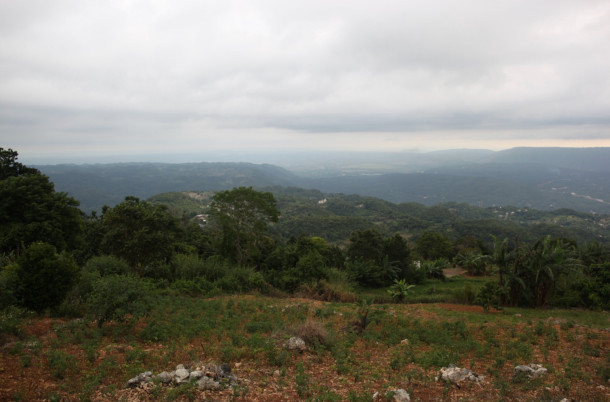
Author Jason Allen-Paisant wanted to highlight the value and beauty of “disregarded” landscapes. (Photo: Jason Allen-Paisant)
SKERRITT: It really doesn't sound strange to me, because I recall there were times when we'd have a class picnic for half term, and I couldn't go because my grandmother had a bad dream the night before.
ALLEN-PAISANT: [LAUGH]
And so being raised by grandparents, it's a gift. After all the time and research that went into this book, what's the main thing that you hope readers take away from The Possibility of Tenderness?
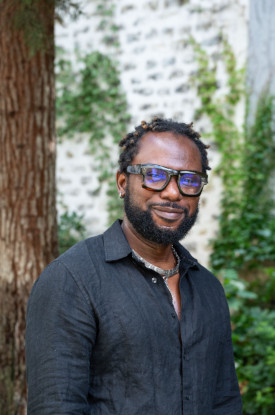
Jason Allen-Paisant is a poet and professor of Critical Theory and Creative Writing at the University of Manchester, in the United Kingdom. (Photo: Courtesy of Ferrante Ferrante.
ALLEN-PAISANT: I would want readers to come away from this book feeling that the Earth wants to connect with us. The Earth wants us back. Land, wants us to be with it and to see it as kin. And that will change the way we look at a piece of land, the way we look at the Earth and the produce of the Earth, the way we look at the plants and the food that we eat. So that's one of the main things, this idea of how the earth shapes the people that we, that we become, and how the Earth is seeking kinship with us.
Another thing I would like is to shift the way people think about so called small spaces, like coffee grove to shift the way people think about people who live with the land. Our idea often of a beautiful landscape is the epic landscape.Kilimanjaro, Everest, the Alps, is kind of landscapes which are epic on a grand scale. But my book is about small, hidden, or I would say, disregarded landscapes. Often these are landscapes which nourish us, which are important for the preservation of life. And so I wanted this book to create a broader ability for us to understand these landscapes and to see the beauty within them.
CURWOOD: Jason Allen-Paisant’s book is The Possibility of Tenderness: A Jamaican Memoir of Plants and Dreams, and he spoke with Living on Earth’s Andrew Skerritt.
Related links:
- Oxford University/ Merton College: Paisant Wins T.S. Eliot poetry prize
- About Jason Allen-Paisant
- Purchase a copy of The Possibility of Tenderness: A Jamaican Memoir of Plants and Dreams (Affiliate link supports Living on Earth and local bookstores)
[BIRDNOTE THEME]
Thirsty Hummingbirds

Rufous Hummingbirds, when they travel north after a hot winter in Mexico or Central America, will be looking for ways to satiate their thirst, making it a good time to invest in a bird feeder. (Photo: VJAnderson, Wikimedia Commons, CC BY-SA 4.0)
BELTRAN: The Caribbean is a wintertime home to many migrating birds that summer in North America, including hummingbirds. Here’s Mary McCann with today’s BirdNote®.
BirdNote®
Thirsty Hummingbirds
Written by Frances Wood
[Whirring and call of Rufous Hummingbird]
Here they come! Rufous Hummingbirds, Ruby-throats, and others are migrating north after a hot, dry winter in sunny Mexico or Central America. And they’re ready for a drink.
[Whirring and call of Rufous Hummingbird]
Hummingbirds need to consume several times their body weight each day, so they're looking for flowering plants to quench that mighty thirst. If a whirring puffball is hovering at your window, consider becoming a hummingbird bartender.
To help feed them, select a hummingbird feeder that you can easily clean on the inside, and one that has plenty of red to attract the birds. Then fill it with sugar water made by dissolving one part sugar in four parts water. No honey or sugar substitutes allowed. And please — no red food coloring.
[Call of the Rufous Hummingbird]
There’s no need to feel guilty that feeding hummers will lure them away from their natural sources of nourishment. The birds will continue to consume a healthy balance of plant nectar, small insects, and sap.
So set out a feeder, and before long, you may be hearing a hummingbird hovering around your watering hole.
[Whirring and call of Rufous Hummingbird]
You can learn a lot more about hummingbirds — and what attracts them. Begin at our website, BirdNote.org. I'm Mary McCann.
###
Senior Producer: Mark Bramhill
Producer: Sam Johnson
Managing Editor: Jazzi Johnson
Content Director: Jonese Franklin
Whirring, call and “J display” of the Rufous Hummingbird #109124, provided by The Macaulay Library of Natural Sounds at the Cornell Lab of Ornithology, Ithaca, New York. Sound Recordist: G.A. Keller.
BirdNote's theme music was composed and played by Nancy Rumbel and produced by John Kessler.
© 2016 Tune In to Nature.org March 2013/2016/2022/2025 Narrator: Mary McCann
ID# 033005RUHU hummingbird-06-2013-03-24 hummingbird-06
BELTRAN: For pictures, zip on over to the Living on Earth website, loe dot org.
Related link:
Find this story on the BirdNote® website
[MUSIC: New York Ska-Jazz Ensemble, “Feel Da Vibe” on Step Forward, Ska-Jazz Productions]
Note on Emerging Science: Detecting Antibiotics in Wastewater
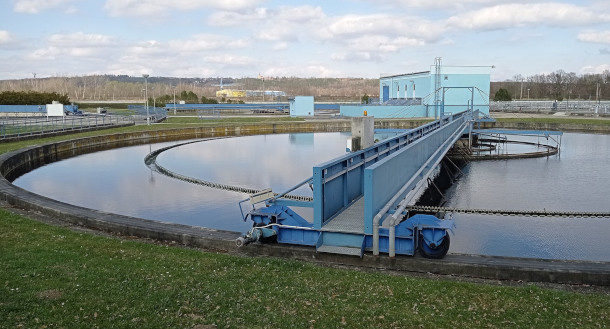
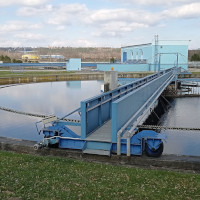
Conventional wastewater treatment plants often fail to remove antibiotic residues, causing them to end up in water sources. (Photo: Czeva, Wikimedia Commons, CC BY-SA 4.0)
BELTRAN: After the break, mining wastewater for nutrients but first this note on emerging science from Hedy Yang.
[SCIENCE NOTE THEME]
YANG: For a lot of the developed world, the motto around waste is: out of sight, out of mind. Like when it comes to wastewater, we flush the toilet or pour something down the sink, and it gets carried away into a sewage system that we never see the inner workings of. Most of us trust these systems to take care of things, and our wastewater treatment systems are pretty good at filtering out most of the harmful stuff. But one thing that they often fail to capture is pharmaceuticals — and in particular, antibiotics that end up in our waterways from improper medication disposal and human excrement. Antibiotic contamination can lead to antibiotic resistance and even create “super microbes” that impact entire aquatic ecosystems. But now, scientists have found a novel way to detect antibiotics in our wastewater — in a very full circle way.
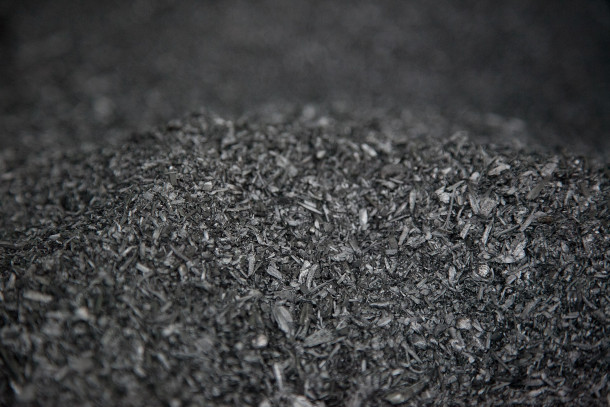
In a new study out of Brazil in January 2026, researchers devised a novel way to turn sewage sludge into biochar, like that shown above, and then applied it as a coating to electrodes to create a simple wastewater sensor. (Photo: Oregon Department of Forestry, Wikimedia Commons, CC BY 2.0)
Researchers in Brazil used none other than sewage sludge to create a coating for sensors that can improve antibiotic detection in wastewater. They first turned the sewage sludge into biochar, a carbon-rich form of charcoal. The biochar was then processed and applied as a coating to carbon electrodes to create a simple sensor. That sensor was able to accurately detect an antibiotic called trimethoprim, or TMP, commonly prescribed for UTIs and other infections. Researchers are hopeful that this process can someday be used to detect not only TMP, but other toxins and micropollutants as well. This gives a whole new meaning to the saying “one man’s trash is another man’s treasure.” Only in this case, one person’s waste might be a whole community’s key to a healthier future. That’s this week’s Note on Emerging Science. I’m Hedy Yang.
Related links:
- Read the full antibiotic resistance study published in January 2026 here
- U.S. Centers for Disease Control and Prevention | “Understanding Antibiotic Resistance in Water”
[SCIENCE NOTE THEME]
ANNOUNCER: Support for Living on Earth comes from the estate of Rosamund Stone Zander - celebrated painter, environmentalist, and author of The Art of Possibility – who inspired others to see the profound interconnectedness of all living things, and to act with courage and creativity on behalf of our planet. Support also comes from Sailors for the Sea and Oceana. Helping boaters race clean, sail green and protect the seas they love. More information @sailorsforthesea.org.
[CUTAWAY MUSIC: New York Ska-Jazz Ensemble, “Feel Da Vibe” on Step Forward, Ska-Jazz Productions]
Wastewater to Wealth
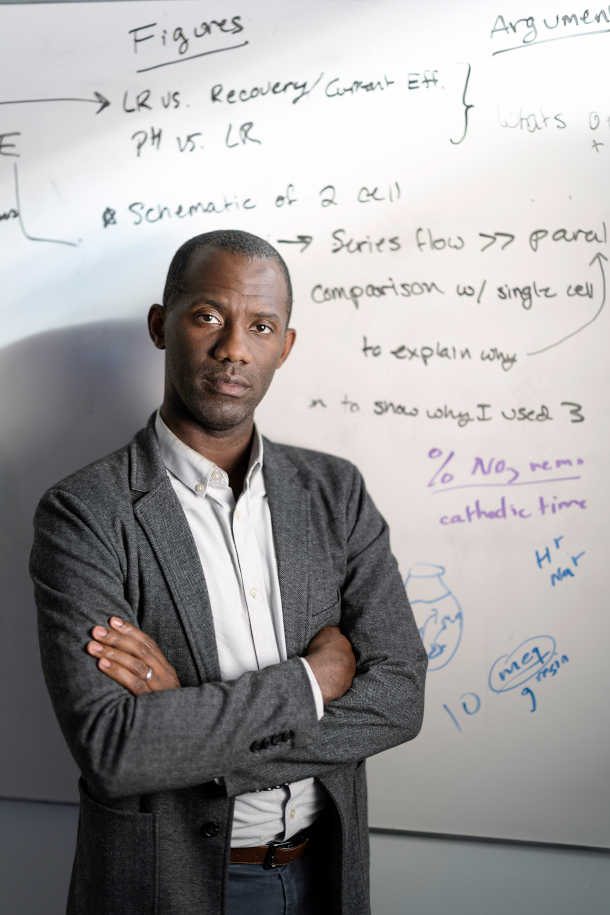
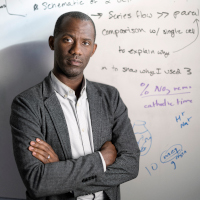
William Tarpeh is a 2025 MacArthur Fellow and a Stanford University Assistant Profesor. He’s a chemical engineer whose work centers on pulling useful chemicals from various kinds of wastewater. (Photo: Christopher Michel, Courtesy of Will Tarpeh)
BELTRAN: It’s Living on Earth, I’m Paloma Beltran
CURWOOD: And I’m Steve Curwood.
When nature calls and we flush, most of the time we don’t give a second thought to where our waste goes. But 2025 MacArthur Fellow William Tarpeh thinks a whole lot about wastewater and how it can be put to good use. Will uses his skills as an engineer to develop ways of pulling nutrients, such as phosphorus and nitrogen, from wastewater. Though these chemicals can be pollutants when they enter the environment unchecked, they can be made into vital fertilizer to nourish our crops. William Tarpeh is an Assistant Professor of Chemical Engineering at Stanford University and joins us now to discuss how we can turn wastewater into wealth. Hi Will congratulations and welcome to Living on Earth!
TARPEH: Thanks a lot. It's great to be here.
CURWOOD: So, your research works on ways to remove waste from wastewater treatment plants and turn what you remove into useful products. But let's get back to the basics here. In your mind, what is waste?
TARPEH: To me, waste is something that we've all sort of agreed on. We've agreed that something is waste based on where it is and how much of it there is. So for example, things we put in the trash can we call waste because we're not sure what else to do with them, but some of us have decided that we should recycle some of those things. And so waste is in some ways quite a social construct, if you will, but it has to do with what we deem as not valuable anymore, and that's some of the things that we try to change in my research group.
CURWOOD: It's kind of like the gardening saying that a weed is only a plant that's in a place we don't like it.
TARPEH: Yeah, that's a great analogy. Yes, we say the same thing, but just about chemical compounds. It's only a waste if it's in a place that we don't like it.
CURWOOD: So what you're doing with wastewater sounds a lot like what, let's face it, oil companies do with crude oil. Talk to me about that.
TARPEH: We use the term wastewater refining, and that's something we devised on purpose to sort of evoke what oil and gas companies do, but with a different type of feedstock, a different type of input. At an oil and gas refinery, a company takes in crude oil and then they have a bunch of processes to make a bunch of products. We immediately think of like gas that goes in our cars, but we can think of other fuels -- jet fuel, rocket fuel, plastics, lots of components of different things we use around the house all the time. We think about the same approach, but the input is wastewater. And so we need to design the next generation of processes that can help us turn wastewater into a lot of different products. Think fertilizers, fuels as well actually, commodity chemicals, things we use in our house all the time.
CURWOOD: I understand that one of your main focuses is actually human urine. And I'm reminded from working with people who are doing composting human "waste." Some of those efforts separate urine from the feces. Most of us don't think of urine as a so-called pollutant, because, well, it's natural. So what's your take on that?
TARPEH: Yeah, I think that's a fantastic take. I always say that people have recycled excreta, including urine, for millennia, right? This isn't a new idea. I think the new challenge in the 21st century is that people are more concentrated than ever. So we've got mega cities of over 10 million people, and we have dozens of those popping up in the world now. And so the question was, how can I recycle like my own urine or my family's urine on our household farm? That is a more feasible question than what do I do with 10 million people's urine if I'm miles and miles away from the nearest farm? And so that's what we think about, on how to concentrate what you want out of the urine, so that you're not carting around loads and loads of urine.
CURWOOD: I mean, yeah, 10 million people's pee. That's, that is a lot, isn't it?
TARPEH: It is. Fun fact, each of us pees around one liter per day. So that's like 10 million liters of pee per day.

Much of Tarpeh’s work aims to treat wastewater the way that oil companies (like the one that runs this oil rig off the Gulf of Mexico) treat crude oil: he pulls the useful chemicals out of the original liquid and turns them into products. That’s why his team refers to the work as “wastewater refining.” (Photo: GuavaTrain, Wikimedia Commons, CC0)
CURWOOD: Okay well, why, of all things, study pee?
TARPEH: That's the question that my family continues to ask me, or they say, are you still studying that pee stuff? And I'm like, Yes. I started off with urine. The realization for me was that, like you mentioned, when people are using composting toilets, they usually separate the feces and the urine. And that most of the time, historically, has been for the benefit of the feces, if you will. If you want to make compost, or you want to make briquettes or charcoal, you want to dry out your feces. And so one of the best ways to do that is to collect the urine separately. So if you do that, then you've got this urine, and you have to do something with it. And so that was the realization I had early in my PhD and said, Okay, what are we going to do with this urine? It turns out that urine contains the majority of nitrogen, phosphorus and potassium that we excrete, and those are the three main nutrients that you purchase fertilizers based off of --- The NPK ratio is nitrogen, phosphorus, potassium. So if you want to go after those nutrients in wastewater, urine is the place that they're naturally separated or concentrated higher.
CURWOOD: And when it's not separated, when it's just plain pee or urine, it's rather polluting, isn't it?
TARPEH: Yes, exactly. And that's where we come back to the concept of waste like nitrogen and phosphorus, particularly as ammonia and phosphate. Those are fertilizer ingredients, but they can also over fertilize algae and water, and that can lead to these harmful algal blooms that some of us have seen. If you've seen green, kind of slimy water, that can be the product of having too much nitrogen or too much phosphorus in that bay, or that stream, or that river, that lake. These are problems that are growing exponentially decade over decade. And so we can stop some of those by removing the nitrogen and phosphorus. And while we're at it, why not make something valuable?
CURWOOD: Yeah, so how valuable is that nitrogen? How valuable is that phosphorus?
TARPEH: Yeah, it really depends where you are and what you make. So at the base level, with the fertilizers --- think like fertilizer you could purchase at the store, something like that --- it's around like $1 per kilogram. So these aren't very expensive components. And part of that is because fertilizer is very cheap and subsidized in the US. However, we've shown that in places like Kenya, where I've done some of my field work, making fertilizer from urine is actually one of the cheapest ways to do it because it's locally produced. There, ertilizer is produced outside of the country, by and large, and then it's imported into the country. And so there are huge markups every time the fertilizer changes hands. So one of the huge benefits of our approach, that honestly, I didn't anticipate, was simply that it's locally derived fertilizer. Where there are people, there's urine, and therefore we can make fertilizer. And it was about 40% cheaper than imported fertilizers.
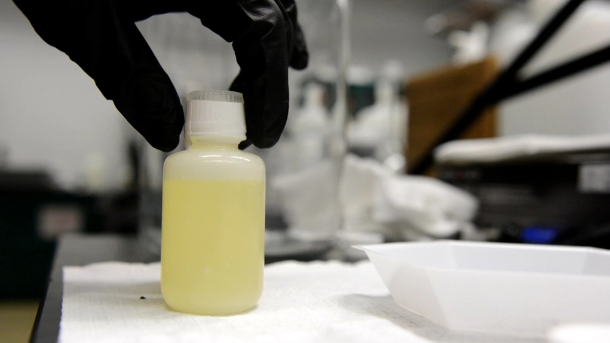
William Tarpeh researches how to pull chemicals used in fertilizer from human urine because it contains high concentrations of phosphorus, nitrogen, and potassium, the key ingredients in many fertilizers. This is a sample from a U.S. Army laboratory in Maryland. The appearance of U.S. Department of Defense (DoW) visual information does not imply or constitute DoW endorsement. (Photo: David McNally, Army Research Laboratory, dvidshub.net)
CURWOOD: So there's a problem in our oceans with too much nitrogen, and that comes from fertilizer runoff from people who use commercial nitrogen as part of fertilizer. To what extent does your work give us some insights as to how we might be able to shift from this sort of chemical burden of using nitrogen-based fertilizer to recycling and having more of a virtuous circle there?
TARPEH: Absolutely, yeah, most of the work we do is motivated by, like you said, a virtuous circle or a vision of a circular economy. Let's take waste that is causing a problem and bend it from a line, a linear economy, like a take-make-waste economy and turn it into a circle where you can have nitrogen that's been used six or seven times. So when it comes to the ocean, a lot of our wastewater treatment plants, at least in coastal places, are on the bay. Like here in San Francisco, several of our 30 plus treatment plants discharge directly to the ocean or to the bay. And what that means is that we get harmful algal blooms. So we got one a few years ago for the first time in several years, and it killed thousands of fish in Oakland. It was a huge eyesore. There were lots of challenges for recreation and tourism. A big contributor to that is our wastewater treatment plants, because at the time, they were not removing much nitrogen. So now there's a bunch of effort to do that. If we look across the country, somewhere like the Chesapeake Bay near where I grew up, there have been limitations on nitrogen and phosphorus for decades, like since the late 1990s for the same reason. But if we are able to recover valuable products, what we can do is doubly incentivize their removal. We're preventing pollution and making something valuable that people need. And in the meantime, since we're making those fertilizers in the green or circular way, we're reducing some of the greenhouse gas emissions associated with traditional fertilizer production.
CURWOOD: So talk to me about these various projects you've done. You mentioned that, in Kenya, locally produced urine is actually a pretty good source of fertilizer for folks who don't have a lot of money. What about here in the United States, say, California, the farmlands and elsewhere. Where does your work translate into giving people a ecological advantage?
TARPEH: Yeah, so we've started some work on farm in Salinas, California, a little bit south of us. And it's in partnership with the US Department of Agriculture, and we've managed to measure different nitrogen forms in runoff at that farm. And so things like nitrate, which is another form of nitrogen --- that actually can cause forms of thyroid cancer, also can cause several disorders for infants --- that nitrate just goes into the water and eventually makes its way to streams, rivers, lakes, et cetera. What we've done is developed a way to capture that nitrate and convert it, at least partially, into ammonia, so that it can be a product that you use on site. So there we're making a small circle, if you will, on the farm, so that the nitrate that would leave the farm gets trapped, converted to ammonia that we can then use on the farm, and again, avoid the energy and emissions of the farm that would have been not importing but transporting fertilizers for use.
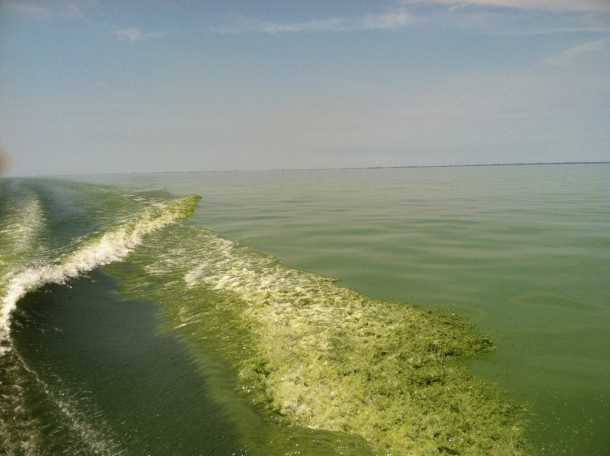
The buildup of phosphorus and nitrogen in natural bodies of water can lead to harmful algal blooms, like this one in Lake Erie. (Photo: NOAA Great Lakes Environmental Research Laboratory, Wikimedia Commons, CC BY-SA 2.0)
CURWOOD: So we've been talking predominantly about fertilizer, urine, but what other products do you envision coming from wastewater?
TARPEH: Yeah, so in my group, really the vision is we are thinking about wastewater as really broadly defined. Like you said, going from the definition of what is a waste and what is a wastewater, to what pollutants are there and what products can be generated. So we started with nitrogen and phosphorus, because that was where some of the work made the most sense. Around 2019, 2020, we started to expand our portfolio, if you will, of pollutants and products we were interested in. Now we're thinking a lot, in addition to those nitrogen phosphorus cases, about things like sulfur, lithium, nickel, cobalt, and getting into some of these higher value products, if you will. So people may have heard the term critical minerals. If you've looked at, I don't know, Department of Energy things, there's a lot of that in the news, in the science news, let's be clear. But these critical minerals are ones where the domestic supply is somehow vulnerable, and so then recycling them becomes very important.
CURWOOD: So you're suggesting that we could get the minerals we might need for smartphones or batteries from sewage?
TARPEH: Yeah. So rather than sewage there, because those are in low concentrations, we instead go to, actually, industrial water. So one of the things we do is look at when batteries are recycled, we can actually leach the old batteries. By that, I mean put them in acid and get the ions out, and then make new batteries. So we can make a circular economy out of batteries. We can also do that with waste electronics. Think some of the circuit boards and other things that get wasted. They often get leached, and then we can make pure forms of each metal that you need, so that you can go back to the front end of the factory.

Not only does Tarpeh research how to utilize chemicals from sewage, but his team also explores how to pull critical minerals, such as lithium, from industrial wastewater. Those minerals could then be used to make smartphones, like those pictured. (Photo: Ka Kit Pang, Wikimedia Commons, CC BY-SA 4.0)
CURWOOD: So how does environmental justice fit into the work you're doing?
TARPEH: Yeah, it's a great question. We are constantly thinking in my group and challenging ourselves to think about, to think big, right? We think very small, and think about, how do you separate one molecule from another? But when I say think big, what I mean is, we think, if lots of people in the world adopted this technology, what would be the benefits and what are the risks? And some of those risks tie into environmental justice. Where does the factory, the refinery, go? Who's around that refinery, and to what extent do they have a say in it? Another thing we've been doing is thinking a lot about how recovering value from people's waste, so going back to the municipal wastewater case, can be a way to improve economic outcomes in rural and low-income communities. So we've had a project actually co-led by another MacArthur Fellow, Catherine Coleman Flowers, 2020, that focuses on septic tanks in Lowndes County, which is between Montgomery and Selma, Alabama. And that's a predominantly Black, low-income rural community, and they have experienced septic tank failures for several years. And so we've been documenting those septic tank failures and then thinking of ways with the community to generate value from septage such that there might be a way to reduce the costs of septic tanks and improve the performance.
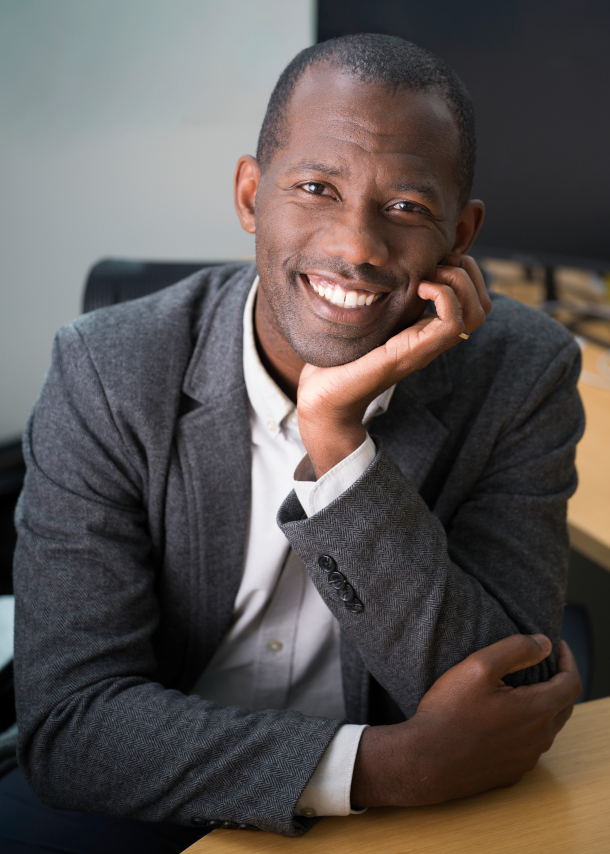
Will Tarpeh is excited to see his team expand the number of chemicals they can pull from various types of wastewaters as they continue their research. (Photo: Christopher Michel, Courtesy of Will Tarpeh)
CURWOOD: Okay, tell me, how are you going to do that? What are the most promising paths?
TARPEH: Yeah, so the promising paths here are really embedded in the communities. We've been doing a lot of focus groups and workshops and surveys, but from a scientific perspective, the septic tank is beautiful because it captures the waste. So we have devices that are pretty small, and they can just attach to the septic tank, basically, and recover nitrogen in a fairly passive way. And then you can imagine, potentially, a micro enterprise or a small company that goes around and collects that valuable nitrogen, sells it for revenue, and then invests that back into improving the septic tanks. And in the meantime, you're getting someone to check your septic tank more often, because there's an incentive to make sure products are being produced.
CURWOOD: What's next for you?
TARPEH: I'm at a fun time in my career. I've been at Stanford about seven and a half years, so I am in academia. We call it. I'm currently up for tenure, and so it's a natural time to think what's next. These days, I'm thinking about both translating what we do out of the lab, like we've talked about a little bit today, and also expanding to higher and higher value products. So some of the things on the nitrogen side, I said we'd make fertilizers, but we're continuing to say --- business, I don't know, maxim is like a diverse portfolio is a productive portfolio, right? And so we're applying that to the products we make. Can we make fuels like hydrazine, like literal rocket fuel from urine? Or can we make hydroxylamine, which is a precursor to a lot of pharmaceuticals? Or just what else can we make? And we're thinking, can we tune what we make? Like it's one thing to have a device that makes one product. It's another to have a device that can make 10 products, and you can choose which one you want it to make. So that tuneability is something we're really excited about.
CURWOOD: William Tarpeh is an Assistant Professor of Chemical Engineering at Stanford University and a 2025 MacArthur Fellow. Thanks so much Will for taking the time with us today.
TARPEH: Thanks for having me.
Related links:
- Learn more about William Tarpeh’s MacArthur fellowship here.
- Explore William Tarpeh’s research.
[MUSIC: New York Ska-Jazz Ensemble, “Pretty Flower” on Step Forward, Ska-Jazz Productions]
Dancing Down the Slopes
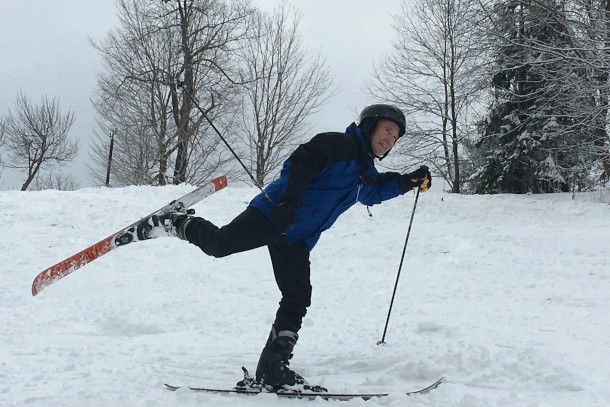
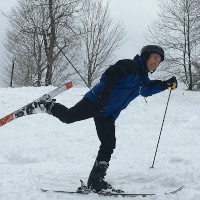
Ed Cook, at a month shy from 67, has been practicing ski ballet in the slopes south of Pittsburgh since 1976. (Photo: Andy Kubis, The Allegheny Front)
BELTRAN: One sport you didn’t see at the 2026 Winter Olympics that just wrapped up is ski ballet, kind of a mashup between ballet, figure skating and skiing. It got a little glory as a demonstration sport in the 1988 and 92 Olympic Games but never became a medal event and some said it was just a fad. But a few winters ago, on the slopes of Hidden Valley Resort in the Laurel Highlands of Pennsylvania, ski ballet was being kept alive by a very enthusiastic, early-adopter. Andy Kubis produced this story for the Allegheny Front back in 2018.
KUBIS: It's hard to describe ski ballet until you've seen it.
Speaker 2: Here comes George, building up speed for his first big maneuver, oh, a two and a half stay cross. That was fabulous.
KUBIS: Picture a choreographed routine of flips, rolls and twirls set to music while the skier glides down the slope in costume.
Speaker 2: Would you look at those sleeves on his outfit. He is really one dramatic skier.
COOK: I saw it on television, and I said, "Whoa, they're doing this on skis, and how do they do that?"
KUBIS: This is Ed Cook. And when he saw ski ballet for the first time in 1976 he knew he had to try it. He went out and bought himself a pair of ballet skis, just a little shorter than a regular downhill pair, and it quickly became his passion.
COOK: I love the fact that I'm out here in fresh air, on top of the snow, being able to twirl around and just get the thrill of it all. It's wonderful, absolutely wonderful.
KUBIS: You can find him most winter weekends on the slopes of the ski resort, practicing his art, but in jeans, no costume.
COOK: The main thing is, you learn all the rules on how to ski properly, and then you break them. What I do is I tend to lift my left leg and bring the ski up towards my shoulder, and then I will start to make 360s on the ground.
KUBIS: Cook starts to propel himself into a circle, using his poles to guide him. At one point, he's skiing backwards. It's surprising how often you see the bottom of his skis. He looks like a pinwheel.
COOK: And then at one point, I bring the tip the ski back down, have the tip cross over my other ski, catch this note, which will turn me again for a 360 and then I do a little bit of a kick out to get my skis parallel with each other again.
KUBIS: A kick out. That's his signature move, and he named it himself. Cook is entirely self taught. He was never interested in competing. He just likes the challenge and energy that ski ballet brings him. He often skis with his kids and grandkids, and though his love of the art form hasn't rubbed off on any of them, his daughter, Zolina Cook clearly admires him.
COOK: I think it's pretty cool. We've always enjoyed watching him. We've always kind of knew where he was on the slopes, also, because we could hear people oohing and eyeing.
KUBIS: Cook does turn heads when he performs tricks. And it's obvious to everyone who sees him that he skis to the beat of his own drummer.
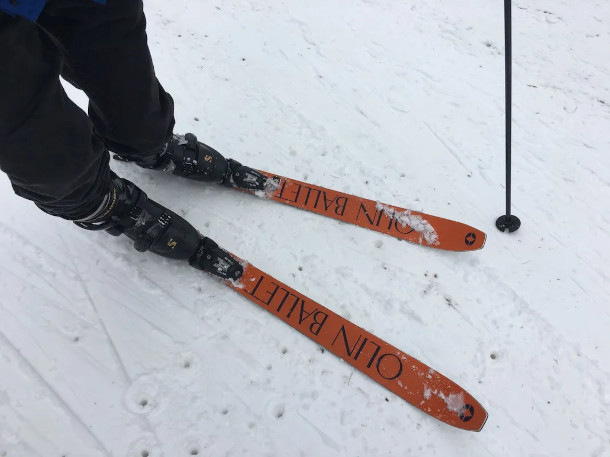
Cook named two of his children, Zolin and Zolina, after his beloved Olin ballet skis. (Photo: Andy Kubis, The Allegheny Front)
COOK: In the beginning, in particular, when I skied ballet, I would have music in my head that I started to move to that the rhythm of it. And unlike typical ballet, it was always rock and roll that was going on in my head. But the slower pace rock and roll. "Lady," I forget who sings that song, even, but Lady, you know, and that made the 360s a whole lot easier.
[MUSIC] "Lady, when you are with me I'm smiling..."
KUBIS: Nowadays, Cook doesn't ski ballet with a soundtrack in his head. He's just trying to get from one move to the next without falling.
COOK: The tricks just don't come as easily as they did when I was younger, but now at this point, I occasionally ... what I fell doing that stupid trick that was a cinch normally.
KUBIS: Still, Cook is incredibly graceful. He says his dad skied well into his 80s and Cook is hoping he’ll be jumping and twirling just as long. For The Allegheny Front. I'm Andy Kubis.
BELTRAN: Andy Kubis produced that story back in 2018 for the Allegheny Front.
Related links:
- Find this story on The Allegheny Front’s website
- Learn more about the history of ski ballet
[MUSIC: Pretty Lights, “Finally Moving” on Taking up Your Precious Time, Pretty Lights Music]
CURWOOD: Living on Earth is produced by the World Media Foundation. Our crew includes Naomi Arenberg, Sophie Bokor, Jenni Doering, Swayam Gagneja, Mark Kausch, Mark Seth Lender, Don Lyman, Ashanti Mclean, Nana Mohammed, Aynsley O’Neill, Sophia Pandelidis, Andrew Skerritt, Bella Smith, Tom Tiger, Julia Vaz, El Wilson, and Hedy Yang.
BELTRAN: Jake Rego engineered our show. Alison Lirish Dean composed our themes. You can hear us anytime at L-O-E dot org, Apple Podcasts and YouTube Music, and like us please, on our Facebook page, Living on Earth. Find us on Instagram, Threads and BlueSky at living on earth radio. And we always welcome your feedback at comments at loe.org. I’m Paloma Beltran. And I’m Steve Curwood. Thanks for listening!
ANNOUNCER: Funding for Living on Earth comes from you, our listeners, and from the University of Massachusetts, Boston, in association with its School for the Environment, developing the next generation of environmental leaders. And from the Grantham Foundation for the protection of the environment, supporting strategic communications and collaboration in solving the world’s most pressing environmental problems.
ANNOUNCER 2: PRX.
Living on Earth wants to hear from you!
Living on Earth
62 Calef Highway, Suite 212
Lee, NH 03861
Telephone: 617-287-4121
E-mail: comments@loe.org
Newsletter [Click here]
Donate to Living on Earth!
Living on Earth is an independent media program and relies entirely on contributions from listeners and institutions supporting public service. Please donate now to preserve an independent environmental voice.
NewsletterLiving on Earth offers a weekly delivery of the show's rundown to your mailbox. Sign up for our newsletter today!
 Sailors For The Sea: Be the change you want to sea.
 The Grantham Foundation for the Protection of the Environment: Committed to protecting and improving the health of the global environment.
 Contribute to Living on Earth and receive, as our gift to you, an archival print of one of Mark Seth Lender's extraordinary wildlife photographs. Follow the link to see Mark's current collection of photographs.
 Buy a signed copy of Mark Seth Lender's book Smeagull the Seagull & support Living on Earth
© Copyright World Media Foundation. All Rights Reserved
Home | Contact | RSS | Donate | Newsletter